What Actually Makes HubSpot AI Work
(And Why Most Teams Miss It)
AI inside HubSpot is no longer speculative. It is built into the platform, increasingly visible, and easy to turn on. Yet most teams we speak with are underwhelmed by the results. Not because the technology is immature, but because expectations are misaligned with how AI actually behaves inside a real CRM.
After working across hundreds of HubSpot portals, one pattern shows up again and again: AI success has very little to do with the agent you enable and almost everything to do with the decisions you make before you enable anything at all.
That gap between expectation and reality is where most AI initiatives stall.
AI Is Not a Capability You Add. It’s an Outcome You Earn.
AI does not operate independently inside HubSpot. It responds to structure. It reflects how clearly your data is modeled, how consistently your teams operate, and how disciplined your governance is.
When AI produces vague, generic, or unhelpful output, the instinct is often to blame the tool. In practice, the issue is usually upstream. Brand voice is undefined. ICP logic lives in slides instead of properties. Lifecycle stages mean different things to different teams. Knowledge bases contradict themselves.
AI doesn’t correct those problems. It surfaces them — quickly, and at scale.
That is uncomfortable, but it is also useful. Teams that recognize this early tend to get value. Teams that don’t often turn AI off and move on.
When AI produces vague, generic, or unhelpful output, the instinct is often to blame the tool. In practice, the issue is usually upstream. Brand voice is undefined. ICP logic lives in slides instead of properties. Lifecycle stages mean different things to different teams. Knowledge bases contradict themselves.
Why Teams Choose Vonazon to Build This Workflow
Before any customer-facing or revenue-impacting AI should be in play, a few things need to be true.
Your ICP must exist as data, not just alignment. When targeting criteria are scattered across fields or inconsistently applied, AI will confidently surface the wrong accounts and contacts. It does not know which definition is “correct.” It only knows what exists.
Your knowledge base must be governed, not just populated. Duplicate or outdated articles are one of the fastest ways to undermine trust in customer-facing AI. The agent does not resolve conflicts between sources. It retrieves what it finds.
Your selling motion must be explicit. AI works far better when it understands not just what you sell, but how you sell. Without that context, even well-written outputs can work against your process instead of supporting it.
These are not glamorous prerequisites. But they are decisive ones.
Where Teams See Real Value First with HubSpot AI
The most successful AI rollouts inside HubSpot tend to follow a predictable sequence.
Early wins usually come from internal productivity. Summaries, internal Q&A, research assistance, and list-building reduce friction without introducing customer risk. They allow teams to observe how AI behaves inside their specific portal before stakes increase.
Customer-facing agents work when they are tightly scoped. The goal is not broad coverage. It is deflecting high-volume, low-risk questions while escalating anything ambiguous, sensitive, or policy-driven. Teams that succeed here treat escalation rules as core configuration, not a fallback.
Revenue-impact automation comes later. Prospecting and outreach agents perform well only when upstream decisions are already done: target accounts are defined, exclusions are intentional, and review workflows protect rep trust. When teams skip these steps, they tend to burn credits and confidence at the same time.
The sequencing matters more than the tooling.
Configuration Is Not the Same as Operation
One of the most common mistakes teams make is equating “enabled” with “ready.”
Configuration answers whether something can run.
Operations determine whether it should — and under what conditions.
Teams that get value from AI treat it like an operational system. They roll it out in phases. They start in shadow mode. They review outputs. They track where confidence breaks down. They expand scope based on evidence, not optimism.
They also measure the right things: accuracy, escalation quality, time saved, and error rates — not just usage.
This is rarely discussed in product documentation. It shows up only when you’ve lived through adoption at scale.

Why We Took This Conversation Live
As these patterns kept repeating in real HubSpot environments, it became clear that this wasn’t a topic that benefited from another checklist or feature overview. It needed context. It needed tradeoffs. It needed real examples from environments where AI is already running alongside sales, marketing, service, and operations teams.
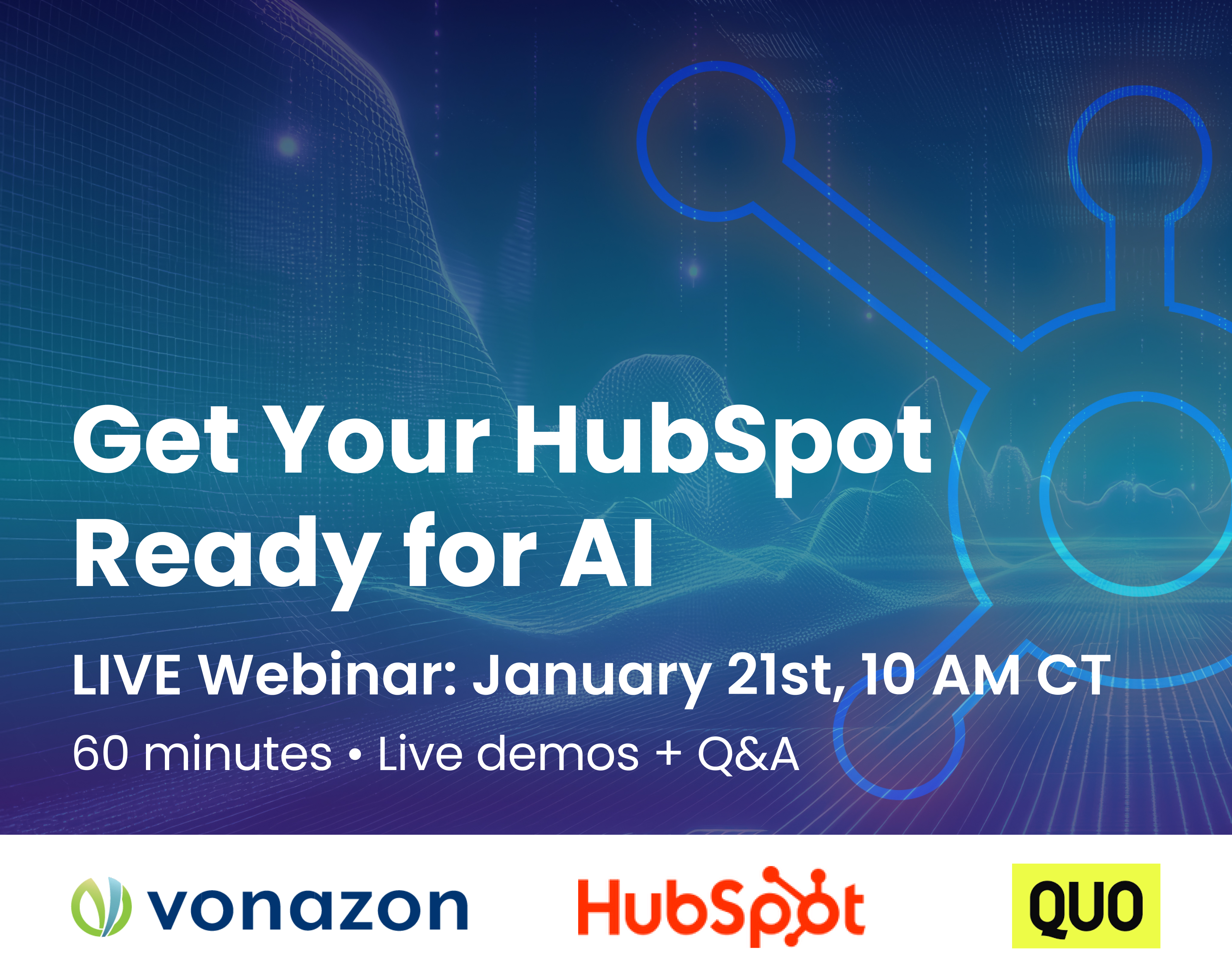
That’s what led us to host a live session focused on getting HubSpot ready for AI. Not to introduce the tools — most teams already know they exist — but to walk through what actually determines whether they deliver value, create noise, or quietly erode trust.
Some of the most useful insights came from showing where teams move too fast, where they hesitate unnecessarily, and how small setup decisions compound once AI is involved. Others emerged as we pressure-tested our own demos and assumptions, deliberately pushing past “here’s what the tool does” toward “here’s what breaks if you skip this step.”
That distinction matters. It is the difference between explaining a capability and sharing experience.

See the Thinking in Practice
This post captures the point of view. The live session shows how it plays out in a real HubSpot portal — including the decisions, guardrails, and moments of restraint that don’t translate cleanly to text.
If you want to see how HubSpot AI behaves when it’s treated as a system rather than a shortcut, the on-demand recording is available below.
Watch the recording to see how these ideas translate into practice.
HubSpot AI works when data, governance, and sequencing are intentional. When those foundations are clear, AI accelerates work and sharpens judgment. When they aren’t, it simply scales confusion faster. The difference isn’t the agent you enable. It’s the decisions you make before you do.