
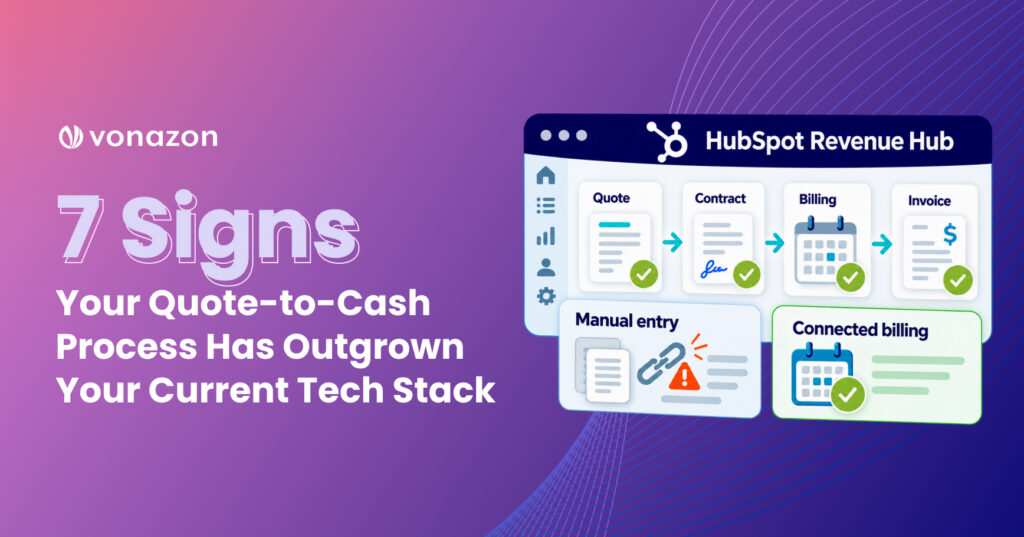

7 Signs Your Quote-to-Cash Process Has Outgrown Your Current Tech Stack
Key Takeaways
Quote-to-cash challenges often surface as re-entered data, pricing exceptions, slow approvals, billing mismatches, and conflicting revenue numbers.
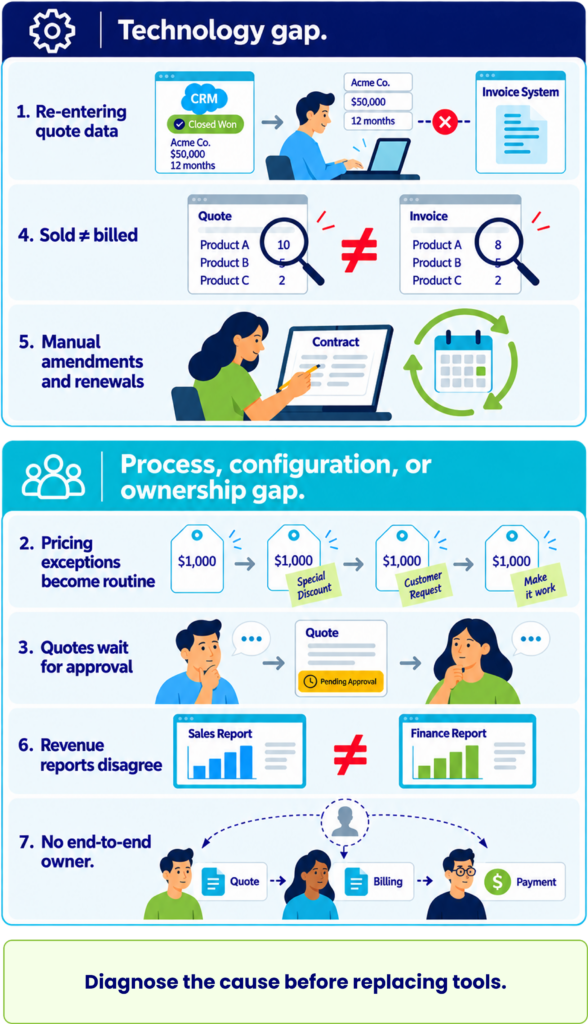
Some signs point to technology gaps, while others trace back to process, configuration, or ownership.
A connected process can open up faster signatures, cleaner billing, and renewals that become expansion moments, especially for subscription, services, and equipment businesses.
Quote-to-cash covers every step from the first price quote to the final payment. It crosses sales, finance, legal, and operations, so small gaps can compound. As deal volume and pricing grow more complex, older tools may start to strain. This guide outlines seven warning signs, what each may cost, what to inspect, and where quote-to-cash software such as HubSpot Revenue Hub may help.
Table of Contents
How to Tell a Technology Gap from a Process Gap
Sign 1: Quote Data is Re-entered After the Deal Closes
Sign 2: Pricing Exceptions Have Become the Default
Sign 3: Quote Approvals are Slowing Deals Down
Sign 4: What was Sold Does Not Match What Gets Billed
Sign 5: Amendments and Renewals Rely on Manual Workarounds
Sign 6: Sales and Finance Report Different Revenue Numbers
Sign 7: No One Owns the Quote-to-Cash Process End to End
What a Connected Quote-to-Cash Process can Unlock
Which Industries Benefit Most from HubSpot Revenue Hub, and How
HubSpot Revenue Hub Readiness Checklist
Conclusion: Building a Connected Revenue Operation with Vonazon
How to Tell a Technology Gap From a Process Gap
Not every quote-to-cash challenge points to missing software. Some stem from process, configuration, or ownership, and replacing tools without separating these causes may move the problem. Vonazon’s overview of enterprise HubSpot RevOps capabilities explains why architecture and data quality tend to set the ceiling for automation.
Quote Data is Re-entered After the Deal Closes
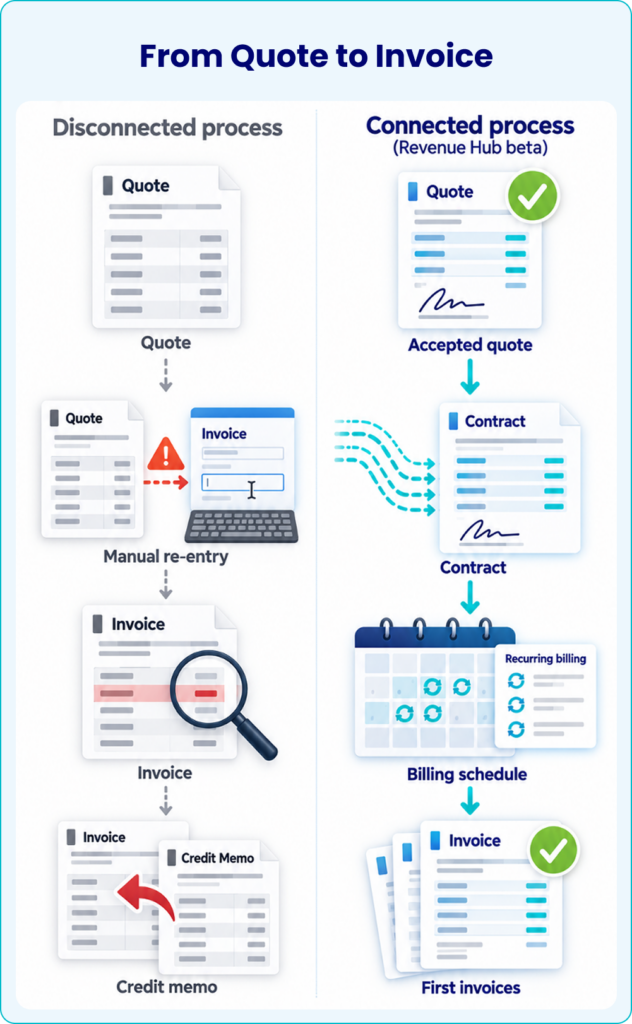
For many organizations, the point of friction starts after the buyer says yes. Sales creates the quote in one system, contracts live somewhere else, Finance recreates billing information, payments are tracked separately, and Customer Success may enter a renewal conversation without a reliable view of what the customer bought or how the agreement changed.
The issue is rarely one isolated tool. It is the translation layer between systems and teams. Every manual handoff introduces another opportunity for delays, mismatched data, inconsistent terms, and reporting that no one fully trusts.
Pricing Exceptions Have Become the Default
When custom discounts, bundles, and one-off terms appear on most quotes, margin can erode and delivery can become harder to plan.
The share of recent quotes with non-standard pricing shows the scale of the issue. If no written pricing policy exists, the root cause is process, and new software alone is unlikely to fix it. Once a policy exists, Revenue Hub supports price books and tiered pricing. On Enterprise, quote rules can warn reps or block quotes that break discount or product limits. Guardrails should be documented before rules are configured.
Quote Approvals are Slowing Deals Down
Slow approvals often show up as quotes waiting in inboxes while reps chase approvers by email or chat. As delays grow, cycles lengthen and reps may be tempted to route around the deal desk.
Approval time and steps by deal size are the metrics to check. Long loops often reflect policy rather than tooling. Revenue Hub supports quote approvals, which tend to work best once thresholds are tiered by deal size and risk.
What was Sold Does Not Match What Gets Billed
Frequent credit memos and disputed invoices suggest a gap between the quote and the bill. An analysis by World Commerce & Contracting and Deloitte on contract value erosion put average losses at 8.6 percent, although that figure covers contracting broadly rather than quote-to-cash alone.
Comparing recent quotes with their invoices and credit memo reasons can reveal the pattern. Mismatches often stem from manual handoffs, a technology or integration gap that quote-to-cash automation can reduce. In Revenue Hub, an accepted quote can automatically create a contract, a billing schedule, and the first invoices. Fixing the most frequent mismatch first keeps work focused.
Amendments and Renewals Rely on Manual Workarounds
Manual workarounds for mid-term changes often include cloned deals, spreadsheet proration, and calendar reminders for renewals. Missed changes can then carry into the next invoice or renewal. A McKinsey analysis of nearly 500 B2B subscription companies associated quote-to-cash complexity with slower sales motion and a weaker ability to grow.
The key check is whether each renewal quote reflects earlier amendments. If the CRM has no contract record, this is a technology limit. In Revenue Hub, change quotes update the contract and apply billing adjustments, including proration, and renewal quotes pull in current contract details. Vonazon explains how HubSpot contracts change renewals, expansion, and revenue reporting in more depth.
Sales and Finance Report Different Revenue Numbers
When CRM and accounting reports disagree, month-end can start with reconciliation, and forecasts may lose credibility.
The first question is which system owns each metric, such as bookings, ARR, invoices, and cash. Vonazon’s analysis of why native HubSpot NetSuite integrations fail on assumptions frames this as an architecture decision rather than a connector problem. With connected records, Revenue Hub can report on ARR, MRR, and DSO and integrates with QuickBooks, Xero, and NetSuite. Agreeing on a system of record for each metric should come before building syncs.
No One Owns the Quote-to-Cash Process End to End
Without a single owner, each team may patch its own stage and add tools. McKinsey’s analysis of lead-to-cash as an ownerless problem notes that finance, sales, and IT each tend to see a different issue, and that most companies lack a natural process owner.
A simple test is whether anyone can report cycle time from quote to cash. This looks more like an ownership gap than a tooling gap. Revenue Hub contracts give every team a shared record, but an owner is still needed. Teams weighing outside support can review these signs a RevOps CRM implementation partner may be needed.
What a Connected Quote-to-Cash Process Can Unlock
The seven signs describe what a disconnected stack costs. The other side is what a connected process can open up. McKinsey’s review of as-a-service quote-to-cash journeys reports typical impacts of 50 percent less rep time on back-office tasks and 10 percent higher deal margins, and suggests about 80 percent of deals can follow the simplest path. Results depend on the starting point, but five opportunities tend to be left on the table.
Missed Opportunity | What Becomes Possible | Revenue Hub Capability |
|---|---|---|
Faster time to signature | Reps build compliant quotes inside the deal, and buyers accept, sign, and pay in one flow | Quote templates, e-signature, and online payment |
Renewals as expansion moments | Customer success sees terms and renewal dates well before the renewal window | Contract records and renewal quotes |
Billing that matches the sale | Invoices follow the contract, so corrections become exceptions | Billing schedules built from contract line items |
One revenue number | Sales and finance review ARR, MRR, and DSO from the same records | Connected revenue reporting |
AI that acts on complete data | Collections follow-up can be prioritized by invoice and payment history | Breeze prioritization of overdue invoices |
For a stage-by-stage view of the connected flow, see Vonazon’s breakdown of what changed in HubSpot Revenue Hub for quote-to-cash.
Which Industries Benefit Most From HubSpot Revenue Hub, and How
Fit depends less on the industry label than on the revenue model. Businesses with recurring contracts, frequent amendments, or complex catalogs tend to feel quote-to-cash friction first. Three use cases show how that plays out.
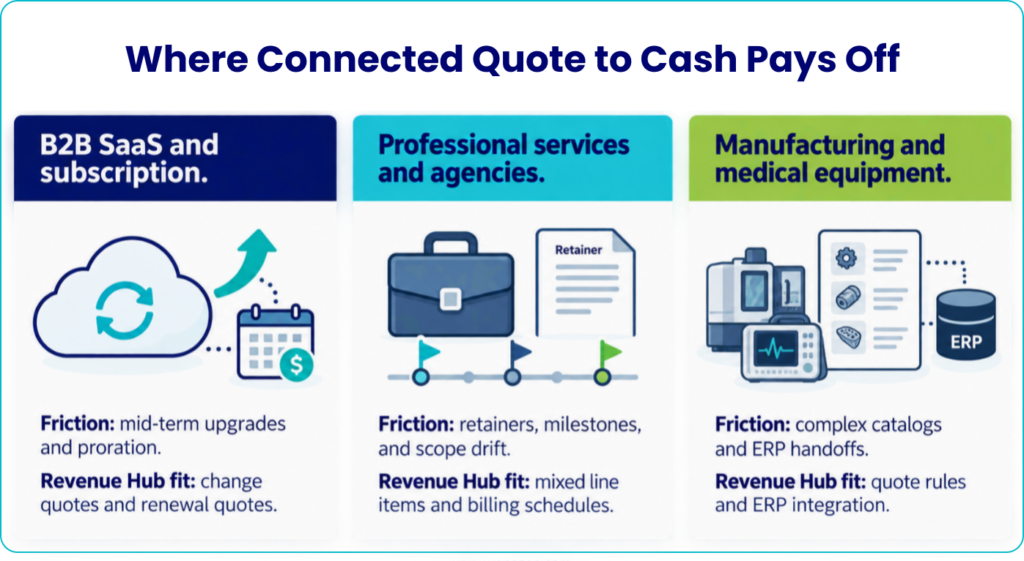
B2B SaaS and subscription software: mid-term upgrades without spreadsheet proration
Subscription contracts change often. A customer might add seats partway through an annual term, leaving finance to calculate the prorated charge by hand. In Revenue Hub, a change quote on the existing contract can prorate charges for the remaining billing period, update the billing schedule, and record the change in the contract history. At renewal, the renewal quote starts from current terms, so customer success can open the conversation with the account’s full growth story.
Professional services and agencies: retainers and milestones on one contract
Services firms often combine a monthly retainer with milestone fees and one-time setup charges. When each lives in a different tool, invoices can drift from the signed scope. Revenue Hub quotes can combine recurring and one-time line items, and the accepted quote can carry those terms into a contract with its own billing schedule. Price books can hold approved rates by client segment, which may reduce ad hoc discounting.
Manufacturing and medical equipment: complex catalogs connected to ERP
Equipment sellers often quote hardware, accessories, installation, and service agreements together, with rules about which products can be sold together. On Enterprise, quote rules can flag incompatible product combinations before a quote reaches the buyer. ERP connectivity matters just as much. In Vonazon’s integration work for a leading medical equipment company, HubSpot was connected to the company’s Great Plains financial system and its quoting tool, and the case study credits the integration with contributing to 32 percent year-over-year growth in the sales division that used HubSpot most.
HubSpot Revenue Hub Readiness Checklist
Before a HubSpot quote-to-cash rollout, confirm these documented requirements.
- Tier and Seats: Professional or Enterprise, plus a Revenue Hub seat for quotes, contracts, and change or renewal quotes.
- Configuration: automatic contract creation from accepted quotes is a setting that needs to be enabled, as described in HubSpot's connected CPQ, billing, and payments process.
- Payments: HubSpot Payments requires a US, UK, or Canada-based business; Stripe applies elsewhere.
- Contract Behavior: at the time of writing, contracts cannot be paused, and subscription records created from recurring line items are for reporting only.
- Accounting Sync: documented payment sync covers QuickBooks Online; other systems may need exports or integrations.
Conclusion: Building a Connected Revenue Operation with Vonazon
Quote-to-cash rarely breaks in one place. It frays at the handoffs between quote and contract, contract and invoice, and invoice and the numbers finance reports. A single sign may not justify a new platform, but several together, especially across sales and finance, may indicate an outgrown stack.
Vonazon’s approach is to settle process, ownership, and data before layering on automation, so that Revenue Hub becomes a connected revenue operation rather than another tool. Vonazon’s HubSpot Revenue Hub services outline how that work is scoped, from process design through launch.
Frequently Asked Questions About Quote-to-Cash Software
What is quote-to-cash software?
Quote-to-cash software supports the steps between a price quote and collected payment. That typically includes configuring products, pricing, approvals, contracts, invoicing, and payments. Some platforms cover every step, while others handle one stage and rely on integrations with CRM, billing, or ERP systems.
Which CPQ software offers the best quote-to-cash solution?
No single CPQ tool is likely to suit every business. The better fit depends on product complexity, pricing, deal volume, and the existing CRM. Teams running HubSpot may find Revenue Hub fits standard subscription deals, while highly configurable products may need specialized CPQ.
How to choose invoicing software with quote-to-cash integration?
Start with how invoices should be triggered: by accepted quote, contract schedule, or usage. Then confirm the tool syncs line items, amendments, credits, and payments with the CRM and accounting system. Check regional payment support, tax handling, and which syncs are native versus custom.
How to evaluate quote-to-cash software for your business?
Map the current process first, including handoffs, exceptions, and owners. Then score options against real deal scenarios, such as amendments, renewals, and discounts. Weigh integration effort, tier requirements, and reporting needs. A pilot on one standard deal type can reduce risk before a wider rollout.




Explore how Vonazon scopes Revenue Hub implementations, from process design and data foundations through launch.