
Best HubSpot RevOps partners for CRM migrations
Table of Contents
The average enterprise now runs 897 applications, and only 29% of them are connected, according to Salesforce’s 2025 State of Data and Analytics research. The same study found that data and analytics leaders consider 26% of their organizational data untrustworthy, and only 43% have formal data governance frameworks in place.
Gartner estimates that poor data quality costs organizations an average of $12.9 million a year. Those conditions travel with the data into a CRM migration: duplicate records, disconnected integrations, unclear field ownership, and reports that no longer reconcile after cutover.
This guide compares seven HubSpot revenue operations implementation partners against the same eight criteria, using 2026 HubSpot Solutions Directory listings, official service pages, and partner case studies. A vendor’s own materials establish what it says it offers; they do not independently prove delivery quality, so each profile ends with points buyers should verify.
What are the top HubSpot revenue operations implementation partners?
Current public evidence points to seven partners with meaningful capability in CRM migration and RevOps implementation: Vonazon, Aptitude 8, Huble, INSIDEA, New Breed, RevPartners, and SmartBug Media. All seven hold Elite status, the top tier of the HubSpot Solutions Partner Program.
Vonazon, the publisher of this guide, is listed first; the remaining partners appear alphabetically. The table frames each partner by buyer scenario rather than rank.
| Partner | Best fit for | Migration depth | RevOps depth | Integration depth | Data governance | Reporting continuity | Complex-project fit |
|---|---|---|---|---|---|---|---|
| Vonazon | Migration combined with CRM architecture, integrations, RevOps, and reporting | Strong | Strong | Strong | Moderate | Strong | Strong |
| Aptitude 8 | Technical architecture and HubSpot plus Salesforce hybrid environments | Strong | Moderate | Strong | Strong | Strong | Strong |
| Huble | Multi-region CRM consolidation with managed services | Strong | Moderate | Strong | Strong | Moderate | Strong |
| INSIDEA | Fixed-scope Salesforce-to-HubSpot migrations with published timelines | Specialized | Moderate | Moderate | Strong | Moderate | Moderate |
| New Breed | Migration with Salesforce or Microsoft Dynamics coexistence | Strong | Strong | Strong | Moderate | Moderate | Strong |
| RevPartners | Migration followed by an ongoing RevOps retainer | Strong | Specialized | Moderate | Moderate | Verify | Moderate |
| SmartBug Media | Implementation plus broader marketing operations, including HIPAA-sensitive work | Strong | Moderate | Strong | Moderate | Moderate | Strong |
Strong: accreditation, service documentation, and case evidence align.
Moderate: service documentation or limited case evidence.
Specialized: a concentrated focus area.
Verify: public evidence was insufficient to assign a label.
Why CRM migration involves more than record transfer
CRM implementation configures the platform: objects, properties, pipelines, permissions, and automation. CRM migration moves an existing operating history into that configuration. The two overlap because migrated data tends to hold up only when the target CRM architecture already reflects decisions about what should exist.
Those decisions typically include which records to migrate versus archive, which legacy fields to retire, how lifecycle and deal stages translate, which system owns each critical field, and whether automation should be rebuilt rather than copied. The answers determine whether historical reporting still reconciles after cutover.
HubSpot’s import mechanics show why sequencing matters. The import tool relies on unique identifiers such as email, company domain, or Record ID to update records, avoid duplicates, and create associations, and Record ID is the default identifier for deals, tickets, activities, and custom objects.
Teams that keep Salesforce running during transition face separate constraints. The HubSpot-Salesforce integration caps field mappings at 500 per object and applies sync rules field by field, so system-of-record decisions need to be made before sync is enabled.
Not every project needs full operational redesign. A team with a sound process and a simple data model may only need accurate mapping and validation. The useful partner question is whether the firm can tell the difference.

How the partners compare
Each profile applies the same criteria to the partner’s HubSpot migration services and RevOps work. Accreditations are those shown on each partner’s HubSpot Solutions Directory profile or official site as of October 2026.
Vonazon

The Best Fit for
Teams pairing migration with CRM architecture, HubSpot integrations, RevOps, and reporting continuity.
Why it stands out
Vonazon’s directory profile lists CRM Implementation, Custom Integration, and Onboarding accreditations. Its Sol Systems migration case describes moving more than 250,000 records from Salesforce alongside redesigned service operations and new integrations, with a reported 60% reduction in CRM licenses.
Relevant migration and RevOps capabilities
- HubSpot CRM migration audit covering data structure, workflows, integrations, and reporting needs
- Configuration of pipelines, lifecycle stages, lead scoring, and permissions, plus post-migration checks of lead routing and dashboards
- Phased Salesforce and Pardot migration for Keyland Polymer covering 75,000 to 90,000 contacts
- Salesforce and HubSpot coexistence work for PerkinElmer covering integration governance and multi-touch attribution
What buyers should verify
The directory does not list a Data Migration accreditation, so buyers should review Vonazon’s test-migration and reconciliation steps directly, along with case evidence matched to their source system.
Aptitude 8
The Best Fit for
Tveams needing technical HubSpot architecture, custom development, or a HubSpot and Salesforce hybrid.
Why it stands out
Aptitude 8’s directory profile lists seven HubSpot accreditations, including Data Migration, Custom Integration, and Solutions Architecture Design. Its published implementation case studies include a Salesforce-to-HubSpot migration for Marq completed in 90 days and a logistics company that moved more than one million assets from Marketo and Pardot over six months.
Relevant migration and RevOps capabilities
- Contact, company, deal, and activity migration, including deals with legacy performance data
- Custom objects, systems integration, and extensibility work
- Project and managed-services engagements that include ongoing RevOps support
What buyers should verify
How much of the team’s time goes to process design versus technical build, and whether RevOps redesign sits inside the migration scope or a separate retainer.
Huble
The Best Fit for
multi-region organizations consolidating several CRMs onto one HubSpot instance.
Why it stands out
Huble describes a migration approach that starts with entity-relationship diagrams of current processes and lists Data Migration, Solutions Architecture, and Custom Integration accreditations. Its Avison Young case covers moving teams from four CRMs, including Salesforce, onto HubSpot while addressing broker adoption and global forecast reporting.
Relevant migration and RevOps capabilities
- As-is process mapping before configuration
- Delivery across EMEA, APAC, and North America, with 24/7 managed services after launch
- ISO 9001:2015 accreditation across international locations
What buyers should verify
Which regional team owns delivery, and how historical activity and reporting are reconciled when several source systems merge.
INSIDEA
The Best Fit for
Salesforce to HubSpot migration projects that benefit from fixed scope and a published timeline.
Why it stands out
INSIDEA publishes its method, pricing, and source-by-source migration timelines, including roughly 12 weeks from Salesforce. It lists five HubSpot accreditations, including CRM Data Migration, CRM Implementation, and Custom Integration, and states that it has moved more than 60 teams off Salesforce.
Relevant migration and RevOps capabilities
- Source audit covering data, automations, integrations, reports, and custom code
- Three-wave data migration with a source CRM sunset plan
- Pre-migration data quality report, with Salesforce typically kept read-only for reference
What buyers should verify
INSIDEA states that it deduplicates and validates during migration but does not repair data quality problems already in the source system, so buyers should confirm who owns remediation. Directory claims of zero downtime should be tested against a written reconciliation plan.
New Breed
The Best Fit for
Migrations where HubSpot must coexist with Salesforce or Microsoft Dynamics, paired with RevOps strategy.
Why it stands out
New Breed’s work with Kelly Services covered a marketing automation migration to Marketing Hub and, two years later, CRM data migration with full Microsoft Dynamics 365 integration. Its directory profile states that it holds all eight HubSpot accreditations.
Relevant migration and RevOps capabilities
- Migration assessments before scoping
- RevOps, CRM strategy, and custom integration practices, including hosting and maintenance
- A proprietary lead routing app
What buyers should verify
Its migration page listed some source-specific pages as forthcoming at the time of review, so buyers should request mapping examples for their own source platform.
Revpartners
The Best Fit for
Scaling teams that want migration followed by fractional revenue operations consulting.
Why it stands out
RevPartners offers RevOps as a managed service alongside HubSpot onboarding, integrations, and migrations. Its Salesforce migration page lists Onboarding and CRM Data Migration accreditations and outlines an audit of every object, field, integration, and automation, followed by mapping, test migration, and training.
Relevant migration and RevOps capabilities
- Object, field, and automation audit before mapping
- Custom property and custom object planning, with test migration before production
- Ongoing RevOps retainer model, plus Elite partner status with Clay for data enrichment
What buyers should verify
How reporting rebuilds and integration ownership are scoped, since public material emphasizes migration speed and RevOps process more than reporting methodology.
SmartBug Media
The Best Fit for
Organizations combining HubSpot implementation services with broader sales and marketing operations, including regulated environments.
Why it stands out
SmartBug’s directory profile lists accreditations including Data Migration, Custom Integration, CRM Implementation, and Solutions Architecture Design, and notes HIPAA-compliance expertise. Its Salesforce-to-Service Hub migration case describes extensive discovery of departmental workflows before redesign. HubSpot named SmartBug its 2024 North American Partner of the Year.
Relevant migration and RevOps capabilities
- Migrations from Salesforce, Microsoft Dynamics, and several marketing automation platforms
- Custom API, NetSuite, and Salesforce integrations
- HubSpot admin services and 19 HubSpot-certified trainers supporting adoption
What buyers should verify
The directory lists North America as its service region, which may matter for global rollouts. Buyers should also confirm the mix of technical and marketing resources assigned.
How to choose a HubSpot RevOps partner for a CRM migration
Partner tier confirms program standing, not fit. These questions separate technical migration capability from operational design capability, and a pre-migration HubSpot audit can answer several of them before proposals arrive.
Architecture and scope
- Will the partner migrate the current architecture as-is or challenge it first?
- How does it decide what should not migrate?
- Who owns architecture decisions, and does the engagement include RevOps redesign or only technical migration?
Data integrity
- How are fields and properties mapped, and is the mapping documented?
- How are custom objects and associations preserved, and how are duplicates resolved?
- How are migrated record counts validated, and what happens if validation fails?
Operations and continuity
- How are workflows rebuilt and tested, and how is the system of record set for each critical field?
- How are integrations tested before cutover, and how is Salesforce coexistence handled if required?
- How is historical reporting preserved, and what support follows go-live?

Migration red flags
Several proposal patterns suggest a migration has been scoped as a file transfer rather than an operational change:
Pricing based only on record volume, with no discovery of objects, associations, or integrations
No data-quality audit, deduplication plan, or written field and property mapping
No test migration or documented reconciliation method
No integration ownership model or post-cutover validation
No role-based enablement
A plan to recreate every legacy field without reviewing whether it is still used
Conclusion
Partner fit depends on what is actually changing. A straightforward data move points toward migration-focused capability. A Salesforce-to-HubSpot transformation that also involves integrations, architecture redesign, lifecycle and routing changes, reporting continuity, data governance, and user adoption calls for a partner whose evidence spans all of those areas, along with a plan for ongoing optimization.
For organizations evaluating migration alongside HubSpot architecture, integrations, RevOps, reporting, and ongoing optimization, Vonazon’s revenue operations practice is one option to assess against the criteria above.
Frequently Asked Questions
What is the difference between HubSpot implementation and CRM migration?
Implementation builds the HubSpot environment: objects, properties, pipelines, permissions, and automation. Migration moves records, associations, and activity history from a legacy system into that environment. Many mid-market projects combine both, and HubSpot implementation decisions made before migration determine where migrated data lands.
How do companies migrate from Salesforce to HubSpot?
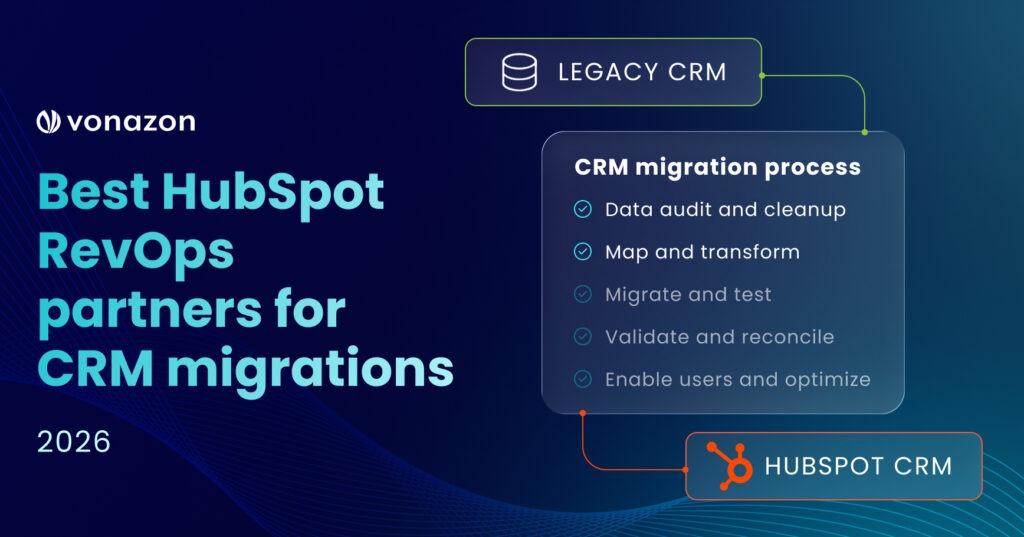
A common sequence is audit, object and field mapping, a test migration, production cutover, and reconciliation. Some teams cut over in one step; others run both systems in parallel through HubSpot’s Salesforce integration and retire Salesforce once validation passes.
Salesforce custom objects need extra planning: HubSpot requires the custom object to exist in HubSpot before sync is configured, and lookup fields on custom objects cannot be mapped.
How long does a HubSpot CRM migration take?
Published ranges vary with data volume and integration count. Vonazon cites four to eight weeks for most migrations, INSIDEA cites about 12 weeks from Salesforce, and HubSpot states that it typically sees most businesses complete a Salesforce migration within three months. Projects that add RevOps redesign can run longer.
Should CRM migration include RevOps redesign?
Not necessarily. Redesign tends to make sense when current lifecycle, routing, or pipeline definitions are causing measurable problems. Migration is a practical moment to fix sales and marketing alignment in HubSpot because automation is rebuilt anyway, but redesign adds scope and change management.
How should CRM migration data be validated?
Common practice compares record counts by object, samples records for property accuracy, checks association counts, and reconciles pipeline totals against the source. HubSpot’s duplicate management tool surfaces potential duplicates daily, although reviewing them individually requires a Professional or Enterprise subscription.
What should happen after a HubSpot migration?
Role-specific training, verification of routing and automation, dashboard rebuilds, and a named owner for property and integration governance. Structured HubSpot training and adoption support helps teams move from parallel habits to daily use of the new system.
How should HubSpot RevOps partners be compared?
Apply the same criteria to every partner: migration depth, HubSpot accreditations, RevOps design, integration architecture, data governance, reporting continuity, and post-launch support. Case studies matched to the buyer’s source system can reveal more than tier alone, and these signs a team needs a RevOps CRM implementation partner can help set scope first.



Planning a CRM migration or RevOps transformation? Speak with our team to evaluate your architecture, data requirements, and integration roadmap before kickstarting your project.