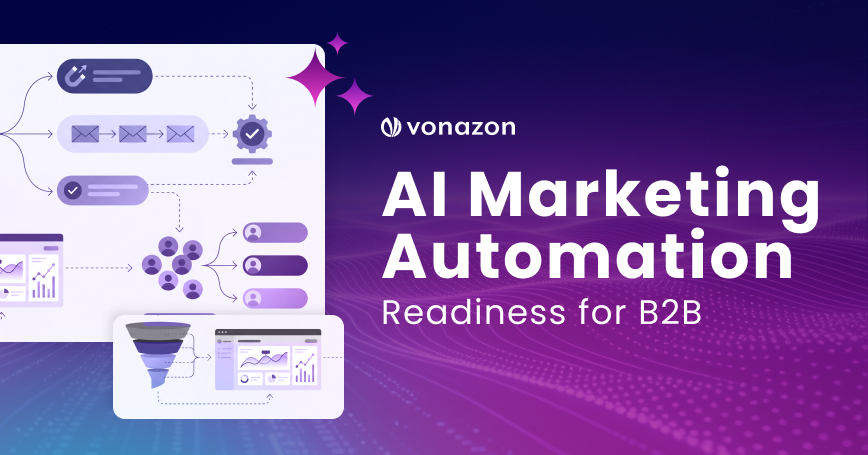

AI Marketing Automation Readiness for B2B: Why Data and Workflows Have to be Clean Before AI Can do Anything Useful
Artificial intelligence has moved from boardroom curiosity to budget line item across B2B organizations. Executive teams are approving investments in AI marketing automation, sales intelligence, and customer service agents at record pace. Yet a growing body of research shows that most of these initiatives never produce measurable results.

According to research from MIT’s Project NANDA, roughly 95% of enterprise generative AI pilots deliver no measurable impact on profit and loss, despite an estimated 30 to 40 billion dollars in enterprise spending. The failures are rarely caused by the technology itself. They are caused by what sits underneath it.
The central lesson for leadership teams is simple. AI does not create operational excellence. It amplifies existing operational maturity. Organizations with clean data, standardized workflows, and connected systems watch AI compound their strengths. Organizations with fragmented systems and inconsistent records watch AI scale their weaknesses instead.
Table of Contents
Why AI Adoption Is Accelerating Across B2B Organizations
Why AI Cannot Fix Broken Operations
The Five Operational Foundations AI Requires
Common Signs an Organization Is Not AI Ready
How Poor Data Impacts AI Marketing Automation
A Practical AI Readiness Checklist for Executives
Preparing Marketing Automation for AI
Why AI Adoption is Accelerating Across B2B Organizations
AI adoption is no longer an early adopter story. The McKinsey Global Survey on the state of AI found that 88% of organizations now use AI in at least one business function, up from 78% a year earlier. Adoption has become the norm across industries and company sizes.
McKinsey Global Survery
AI Adoption and Business Impact
A snapshot of current enterprise AI adoption

88%
Use AI in at least one business function

78%
Used AI a year earlier

1 in 3
Have scaled AI beyond pilots

39%
Report measurable impact on earnings
Several forces are driving the acceleration. Boards and investors expect leadership teams to show an AI strategy. Modern marketing automation systems now embed AI features directly into campaign, scoring, and content tools. Sales organizations face pressure to increase productivity without increasing headcount. Customers expect faster, more personalized experiences across every channel. Revenue leaders see AI as a way to grow pipeline without growing cost.
The vendor landscape adds urgency of its own. Every major CRM, marketing automation, and analytics platform now ships AI features by default, which means many organizations technically adopted AI the moment they renewed a subscription. That makes adoption statistics easy to inflate and easy to misread. Turning a feature on is not the same as building the operational conditions that let the feature produce revenue.
The same McKinsey research reveals the gap that should concern executives. Only about one third of organizations have begun scaling AI beyond pilots, and just 39% report any measurable impact on enterprise earnings. Adoption is nearly universal. Value is not. The difference between the two comes down to the operational foundation each organization brings to the table.
Why AI Cannot Fix Broken Operations
AI systems do not operate in a vacuum. They learn from CRM records, historical workflows, past campaign performance, and the processes teams follow every day. When those inputs are inconsistent, the outputs are inconsistent at a much larger scale and speed.
Gartner’s research on AI-ready data makes the stakes explicit. Gartner predicts that through 2026, organizations will abandon 60% of AI projects that are not supported by AI-ready data. The same research found that 63% of organizations either do not have, or are not sure they have, the right data management practices in place to support AI at all. For executives, this means the majority of AI budgets are currently at risk for reasons that have nothing to do with which vendor was selected.
Gartner Research
AI Projects Need AI-Ready Data
A key reason AI initiatives fail is weak data readiness.

60%
Of AI projects may be abandoned by 2026 without AI-ready data
The pattern plays out in predictable ways. An AI lead scoring model trained on duplicate contact records learns from conflicting signals and produces unreliable scores. An AI agent connected to a CRM with inaccurate lifecycle stages routes prospects to the wrong teams faster than any human ever could. A forecasting model built on pipeline data that sales reps update inconsistently produces confident projections that no one should trust.
In each case, the AI performs exactly as designed. It inherits the business problems it was supposed to solve. That is why AI readiness is an operational maturity challenge rather than a software purchasing decision.
The sequencing also matters financially. Fixing data and workflow problems after an AI rollout costs far more than fixing them before, because every downstream model, automation, and report built on flawed inputs has to be retrained or rebuilt. Teams also lose confidence quickly. Once sales reps watch an AI tool score obvious junk leads as hot, or executives catch a forecast that contradicts the pipeline they can see, adoption collapses and the investment stalls regardless of how good the technology is.
The Five Operational Foundations AI Requires
Organizations that succeed with AI share a common set of operational foundations. Each one determines how much value AI can extract from the business.

Clean Customer Data
Customer data is the raw material for every AI capability. That means duplicate prevention rules that stop redundant records before they enter the CRM. It means standardized properties, so a field like industry or region holds consistent values across every record. It means lifecycle stages that reflect where each contact actually sits in the buying journey. And it means CRM data governance that assigns clear ownership for keeping all of it accurate over time.
Data quality is also not a one-time project. Contacts change jobs, companies merge, and email addresses go stale continuously. Organizations that treat cleanup as an annual event watch quality decay between efforts, while organizations that build ongoing validation into their operations give AI a stable foundation that stays reliable quarter after quarter.

Standardized Workflows
AI can only automate processes that exist in a repeatable form. Lead routing rules should behave the same way for every inbound lead. Approval steps should follow documented paths rather than tribal knowledge. Lifecycle automation and HubSpot workflows should move contacts between stages based on defined criteria. Sales handoffs should transfer context in a structured way. When every team runs its own version of a process, AI has no reliable pattern to learn from or improve.

Connected Systems
Disconnected platforms starve AI of context. The Salesforce State of Data and Analytics report found that the average enterprise runs 897 applications, and only 29% of them are connected. Data leaders in the same study estimate that 19% of company data is siloed or unusable, and 70% believe their most valuable business insights sit inside that inaccessible portion. In practical terms, most organizations are asking AI to reason about the customer while hiding a fifth of the evidence.
The consequences are easy to picture. A CRM that does not talk to the marketing automation platform cannot tell AI which campaigns actually influenced revenue. An ERP disconnected from customer records hides billing and fulfillment context. A support platform isolated from sales data prevents AI from spotting churn risk. A project management tool cut off from the CRM hides delivery status from account teams. Every gap between systems becomes a blind spot for AI.

Reliable Reporting
Executives cannot act on AI recommendations when the underlying dashboards contradict each other. The Salesforce research found that data leaders consider roughly 26% of their data untrustworthy, and 54% of business leaders are not fully confident the data they need is even accessible. If two dashboards report different pipeline numbers today, an AI model trained on that same data will simply produce a third version of the truth. Reporting must be trusted before AI insights can be.

Governance
Governance is the connective tissue that holds the other foundations together. It defines who owns each system, each dataset, and each automation. It requires documentation, so processes survive employee turnover. It establishes change management, so updates to workflows and properties happen deliberately rather than accidentally. The appetite for this work is clear. In the same Salesforce study, 84% of data and analytics leaders said their data strategies need a complete overhaul before their AI ambitions can succeed.
Common Signs an Organization is Not AI Ready
Leadership teams do not need a technical audit to spot the early warning signs. The table below maps the most common symptoms to what they indicate and where to begin investigating.
Warning Sign | What It Indicates | Potential AI Impact | First Area to Review |
|---|---|---|---|
Duplicate CRM records | Weak data governance | Inaccurate segmentation and recommendations | Contact and company records |
Inconsistent lifecycle stages | Teams use different definitions | Unreliable lead scoring and forecasting | Lifecycle stage criteria |
Conflicting dashboards | Reporting logic is inconsistent | AI recommendations rest on disputed metrics | Reporting properties and data sources |
Broken or orphaned workflows | Automation lacks ownership or maintenance | Leads routed or nurtured incorrectly | Workflow history and enrollment rules |
Manual spreadsheet processes | Core systems are disconnected | AI cannot see a complete operational picture | Integrations and data syncs |
Missing attribution data | Customer journeys are incomplete | Campaign optimization becomes unreliable | Source tracking and attribution setup |
One more symptom belongs alongside these: conflicting sales and marketing KPIs. When the two teams are measured against each other, AI optimizes one team’s goals at the other’s expense, which makes shared revenue metrics and sales and marketing alignment the first area to review.
Any single row is manageable. Several rows appearing together signal that AI investment will underperform until the underlying operations are repaired.
These symptoms tend to surface later as failed AI projects. Gartner’s forecast on agentic AI predicts that more than 40% of agentic AI projects will be canceled by the end of 2027, driven by escalating costs, unclear business value, and inadequate risk controls. All three causes trace back to operational immaturity rather than model quality.
How Poor Data Impacts AI Marketing Automation
Marketing operations feel the consequences of poor data faster than almost any other function, because AI marketing automation touches every stage of the customer journey. Each core capability degrades in a specific way when the data underneath it is unreliable.
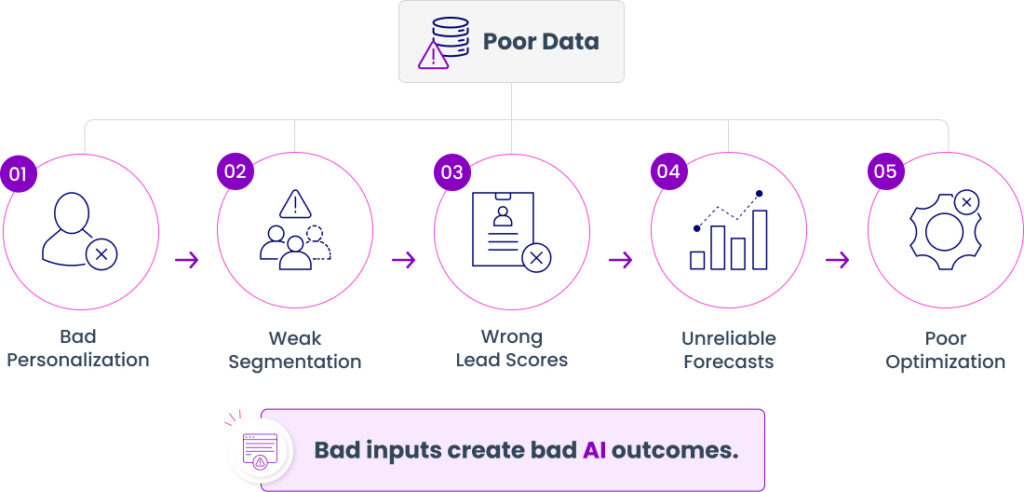
Personalization depends on accurate contact and company records. Wrong job titles, stale industries, and outdated lifecycle stages produce messages that feel irrelevant or careless.
Segmentation breaks when duplicates inflate audience counts and inconsistent properties scatter similar contacts across unrelated lists. Campaigns then target fragments of an audience instead of the whole.
Lead scoring models learn from historical outcomes. When past deals carry mislabeled sources, missing close reasons, or skipped stages, the model learns the wrong definition of a good lead.
Predictive analytics and forecasting amplify whatever bias exists in pipeline data. Deals that sit in the wrong stage for months teach the model that stalled pipeline is normal.
Campaign optimization and AI-generated insights depend on attribution. When attribution is incomplete, AI shifts budget toward channels that only appear to perform.
A Practical AI Readiness Checklist for Executives
Leadership teams evaluating AI readiness can pressure test their operations against the following questions:
- CRM Governance Does a named owner control data standards, property definitions, and access rules?
- Data Quality Are duplicate rates, field completion, and lifecycle accuracy measured and reported?
- Reporting Accuracy Do executives trust one version of pipeline, revenue, and campaign numbers?
- Automation Documentation Is every workflow documented, owned, and reviewed on a schedule?
- Workflow Ownership Does each core process, from lead routing to renewal, have an accountable owner?
- Integration Health Are system connections monitored, and are sync errors resolved rather than ignored?
- Marketing Attribution Can the organization connect campaigns to pipeline and revenue with confidence?
- Customer Lifecycle Definitions Do sales, marketing, and service share the same stage definitions?
- AI Governance Policies Are there rules for where AI can act autonomously and where humans must review?
An organization that cannot answer yes to most of these questions will struggle to see returns from additional AI investment, no matter which tools it purchases. Many leadership teams assign this assessment to a Revenue Operations function, which is positioned to see across sales, marketing, and service at once.
Preparing Marketing Automation for AI
Preparing marketing automation for AI follows a logical sequence, and none of it requires new AI software to begin.
The work starts with an automation audit. Every workflow, sequence, and trigger gets catalogued, tested, and either fixed, documented, or retired. Broken and orphaned automations are removed before AI can amplify them.
CRM optimization comes next. Duplicates are merged, properties are standardized, and inactive records are archived under clear rules. Lifecycle mapping then aligns sales, marketing, and service on shared stage definitions, so AI-powered marketing automation moves contacts through a journey everyone recognizes.
Campaign governance establishes naming conventions, UTM standards, and attribution rules, so performance data stays comparable across teams and quarters. Operational documentation captures how each system, integration, and process works, giving both new employees and AI tools reliable context.
None of this work needs to freeze current campaigns. Most organizations run the audit and cleanup in parallel with normal operations, prioritizing the systems that upcoming AI use cases will depend on first. A team planning AI-assisted lead scoring, for example, starts with contact data and lifecycle stages, while a team planning AI campaign optimization starts with attribution and campaign governance.
Organizations that complete this sequence give AI for marketing automation something worth amplifying: consistent data, predictable workflows, and trustworthy measurement. Those that skip it hand AI a copy of their existing problems.
Why AI Readiness is a Competitive Advantage
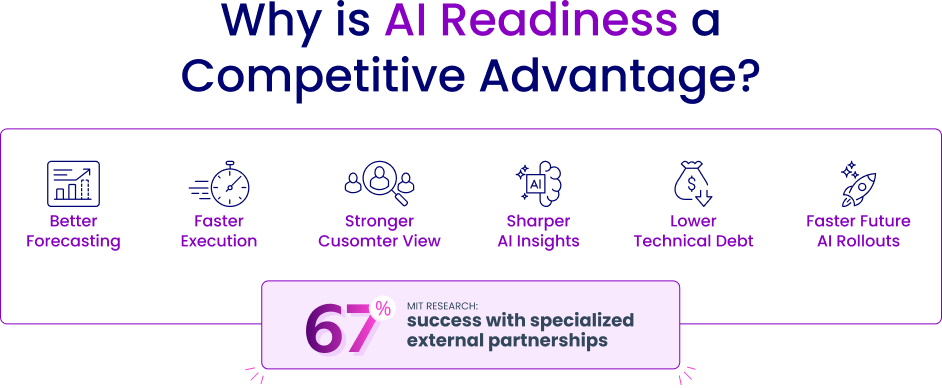
Operational readiness pays off well beyond any single AI project. Forecasting improves because pipeline data reflects reality. Execution speeds up because teams stop reconciling conflicting reports and duplicate records. Customer experience improves because every team works from the same accurate view of each account. AI recommendations get sharper with every cycle because the systems feeding them stay clean. Technical debt shrinks instead of compounding.
The MIT research offers one more insight worth noting. AI implementations built through specialized external partnerships succeeded about 67% of the time, roughly twice the success rate of purely internal builds. Organizations that combine a solid operational foundation with experienced HubSpot implementation support consistently outperform those that attempt either half alone.
Readiness also compounds. Every quarter spent on clean data and governed workflows makes the next AI capability cheaper and faster to deploy. Competitors that skipped the foundation work must stop and rebuild while ready organizations keep shipping.
Conclusion
The evidence across MIT, McKinsey, Gartner, and Salesforce research points in one direction. AI success depends on operational readiness rather than software selection. Organizations that prepare their CRM, workflows, integrations, and reporting before scaling AI join the minority that captures measurable value. Organizations that buy tools first simply automate the problems they already have.
The practical next step is an honest assessment of where the foundation stands today, before the next AI line item reaches the budget.
For leadership teams ready to find out where the organization actually stands, a Digital Transformation Evaluation with Vonazon assesses CRM data quality, workflow maturity, integration health, reporting reliability, marketing automation readiness, and overall AI readiness in one structured review.
The result is a clear map of the specific gaps standing between the organization and reliable AI performance, along with a prioritized path to close them. Knowing exactly where the foundation is weak is the fastest path to making AI genuinely useful.
Frequently Asked Questions
What does AI readiness mean for a B2B organization?
AI readiness means an organization has the operational foundation AI depends on: clean customer data, standardized workflows, connected systems, trusted reporting, and clear governance. It measures operational maturity rather than software ownership. A company can hold licenses for advanced AI tools and still be unready if its CRM contains duplicates, its teams define lifecycle stages differently, or its dashboards disagree. Readiness determines whether AI amplifies strengths or scales existing problems.
Why does clean data matter for AI marketing automation?
Clean data matters because AI marketing automation makes decisions directly from CRM records, campaign history, and attribution data. Personalization pulls from contact properties, segmentation from list quality, lead scoring from historical outcomes, and forecasting from pipeline stages. When those inputs contain duplicates, stale values, or inconsistent definitions, every downstream AI decision inherits the errors and repeats them at scale, across thousands of contacts at once.
Can AI fix inaccurate or incomplete CRM data?
No. AI cannot reliably repair the data it learns from, because it has no way to know which of two conflicting records is correct or which lifecycle stage a contact truly belongs in. AI can assist cleanup by flagging likely duplicates or anomalies, but the standards, merge rules, and ownership decisions require human governance. Organizations that expect AI to clean their CRM automatically typically end up automating the inaccuracy instead.
How can a company evaluate whether its workflows are ready for AI?
A company can start by asking whether each core process is documented, owned, and consistent. Ready workflows behave the same way every time: leads route by defined rules, handoffs transfer complete context, and lifecycle stages advance on agreed criteria. Warning signs include automations no one maintains, manual spreadsheet workarounds, and processes that vary by team or individual. A structured readiness assessment or workflow audit turns that informal check into a prioritized action plan.
What should a business improve before implementing AI-powered marketing automation?
A business should complete four things first: an automation audit that fixes or retires broken workflows, a CRM cleanup that merges duplicates and standardizes properties, lifecycle mapping that aligns sales, marketing, and service on shared stage definitions, and campaign governance that makes attribution trustworthy. These steps give AI-powered marketing automation reliable inputs to work from. None of them requires new software, and all of them improve performance even before AI is added.
Is Your Business Ready for AI or Just Buying Tools?
AI only performs as well as the data, workflows, systems, reporting, and governance behind it. Take the quick readiness check to uncover gaps before they become expensive AI failures.