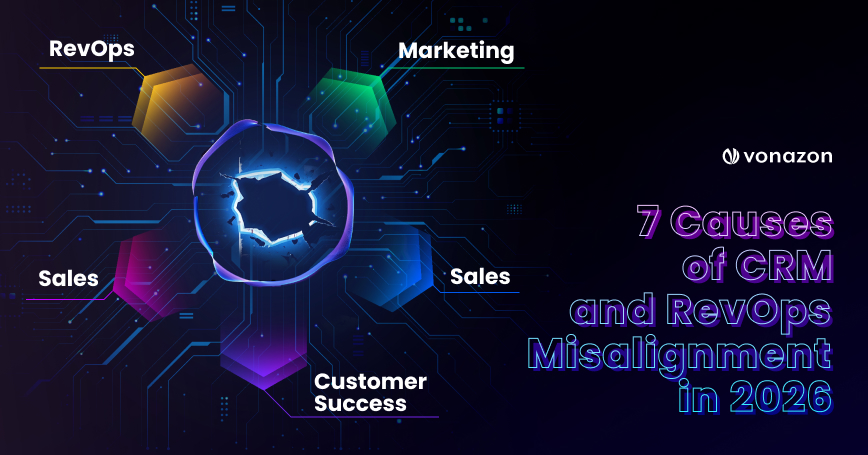

7 Causes of CRM and RevOps Misalignment in 2026
CRM and RevOps misalignment happen when teams share the same platform but follow different rules, workflows, and reporting standards. As those rules drift, lifecycle stages, data quality, ownership, and reporting become unreliable. The cost is real: Gartner estimates poor data quality costs organizations an average of $12.9 million per year. This guide breaks down the seven root causes of misalignment, their business impact, and the key areas to inspect first.
1. Disconnected Data and Fragmented Systems
Marketing, sales, and customer success often work from disconnected tools, fragmented data sets, or department-specific systems adopted independently. A marketing automation platform, a CRM, a support desk, and a billing system each hold a piece of the customer record, and those pieces rarely reconcile cleanly. Weak data quality begins here.
As shown in the dashboard image, fragmented systems usually appear through a few visible warning signs:

- Conflicting CRM numbers
- Sync failures
- Duplicate records
- Broken imports
- Fragmented journey
- Unreliable reporting
- Disconnected tech stack
The effect is lost visibility into the full customer journey. Reports built from different systems conflict, and revenue decisions get made from incomplete data. When a single customer exists as three partial records across three platforms, segmentation weakens, routing misfires, and leadership cannot trust one view of the funnel.
2. Conflicting Lifecycle Definitions
Teams do not share one clear definition of Lead, MQL, SQL, Opportunity, or Customer. Marketing may count a content download as an MQL, while sales expects a budget-confirmed conversation before the same label applies.
Lead quality then becomes a recurring dispute, handoffs turn ambiguous, and funnel reporting loses reliability. Each team measures a different funnel, so conversion rates between stages stop meaning anything across the organization.

3. Misaligned Goals, KPIs, and Incentives
Misalignment begins when every team can hit its own number while the revenue system still underperforms.
As shown in the image, marketing chases lead volume, sales chases closed deals, customer success protects retention, and leadership expects revenue growth. The issue is not effort. The issue is that no shared success metric ties these actions together.
Each team then optimizes its own department instead of shared revenue outcomes. Forrester research found that firms with high levels of alignment across customer-facing functions report 2.4 times higher revenue growth than those without it, a gap that traces directly back to whether teams pursue the same goal.

4. Broken or Unclear Handoff Processes
Leads, opportunities, and customers move between teams without clear context, SLA rules, or required next-step information. A record changes owners, but the qualification notes, intent signals, and prior conversations do not travel with it. This is where lead routing breaks down in practice.
Follow-up slows, sales repeats discovery that marketing already completed, customer success starts cold, and the buyer experience suffers. Every dropped piece of context forces the buyer to repeat themselves, which erodes trust at the moment consistency matters most.
5. Technology-First CRM Approach
This happens when a company sets up its CRM before clearly defining how its teams actually sell, follow up, close deals, and manage renewals.
Instead of building the CRM around the real customer journey, teams often use the platform’s default fields, stages, and automations. As a result, the CRM may look organized on the surface, but it does not match how the business really operates.
Over time, the CRM becomes just a place to store data instead of a system that guides the revenue process. Teams start using it in their own way, processes become inconsistent, and the CRM no longer reflects one clear way of working across marketing, sales, and customer success.
6. Lack of Centralized Data Governance
When no single person or team owns CRM data quality, small mistakes quickly become system-wide problems.
Without clear rules for fields, duplicates, validation, and routine audits, the CRM starts treating inconsistent records as separate accounts or contacts.
That creates problems across the entire revenue process:
- Leads may get routed to the wrong owner
- Reports may show inaccurate numbers
- Attribution may become unreliable
- Automations may trigger at the wrong time

Over time, every tool connected to the CRM inherits the same bad data. The longer it goes unmanaged, the harder and more expensive it becomes to clean up.
7. Poor User Adoption and Inadequate Training
Teams are not properly trained, workflows are not designed around real user behavior, and reps view the CRM as administrative overhead rather than a tool that helps them sell.
Users then create workarounds: private spreadsheets, side notes, and shadow systems. CRM trust declines, and the platform becomes a partial source of truth. Once a meaningful share of activity lives outside the system, every report built on top of it understates reality.
Practical Impact of CRM and RevOps Misalignment
Misalignment does not stay contained inside operations. It surfaces in four distinct areas.
Execution Impact
Records move incorrectly when routing rules or field values are wrong. Follow-up slows when ownership is unclear or assignment rules conflict. Handoffs lose context, which forces teams to repeat discovery or start engagements cold.
Measurement Impact
Funnel reports do not match because teams apply different stage definitions and filters. Attribution becomes unreliable when source fields are overwritten or UTM rules are inconsistent. Pipeline reporting loses stakeholder trust when the same question returns different numbers depending on who runs the report. Forrester’s 2024 research captured the resulting perception gap: 82% of C-level executives believed their sales and marketing teams worked together effectively, while 65% of frontline professionals reported a lack of alignment.
Decision-Making Impact
Leadership makes budget, staffing, and go-to-market decisions using distorted data. Channel investment gets skewed by attribution failures that inflate or deflate return on spend, and forecasts lose accuracy when pipeline stages are not standardized.
Customer Experience Impact
Buyers face repeated questions across teams because context does not transfer at handoffs. Messaging turns inconsistent when teams work from different data. Strong sales and marketing alignment removes that friction, particularly at the MQL to SQL and opportunity to onboarding transitions, where the buying experience should feel most seamless.
Solution: CRM and RevOps Misalignment Diagnostic Matrix
The matrix identifies where misalignment is happening, what it looks like operationally, how it affects revenue execution, and what to inspect first inside the CRM and connected systems.
Misalignment Area | What Breaks | Business Impact | What to Inspect First | What Aligned Looks Like |
|---|---|---|---|---|
Lifecycle definition drift | Stages mean different things to different teams | Inflated funnel, poor lead quality, handoff conflict | Lifecycle fields, lead status fields, stage update rules, automation rules | One lifecycle dictionary with clear entry and exit rules |
Routing and ownership misalignment | Leads reach the wrong person or too late | Slow follow-up, dropped leads, lower conversion | Owner fields, assignment rules, territory logic, queues | One governed routing and ownership model |
Data quality issues | Duplicate and incomplete records break trust | Bad reporting, bad routing, weak segmentation | Duplicate rules, required fields, account matching, field normalization | Clean record architecture and governed data rules |
Handoff failure | Stage changes without required context | Rework, repeated discovery, slower deal movement | Required handoff fields, notes, tasks, qualification fields | Context-based handoffs with required fields and reason codes |
Workflow and automation sprawl | Automations overlap or conflict | Stage bouncing, owner overwrites, duplicate tasks | Workflow inventory, trigger logic, re-enrollment rules, sync behavior | Every automation has an owner, purpose, and review cadence |
Reporting mismatch | Dashboards use different logic | Weak forecast trust and poor decisions | Report filters, funnel definitions, source logic, pipeline rules | Shared revenue KPIs and one reporting model |
Attribution failure | Sources get overwritten or misread | Wrong budget decisions and unclear campaign ROI | Source fields, UTM rules, campaign influence, integration overwrite rules | Stable source governance and controlled overwrite rules |
Recommended CRM Audit Sequence
A structured CRM audit converts the matrix into action. Run these steps in order.
1. Map lifecycle stage, lead status, opportunity stage, and customer stage definitions across all teams.
2. Inventory every automation that updates lifecycle, owner, score, routing, or source fields.
3. Trace real records from first touch to opportunity creation and closed-won or closed-lost.
4. Compare owner history across contacts, accounts, leads, and opportunities.
5. Check required handoff fields at MQL, SQL, opportunity creation, and closed-won.
6. Reconcile dashboard, funnel, attribution, and pipeline reporting logic across teams.
7. Review integration and sync overwrite rules for all connected systems.
8. Document the source of truth for stage, owner, score, source, and qualification status.
Why Vonazon is the best partner for fixing RevOps misalignment
Vonazon brings deep RevOps expertise to enterprise HubSpot teams. With over 400 successful implementations and 300+ certifications, the team understands both the technical platform and the organizational dynamics that create misalignment.

As an Elite HubSpot Partner, Vonazon combines strategic consulting with hands-on execution. That means you get senior expertise on data architecture, integration design, and lifecycle automation without having to manage multiple vendors or translate between strategy and implementation.
The focus is on operational outcomes: cleaner data, faster handoffs, reliable reporting, and a CRM that works as a revenue engine rather than a contact database. Reach out to Vonazon to start with a free HubSpot audit and see where your RevOps gaps are creating the most drag.
Frequently Asked Questions
What causes CRM and RevOps misalignment in 2026?
Misalignment stems from inconsistent governance across the revenue system: conflicting lifecycle definitions, fragmented data, mismatched goals, broken handoffs, a technology-first setup, weak data governance, and low user adoption. These causes compound, so a single fix rarely resolves the underlying problem.
How does CRM misalignment affect revenue operations?
It distorts the data RevOps depends on. Forecasts lose accuracy, routing misfires, attribution breaks, and leadership makes decisions from reports that no longer agree with one another. The result is slower execution and lower trust in the pipeline.
What are the warning signs of CRM and sales misalignment?
Common signs include funnel reports that do not reconcile, recurring disputes over lead quality, leads that go uncontacted, duplicate records, and reps maintaining private spreadsheets outside the system. Each signal points to a governance gap rather than a one-off error.
Are marketing, sales, and customer success teams working out of a unified CRM, or fragmented department-specific tech stacks?
This is the first diagnostic question to answer. A unified system gives every team one view of the customer, while fragmented stacks force reconciliation between tools that rarely match. Mapping which system owns each part of the record reveals where fragmentation begins.
Can a user track a single customer's entire journey from first website visit to post-sale renewal without switching platforms?
In an aligned environment, yes. If tracing one customer requires logging into several disconnected systems and stitching the history together manually, the data architecture is fragmented and the full journey is invisible to most teams.
Why do CRM reports show different numbers across departments?
Different numbers usually come from different definitions and filters, not different data. When teams define stages, date ranges, or source fields differently, each dashboard measures a slightly different funnel and the totals diverge.
Is data integration happening in real time, or does the organization rely on manual spreadsheet imports?
Real-time integration keeps records current across systems; manual imports introduce lag, human error, and duplicate entries. A reliance on spreadsheet imports is a strong indicator of fragmentation and decaying data quality.
Do sales and marketing share a documented definition of MQL versus SQL?
Alignment requires a written, agreed definition with clear entry and exit criteria for each stage. Without it, marketing and sales apply different thresholds, and the MQL to SQL handoff becomes a recurring source of conflict.
What is lifecycle stage drift in CRM?
Lifecycle stage drift is the gradual divergence in how teams interpret and apply the same stage over time. The label stays constant while its real meaning shifts per team, which inflates the funnel and weakens reporting.
What should happen when sales rejects an MQL?
A rejected MQL should return to marketing with a documented reason code, then route to nurture if it is early or to disqualification if it does not fit. The reason data feeds back into scoring so future lead quality improves.
How can companies fix broken lead handoffs?
Fixes start with required handoff fields, an SLA on follow-up time, and a shared definition of a sales-ready lead. Context, qualification notes, and next steps must travel with the record so the receiving team never starts cold.
What happens to leads that sales determines are not ready to buy?
Not-ready leads should move into a structured nurture track rather than disappear. A governed lifecycle returns them to marketing with status and context intact, so they re-enter the funnel when intent signals return.
Are marketing's success metrics tied to pipeline contribution and closed-won revenue?
In aligned organizations, marketing is measured on sourced and influenced pipeline and closed-won revenue, not lead volume alone. Tying metrics to revenue outcomes is what pulls both teams toward the same goal.
Do CRM dashboards reflect shared revenue outcomes or isolated department performance?
Aligned dashboards report shared revenue KPIs that every team recognizes. Dashboards built around isolated department metrics reinforce silos and make cross-functional performance hard to assess.
How should companies handle incentives when a deal requires cross-functional collaboration?
Incentives should reward the shared outcome, with credit structured so marketing, sales, and customer success all benefit when a collaborative deal closes and retains. Compensation tied only to siloed metrics discourages the cooperation complex deals require.
What is CRM governance?
CRM governance is the set of documented rules and ownership that controls how data is entered, how fields and stages are defined, how duplicates are managed, and how automations are reviewed. It keeps the system a trusted source of truth as it scales.
Why do CRM automations create misalignment?
Automations create misalignment when they overlap or conflict, for example two workflows updating the same owner or stage with different logic. Without a single owner and a review cadence, automation sprawl produces stage bouncing, overwrites, and duplicate tasks.
Who should own CRM data governance?
Ownership typically sits with RevOps or a dedicated CRM administrator who sets standards and coordinates across teams. The essential point is that one accountable owner exists, rather than governance being diffused across every user.
How can poor CRM adoption affect RevOps performance?
Low adoption means activity and outcomes go unrecorded, so reports understate reality and forecasts weaken. As reps build workarounds, the CRM becomes a partial source of truth and every downstream RevOps process inherits the gaps.
Should CRM architecture be owned by RevOps or IT?
RevOps generally owns the process and data model because it understands the revenue motion, while IT supports integration, security, and infrastructure. A clear division of responsibility between the two prevents both technical and process gaps.
How can companies improve CRM and RevOps alignment?
Improvement starts with one lifecycle dictionary, shared revenue KPIs, governed routing and handoff rules, and a named owner for data governance. A regular audit then keeps definitions, automations, and reporting from drifting back out of sync.
What should be included in a CRM audit?
A complete audit covers lifecycle and stage definitions, an automation inventory, record tracing, owner history, required handoff fields, reporting logic, integration overwrite rules, and a documented source of truth for each key field.
What is a CRM diagnostic matrix?
A CRM diagnostic matrix maps each misalignment area to what breaks, the business impact, what to inspect first, and what an aligned state looks like. It turns a vague sense of misalignment into a specific, prioritized inspection list.
How often should companies audit CRM data, workflows, and lifecycle rules?
A light review each quarter and a deeper audit once or twice a year suits most organizations. High-growth teams, or those running frequent automation changes, benefit from a more frequent cadence to catch drift early
Turn HubSpot Into a Revenue Engine