
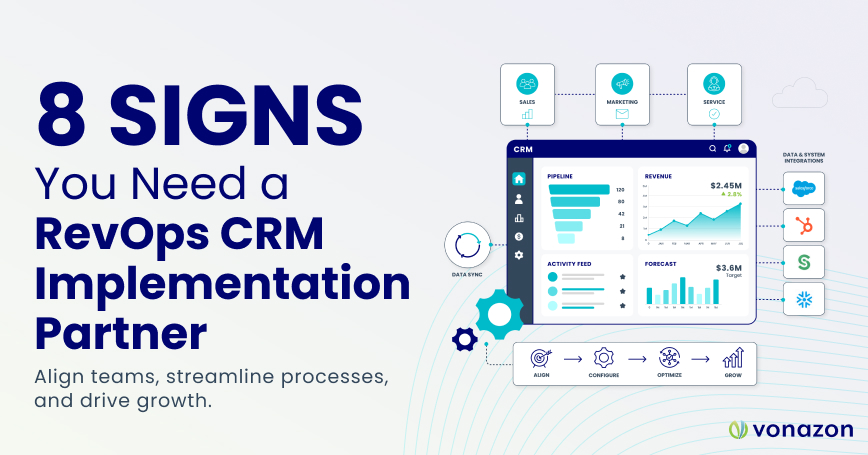

8 Signs You Need a RevOps CRM Implementation Partner
The CRM is live and the dashboards technically exist. Yet marketing and sales still disagree about what counts as a qualified lead, leadership double checks pipeline numbers in a spreadsheet, and every new integration produces fresh duplicates. This is the most common state of a mid-market CRM: functional on the surface and unreliable underneath.
The reason is that CRM implementation was never a software configuration project. It is an operational initiative that involves people, processes, data, governance, integrations, measurement, and adoption.
When those operational foundations are weak, no amount of configuration produces dependable revenue execution.
27%
of CRM project challenges stem from process-related issues.
The eight signs below help revenue teams recognize when a revenue operations implementation calls for outside expertise, and when an internal project remains the practical choice.
Table of Contents
Sign 1: Marketing, Sales, and Service Use Different Definitions
Sign 2: CRM Data Cannot Be Trusted
Sign 3: Manual Workarounds Have Become Part of Daily Operations
Sign 4: Integrations Create Duplicate or Conflicting Information
Sign 5: Leadership Cannot Get a Reliable View of the Pipeline
Sign 6: The Company Is Selecting or Migrating to a New CRM
Sign 7: Internal Teams Lack the Time or Expertise to Lead Implementation
Sign 8: CRM Activity Is Increasing Without Improving Revenue Outcomes
What a RevOps CRM Implementation Partner Should Provide
When an Internal CRM Implementation May Be Enough
Marketing, Sales, and Service Use Different Definitions
When lifecycle stages, MQL and SQL thresholds, opportunity stages, and handoff criteria mean different things to different teams, the CRM records the disagreement instead of resolving it.
27.6%
of marketers rank sales and marketing alignment among their leading challenges.
The risk is that leads stall in handoffs, accountability blurs, and funnel conversion cannot be measured consistently. A typical mid-market example: marketing reports 400 MQLs per quarter in HubSpot while sales recognizes fewer than 100 as workable, and pipeline meetings become debates about whose number is real.
A RevOps CRM implementation partner facilitates shared definitions before configuration, then encodes them into lifecycle and pipeline architecture so the system enforces the agreement. Definition drift is often an early symptom of deeper CRM and RevOps misalignment.
Diagnostic Question: Can marketing, sales, and service each define a qualified lead and give the same answer?
CRM Data Cannot Be Trusted
Duplicate records, incomplete fields, inconsistent naming, and uncontrolled data entry point to one root cause: nobody governs how information enters the system.
26%
of data is considered unreliable by data leaders.
The risk compounds during migration, because moving unreliable data into a new portal reproduces every problem at a higher cost. A mid-market HubSpot team might find a third of its companies existing twice under slightly different names, quietly breaking segmentation and attribution. A qualified partner audits the dataset, defines deduplication and governance rules, and runs a structured HubSpot data migration so the new system starts clean and stays clean.
Diagnostic Question: Would anyone in the company confidently build a forecast from a list pulled straight out of the CRM today?
Manual Workarounds Have Become Part of Daily Operations
Spreadsheet-based reporting, manual lead assignment, repeated exports, and personal tracking systems are rational responses to a system that does not match how the business operates. People route around broken processes, and the workarounds gradually become the process.
The risk is fragility: operational knowledge lives in individuals rather than the system, and growth multiplies manual effort instead of output. A realistic example is the RevOps manager who rebuilds the pipeline report by hand every Monday because HubSpot deal stages do not match how leadership thinks about the funnel.
An implementation partner separates decisions that genuinely require human judgment from steps that should be automated, then rebuilds routing, assignment, and reporting so the platform absorbs the repetition.
Diagnostic Question: Which reports or assignments would break if one specific person took two weeks off?
Integrations Create Duplicate or Conflicting Information
Broken field mappings, competing systems of record, duplicate synchronization, and sync errors nobody notices for weeks trace back to one gap: integrations were connected before anyone defined how data should flow. When two systems write to the same records without clear rules, teams act on different versions of the same account.
The risk shows up in customer-facing moments. In a common mid-market scenario, the ERP and HubSpot both update company records, and finance and sales quote different renewal dates to the same customer. A RevOps partner starts from business processes and data architecture, defines the system of record for each object, assigns ownership, and only then builds or repairs the HubSpot integrations. The sequence matters more than the middleware.
Diagnostic Question: For each core object, which system wins when two connected systems disagree?
Leadership Cannot Get a Reliable View of the Pipeline
Conflicting dashboards, inconsistent attribution, vague stage definitions, and marketing and sales reporting from different datasets produce the same outcome: executives stop trusting the numbers.
45%
of sales leaders and sellers report strong confidence in forecast accuracy.
Reporting problems rarely originate in the reporting tool. They originate upstream in stage definitions, missing conversion data, and inconsistent entry, so rebuilding a dashboard on a broken data model produces a prettier version of the same unreliable number. A partner designs stage entry and exit criteria, standardizes attribution, and builds reporting on a single shared dataset so forecasting debates become forecasting reviews.
Diagnostic Question: Do the marketing pipeline report and the sales pipeline report start from the same dataset and the same definitions?
The Company Is Selecting or Migrating to a New CRM
CRM selection looks like a technology decision but behaves like a process decision. A thorough CRM selection should weigh business requirements, user needs, integration requirements, data structure, reporting expectations, scalability, governance, and total implementation effort, not just the feature list and license price.
The risk of skipping this work is expensive rework. Companies that select first and design later often discover months in that the pipeline structure or data architecture fights the way their teams operate. A partner with sales operations consulting experience maps the revenue process first, translates it into platform requirements, and sequences the migration so the new CRM reflects the business rather than constraining it.
Diagnostic Question: Does a documented map of the current revenue process exist, or only a feature comparison spreadsheet?
Internal Teams Lack the Time or Expertise to Lead Implementation
Most internal teams are entirely capable of running a CRM. Running an implementation is a different job, requiring a methodology, dedicated capacity, change management, and pattern recognition that comes from repetition. An internal team typically leads one implementation every several years, alongside daily operational work that never pauses for the project.
The warning signs are familiar: the project depends on a single administrator, training is planned as one session, and change management has no owner. The risk is not failure on day one but slow erosion, where launch happens and adoption never follows. A partner supplies structure, specialized expertise, and capacity, while the internal team keeps ownership of the decisions that shape how the business runs.
Diagnostic Question: Who owns the implementation as their primary responsibility, and what happened to the work they were doing before?
CRM Activity Is Increasing Without Improving Revenue Outcomes
More workflows, more dashboards, more logged activities, and more reports can all coexist with flat conversion rates, slower sales velocity, unreliable forecasts, and stagnant retention.
84%
of sales leaders say analytics has delivered less performance impact than expected.
This is usually the clearest sign that CRM work has disconnected from the broader revenue operations strategy. The system produces motion instead of leverage, a pattern that overlaps with the symptoms of an underused HubSpot portal. A partner reconnects the architecture to revenue metrics, pruning automation that serves no decision and tying every workflow and dashboard to a specific conversion, velocity, or retention outcome.
Diagnostic Question: Which three CRM reports changed an actual business decision in the last quarter?
Quick Diagnostic Table
The table below summarizes the eight signs for quick internal review.
Warning Sign | What It Usually Indicates | Business Risk | Expertise Required |
|---|---|---|---|
Teams use different definitions | No shared lifecycle or qualification model | Stalled handoffs, unmeasurable funnel | RevOps strategy, lifecycle design |
CRM data cannot be trusted | Missing governance and data standards | Broken segmentation, flawed decisions | Data governance, migration |
Manual workarounds everywhere | System does not match real processes | Fragile operations, key-person risk | Process mapping, automation |
Integrations conflict or duplicate | No data architecture or system of record | Teams act on different versions of truth | Integration architecture |
Pipeline reporting is unreliable | Upstream process and data design gaps | Decisions made on doubted numbers | Reporting and attribution design |
Selecting or migrating CRMs | Software chosen before process mapping | Expensive rework after launch | CRM selection, migration planning |
No internal capacity or method | Implementation competes with daily work | Launch without adoption | Implementation methodology, training |
Activity up, outcomes flat | CRM disconnected from revenue strategy | Effort without revenue leverage | Revenue operations strategy |
What a RevOps CRM Implementation Partner Should Provide
Mid-market teams evaluating RevOps services should expect a specific set of capabilities rather than a general promise of expertise:
- Revenue operations strategy and revenue process mapping
- CRM selection guidance and CRM architecture
- HubSpot implementation, lifecycle design, and pipeline design
- Data migration, deduplication, and ongoing governance
- Integration planning with defined systems of record
- Workflow automation tied to measurable outcomes
- Attribution, reporting, and forecasting design
- User training, adoption programs, and change management
- Post-launch optimization and support
The dividing line between providers is simple. One type configures CRM features and hands over logins. The other connects CRM architecture and processes to measurable revenue outcomes and stays accountable for adoption. Vonazon’s build of a unified revenue engine across Salesforce and HubSpot for a global scientific instruments company illustrates the difference: the deliverable was a working revenue process, not a configured portal.
When an Internal CRM Implementation May Be Enough
Not every company needs an external partner, and a credible one will say so. An internal implementation is often practical when most of the following are true:
- The sales process is simple and involves few handoffs
- Lifecycle and qualification definitions are already aligned across teams
- The data is clean, deduplicated, and governed
- The company runs few integrations, none of them business critical
- Reporting requirements are straightforward and agreed upon
- A specific person owns the implementation with real dedicated time
- The team has hands-on platform expertise from previous implementations
- Change management needs are limited because workflows barely change
When several of these conditions fail at once, the eight signs above tend to appear within two quarters of launch. That assessment is worth making before the project starts rather than after adoption stalls.
How to Evaluate a RevOps CRM Implementation Partner
Experience claims are easy to make and hard to verify, so evaluation should focus on evidence. A practical checklist covers:
- HubSpot platform depth, including certifications and accreditations
- Documented revenue operations and sales operations consulting experience
- A written process-mapping and discovery methodology
- A defined data migration methodology with validation steps
- Integration capabilities, including systems similar to the current stack
- Governance planning for data, fields, and permissions
- Attribution and reporting expertise tied to executive decision-making
- Structured training, adoption measurement, and change management support
- Referenceable client outcomes in comparable industries
- A defined post-implementation support model
Useful evaluation questions include: What artifact does the discovery phase produce? What happens to duplicate and legacy data during migration, and who approves the rules? Which metrics define success 90 days after launch? How is adoption measured rather than assumed? Answers that reference specific methods, deliverables, and numbers indicate real implementation maturity.
Conclusion
CRM complexity alone is not the strongest signal that outside help is required. The more reliable signal is a growing gap between CRM activity and dependable revenue execution: more effort going in, and no additional trust, speed, or predictability coming out.
A successful revenue operations implementation closes that gap by connecting strategy, processes, people, data, technology, reporting, and accountability into one system that teams actually use. For revenue teams recognizing several of the eight signs, the practical next step is an honest assessment of the current CRM, revenue processes, integrations, data, and reporting. Vonazon’s revenue operations team helps mid-market HubSpot organizations run exactly that assessment and turn the findings into an implementation plan built around measurable revenue outcomes.
Frequently Asked Questions
What does a RevOps CRM implementation partner do?
A RevOps CRM implementation partner designs and executes the operational side of a CRM project: revenue process mapping, lifecycle and pipeline architecture, data migration and governance, integration planning, reporting design, and user adoption. The partner connects platform configuration to revenue outcomes rather than simply activating features, and remains accountable for whether teams actually use the system after launch.
When should a company hire a CRM implementation partner?
A partner becomes valuable when several warning signs appear together: teams disagree on definitions, data cannot be trusted, integrations conflict, reporting is unreliable, or internal capacity is limited. It is also the right moment during CRM selection or migration, because process mapping before configuration prevents the most expensive category of rework.
How is revenue operations implementation different from basic CRM setup?
Basic CRM setup configures the software: pipelines, properties, users, and templates. Revenue operations implementation starts earlier and reaches further. It aligns definitions across marketing, sales, and service, designs the data model and governance, plans integrations around a defined system of record, and builds reporting that leadership trusts. Setup produces a working portal. RevOps implementation produces a working revenue process.
Can an internal team manage a HubSpot implementation?
Yes, when conditions support it. A simple sales process, aligned definitions, clean data, few integrations, clear ownership, and genuine platform expertise make internal implementation practical. The risk rises when the project competes with daily operations or depends on a single administrator. In those cases outside capacity and methodology reduce implementation risk considerably.
What should a company consider during CRM selection?
CRM selection should evaluate business requirements, user needs, integration requirements, data structure, reporting expectations, scalability, governance, and total implementation effort. The most reliable approach maps the revenue process first and then tests platforms against it. Choosing software before mapping the process forces the business to adapt to the tool instead of the reverse.
How long does a RevOps CRM implementation take?
Timelines depend on data quality, integration count, and process complexity. Focused mid-market HubSpot implementations often complete core phases in roughly six to twelve weeks, while multi-system migrations with heavy integration work run longer. Discovery and process mapping typically consume the first several weeks, and adoption work continues past launch regardless of scope.




Get a personalized CRM Health Assessment to identify gaps in your data, automation, reporting, integrations, and revenue processes. We’ll show you what to prioritize and provide practical recommendations tailored to your business.