


How to Fix Sales and Marketing Alignment in HubSpot
A diagnostic guide for mid-market marketing and revenue operations leaders
Key Takeaways
- Sales and marketing misalignment in HubSpot tends to originate in configuration and definitions rather than in how often the two teams talk.
- Shared lifecycle stages, plus agreed MQL and SQL criteria enforced through workflows both teams have reviewed, give every handoff a consistent meaning.
- A reliable handoff assigns an owner, notifies that owner, and starts a response-time expectation; slow lead response is usually a routing problem rather than a motivation problem.
- Automation strengthens alignment only when it encodes definitions both teams accept, since ungoverned automation can scale a private definition silently.
- Clean, governed CRM data, covering duplicates, required fields, and property ownership, is what lets both teams trust the same records and reports.
- Integrations with systems such as Salesforce or an ERP need explicit source-of-truth decisions per field, or a sync can quietly overwrite owners and stages.
- Every shared metric works best with an agreed definition, a named data source, and a single owner, which turns reporting from a source of conflict into a shared instrument.
- Revenue operations provides the ownership that holds all of this together; many teams see initial improvement within roughly 90 days, with regular reviews sustaining it over time.
Two teams can share the same HubSpot portal and still operate as if they work in different systems. Marketing may treat a contact as sales-ready the moment a lead score crosses a threshold, while sales may consider that same person unqualified until a discovery call confirms budget, authority, and timing. The record looks identical on both screens. The meaning attached to it does not.
That gap rarely announces itself directly. It tends to surface in indirect ways: leads marketing counts as delivered that sales never works, pipeline reports that disagree depending on who runs them, and lifecycle stages that advance automatically while sellers quietly work from their own mental model instead. When marketing and sales alignment breaks inside HubSpot, the cause is seldom a shortage of goodwill between the teams. More often it traces back to configuration and process decisions that were never reconciled.
Picture a portal where the two functions run against different lifecycle definitions, different MQL and SQL criteria, conflicting ownership rules, disconnected workflows, inconsistent CRM properties, and separate reporting methodologies. Each difference can look harmless on its own. Together, they generate the friction leaders often describe as a sales and marketing problem when the underlying issue lives in how the CRM has been built, automated, and governed.
This guide works through that diagnosis. It moves from the symptoms teams tend to notice, to the operational root causes inside HubSpot, to the specific settings worth inspecting, and finally to the governance and measurement practices that keep alignment from drifting again. Throughout, the focus stays on HubSpot operations rather than the familiar advice that the two teams should simply meet more often.
Table of Contents
1. Why Alignment Breaks Inside a Shared HubSpot Portal
2. Symptoms of Misalignment and Their Likely Causes
3. Lifecycle Stages, MQL, and SQL: The Definition Layer
4. Lead Scoring, Routing, and the Handoff Moment
5. Marketing Automation: Leverage or Liability
6. Sales Automation and the Response Loop
7. CRM Data Governance Beneath Alignment
8. Platform Integration and Conflicting Data
9. Reporting and Measurement Discrepancies
10. Sales Enablement: Making Marketing Context Usable
Why Alignment Breaks Inside a Shared HubSpot Portal
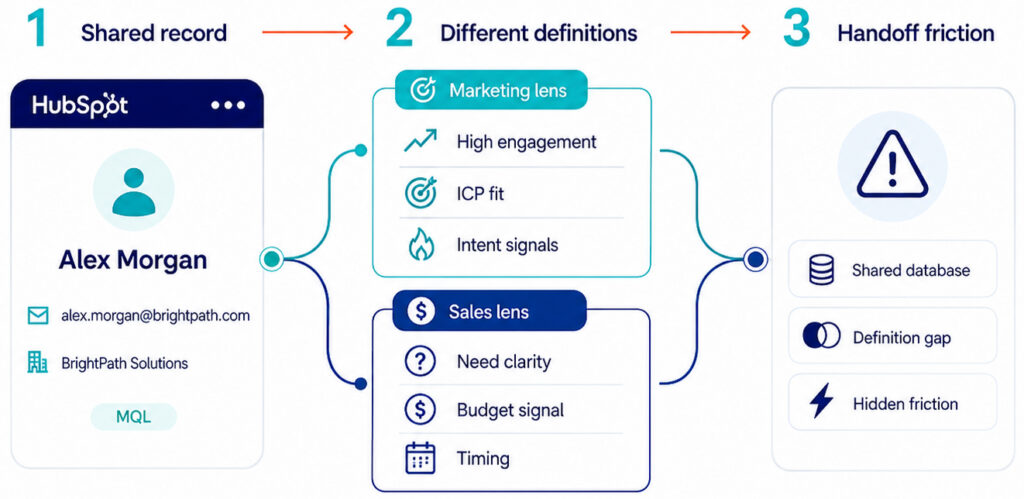
A shared portal creates an assumption of shared understanding that the configuration may not support. HubSpot centralizes contacts, companies, deals, activities, and reporting in one place, which can make it easy to believe both teams are working from the same picture. Alignment depends less on the shared database and more on whether the definitions, triggers, and ownership rules layered on top of that database mean the same thing to everyone using them.
Misalignment usually forms in the seams between functions rather than inside either one. Marketing may build sophisticated nurture and scoring logic that works exactly as designed, while sales runs a disciplined pipeline process that also works as designed, and the breakdown occurs at the single point where a lead crosses from one system of assumptions into the other. Because each team can point to its own working process, the problem often gets framed as the other side’s fault.
Framing the issue as a relationship problem tends to under-serve the fix. The long-running tension between the two functions is real, yet the durable remedy usually lies in the shared operating model: the definitions both teams accept, the handoff both teams can see, and the reporting both teams trust. The sections that follow treat each of those as an inspectable part of the HubSpot environment.
Symptoms of Misalignment and Their Likely Causes
Before changing any configuration, it helps to connect the symptoms teams report to the mechanisms inside HubSpot that tend to produce them. The same complaint can have more than one cause, so the comparison below is a starting point for investigation rather than a diagnosis on its own.
Symptom Teams Notice | Likely Operational Cause in HubSpot |
|---|---|
Sales calls marketing leads low quality | MQL threshold set on engagement volume rather than fit and intent, with no shared MQL definition |
Marketing says sales ignores its leads | No ownership assignment or routing at handoff, so leads land unassigned or in a queue nobody owns |
Pipeline numbers differ by report | Dashboards filter on different properties, such as lifecycle stage, deal stage, or lead status, with no agreed definition |
Qualified leads sit untouched for days | No SLA reminder or task automation on handoff, so response time slips |
Duplicate or conflicting records | Weak deduplication and field governance, often with integrations creating parallel records |
Marketing content goes unused | Engagement history and assets are not surfaced on the record where sellers work |
A pattern runs through most of these rows. The visible symptom sits with one team, while the mechanism that produces it sits in a setting, property, or workflow that neither team fully owns. That ownership gap is worth holding onto, because it reappears throughout the remediation process.
Lifecycle Stages, MQL, and SQL: The Definition Layer
Much of what teams experience as misalignment originates in how lifecycle stages and qualification terms have been defined. In HubSpot, the lifecycle stage property tracks where a contact or company sits in the marketing and sales process, and by default it advances in one direction only rather than reverting. Its default stages run from Subscriber through Lead, Marketing Qualified Lead, Sales Qualified Lead, Opportunity, Customer, Evangelist, and Other.
The friction begins when the criteria behind those stages are not shared. Marketing may define an MQL as a contact whose score crosses a threshold or who completes a specific form, while sales treats the same label as noise because it never agreed to those criteria. An SQL can mean passed to sales for one team and accepted by sales after a qualifying conversation for the other. When the same word carries two meanings, every handoff inherits the disagreement.
Term | How Teams Often Differ | What a Shared Definition Specifies |
|---|---|---|
MQL | Marketing counts a score or form fill; sales quietly ignores it | Agreed fit and intent criteria both teams endorse, enforced by a reviewed workflow |
SQL | Marketing means passed on; sales means accepted | Explicit acceptance criteria and who sets the stage |
Opportunity | Marketing counts any open deal; sales counts a qualified deal | A defined deal stage tied to the lifecycle stage |
Lead status | Used inconsistently or left blank | Agreed values such as New, Attempted, Connected, Qualified, and Unqualified, with an owner |
A practical fix is less about the perfect definition and more about a single documented definition that both teams endorse and that the CRM enforces. When an MQL is defined by agreed fit and intent criteria, set through a workflow both teams have reviewed, the label starts to carry consistent meaning. Lead status can then track the sub-stages within qualification, giving sales a place to record progress that marketing can also see.
Ownership of this definition layer matters as much as its content. If lifecycle criteria change without documentation, the two teams gradually drift apart again even after an initial reconciliation. Recording who may change a definition, and where that change is logged, keeps the shared meaning stable over time.
Lead Scoring, Routing, and the Handoff Moment
If lifecycle stages are the definition layer, routing is where those definitions either hold up or collapse. The handoff is a specific moment in HubSpot: a contact reaches a qualifying condition, the record needs an owner, that owner needs to be notified, and a follow-up expectation needs to start. A weak configuration at any of those four points can turn a well-defined MQL into a lead that no one works.
Speed is part of what is at stake. In a Harvard Business Review audit of 2,241 companies, the average first response to a web-generated lead was 42 hours, and firms that made contact within an hour were close to seven times more likely to qualify the lead than those that waited even sixty minutes longer. The gap between that benchmark and a same-day-at-best process is rarely a motivation problem on the sales side. It is usually a routing and notification problem: the lead was never assigned, or the owner was never told.
What Breaks at the Handoff | What to Inspect in HubSpot |
|---|---|
Lead is never assigned | Ownership rotation or assignment action in the routing workflow, and assignment logs |
Rep is not notified | Internal notification and task-creation steps in the workflo |
No follow-up commitment | SLA reminder workflow and a time-to-first-touch report |
Stage advances but no work happens | Enrollment and suppression criteria, and lifecycle automation settings |
Wrong owner receives the lead | Routing logic, territory rules, and round-robin configuration |
Inspecting the handoff means following a single lead through the system rather than reviewing settings in the abstract. Enrolling a test contact, then watching whether it receives an owner, whether the assigned rep gets a task or notification, and whether a response-time clock starts, tends to reveal more than any dashboard. Where lead scoring drives the trigger, it helps to confirm that the score reflects fit and intent that sales recognizes, not only marketing engagement volume.
Marketing Automation: Leverage or Liability
Marketing automation shapes alignment long before the handoff, because it decides which contacts are surfaced, how their lifecycle stage changes, and what suppression protects them from conflicting outreach. Well-governed automation can carry a lead-qualification and routing process reliably at scale. Poorly governed automation can just as reliably scale a flawed definition, moving contacts into an MQL stage that sales has never accepted.
Suppression is a frequent blind spot. Without lists that exclude contacts tied to open deals or owned by a seller, nurture campaigns can keep marketing to people who are already in an active sales conversation, which erodes trust in the handoff. Capabilities in HubSpot’s Operations Hub and automation layer give revenue operations a place to standardize these transitions, so lifecycle changes, routing triggers, and notifications follow documented rules rather than ad hoc workflows built by different teams at different times.
Ungoverned Pattern | Governed Automation |
|---|---|
Reps hand-pick leads from a shared list | Routing workflow applies criteria both teams agreed to |
Lifecycle updated by hand, inconsistently | Workflow-driven lifecycle transitions with documented triggers |
No suppression, contacts double-touched | Suppression lists tied to open deals and ownership |
Notifications sent ad hoc, if at all | Standardized internal notifications and tasks on every handoff |
The distinction that matters is not manual versus automated, but ungoverned versus governed. Automation that encodes a definition both teams have agreed to tends to strengthen alignment. Automation that encodes one team’s private definition tends to entrench the disagreement and make it harder to see, because the logic now runs silently in the background.
Sales Automation and the Response Loop
Sales automation is most useful to alignment when it closes the loop that marketing automation opens. Task creation, follow-up reminders, sequence enrollment, lead-status updates, and deal-stage automation can turn a delivered lead into a tracked, time-bound commitment rather than a note that depends on a rep remembering to act.
The connection to marketing is direct. An SLA reminder that fires when a qualified lead has gone untouched for a defined window gives the response-time commitment teeth, and it produces the activity data needed to see whether the commitment is being met. Deal-stage automation that requires certain properties before a deal advances keeps the pipeline data clean enough for both teams to trust the reports built on top of it.
Sales automation can also work against alignment when it runs on its own logic. Sequences that enroll contacts marketing is actively nurturing, or lead-status changes that never sync back into a form marketing can segment on, recreate the same silent divergence in the opposite direction. The remedy is the same principle applied from the sales side: automate against shared definitions, and make the resulting activity visible to both teams.
CRM Data Governance Beneath Alignment
Underneath definitions and automation sits the data itself, and data governance is where many alignment problems quietly originate. Property sprawl, duplicate records, inconsistent required fields, and undocumented changes all degrade the shared picture that alignment depends on. When two reports draw on properties that different teams populate differently, the reports will disagree no matter how well-intentioned both teams are.
Duplicate and conflicting records deserve particular attention in a mid-market portal, because they often arrive through imports and integrations rather than manual entry. A single buyer represented by two contact records, each with a different owner and lifecycle stage, can make a handoff fail in a way that looks like a people problem but is really a deduplication and field-governance problem.
Problem | Suggested Owner | Control |
|---|---|---|
Property sprawl | RevOps or HubSpot admin | Creation permissions, naming standards, quarterly property review |
Duplicate records | RevOps | Deduplication rules, import governance, mapped integration fields |
Inconsistent required fields | RevOps and sales ops | Required properties enforced at stage transitions |
Undocumented definition changes | RevOps | Change log and versioned definitions |
Governance here is less about restriction and more about clarity: who may create a property, what naming standards apply, which fields are required at which stage transitions, and where definition changes are recorded. Assigning those controls to a clear owner, rather than leaving them as shared informal habits, is what keeps the data consistent enough to support a reliable handoff.
Platform Integration and Conflicting Data
Platform integration is where alignment problems often become hardest to see, because the conflicting data originates outside HubSpot. When HubSpot exchanges records with Salesforce, an ERP, a customer success platform, a data warehouse, enrichment tools, sales engagement software, or a business intelligence layer, each connection introduces decisions about field mapping, sync direction, and source of truth that can quietly override what teams see in the CRM.
Common failure points include a lifecycle stage that means one thing in HubSpot and another in the connected system, ownership that conflicts between platforms, required fields missing on one side, and latency that leaves the two systems disagreeing for hours. Enterprise HubSpot environments that connect to Salesforce, NetSuite, or custom systems tend to need explicit source-of-truth decisions for each shared field, so that a sync does not silently reassign an owner or reset a stage a seller is relying on.
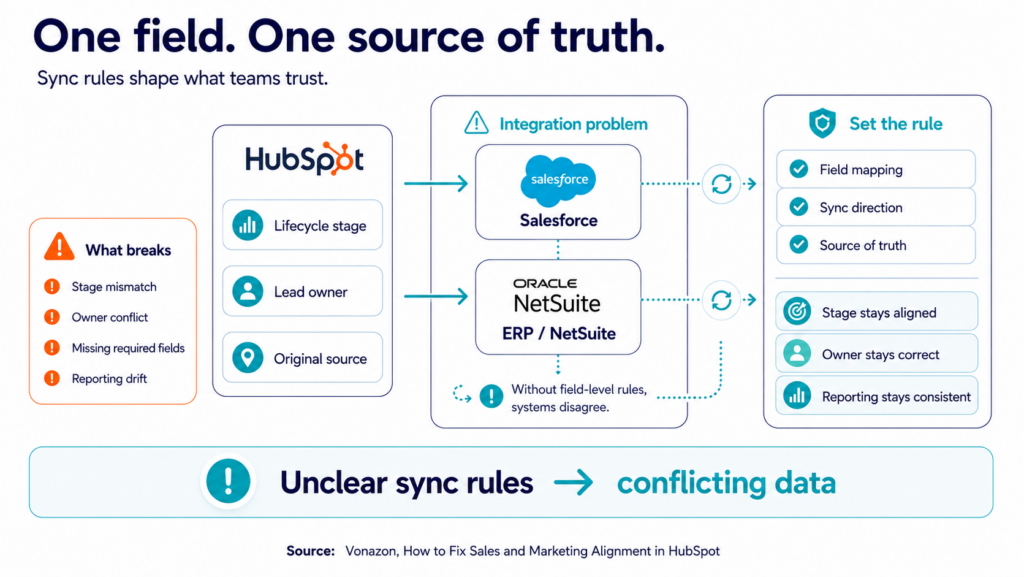
Attribution and reporting inconsistencies frequently trace back to these integration choices. If a lead’s original source is set by an integration on one path and by HubSpot tracking on another, marketing-influenced revenue can look different depending on which system reports it. Documenting sync direction and source of truth per field turns these from recurring mysteries into settled decisions.
Reporting and Measurement Discrepancies
When two dashboards tell different stories, the disagreement is usually a definition problem wearing a reporting costume. A pipeline-created number depends on which deal stage counts as created and which date property anchors it. An MQL-to-SQL conversion rate depends on the very lifecycle definitions discussed earlier. Reconciling reports therefore starts with reconciling the definitions and data sources beneath them.
Metric | Definition that Must be Agreed |
|---|---|
Pipeline created | Which deal stage counts as created, and the anchor date |
MQL-to-SQL conversion | What qualifies as each stage |
Time to first touch | First sales activity counted after handoff |
Marketing-influenced revenue | Which attribution model applies |
A useful practice is to treat every shared metric as having three settled components: an agreed definition, a named data source, and a single owner who maintains it. Attribution deserves explicit attention here, because the choice of attribution model changes marketing-influenced revenue without any change in underlying activity. When both teams have endorsed the model and know where the number comes from, reporting shifts from a source of conflict to a shared instrument.
Sales Enablement: Making Marketing Context Usable
Alignment also depends on whether the context marketing generates is usable by sellers at the moment they need it. Marketing may capture rich engagement signals, build well-researched content, and record account history, yet if none of that is visible on the record where a rep works, the seller effectively starts cold and the marketing effort goes unused.
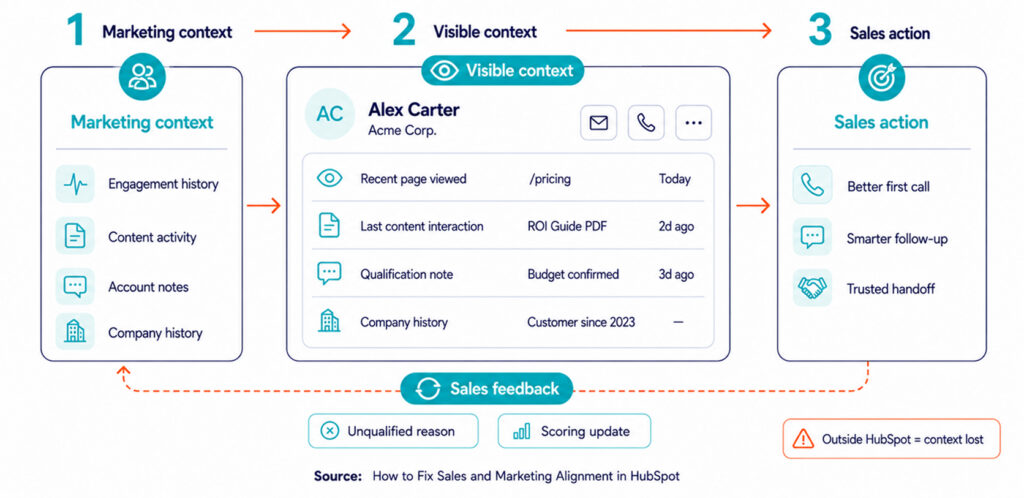
Sales enablement in a HubSpot context is partly a surfacing problem. Engagement history, content interactions, and qualification notes that live on the contact and company records, and that appear in the seller’s normal view, let a rep open a conversation informed by what marketing already knows. Feedback flowing the other way matters just as much: a lightweight, structured way for sellers to mark why a lead was unqualified feeds directly back into scoring and definitions, closing the loop that keeps qualification honest.
CRM adoption underpins all of this. Enablement assets and engagement signals only help if sellers actually work inside HubSpot rather than around it, which is one reason the handoff, the record view, and the reporting all need to feel trustworthy to the sales team, not only to marketing and operations.
Revenue Operations Governance for a Shared System
Most of the fixes described so far share a requirement: someone has to own the shared system rather than only its individual parts. This is the organizing idea behind revenue operations, and its adoption reflects how central that ownership has become.
75%
Gartner has projected that 75% of the highest-growth companies would deploy a RevOps model, positioning revenue operations as the function that governs process, data, and technology across marketing, sales, and customer success.
In practice, RevOps governance over alignment means holding the shared definitions, the handoff configuration, the automation standards, the data controls, and the reporting model as one connected system with clear accountability. When marketing controls one definition and sales uses another while operations maintains the technology without governing the process, the gaps between those responsibilities are exactly where misalignment forms.
Governance does not require a large team. It requires a named owner for each shared decision, a place where definitions and changes are documented, and a regular review where both teams inspect the same numbers. The aim is to make drift visible early, so that a changed MQL definition or a new integration field does not silently reintroduce the friction the organization worked to remove.
The absence of that ownership is often the root cause beneath the visible symptoms. When no one is accountable for how the portal performs as a whole, properties accumulate, workflows evolve without documentation, and reporting definitions drift between teams, and the result reads as a marketing and sales conflict rather than a governance gap. Naming that ownership, in-house or through a partner, is frequently the change that makes the other fixes hold.
A Structured Diagnostic and Remediation Sequence
The specific order will vary by portal, but many teams can make meaningful progress by working through a defined sequence rather than fixing symptoms as they appear. The outline below moves from assessment to shared definitions to handoff to governance, and it is meant to be adapted rather than followed rigidly.
- 1. Audit the current state. Document how lifecycle stages, MQL and SQL criteria, lead status, routing, and key reports are configured today, and where the two teams disagree.
- 2. Reconcile definitions. Agree on a single documented definition for each shared stage and qualification term, and decide who may change it.
- 3. Rebuild the handoff. Configure routing, ownership assignment, notifications, and an SLA reminder so a qualified lead reliably reaches an owner with a response-time expectation.
- 4. Govern the data. Set property-creation standards, deduplication rules, required fields at stage transitions, and source-of-truth decisions for integrated systems.
- 5. Align the reporting. Give every shared metric an agreed definition, a named data source, and an owner, and retire dashboards that contradict them.
- 6. Establish the review. Put a recurring cadence in place where both teams inspect the same numbers and recalibrate definitions, scoring, and workflows as the business changes.
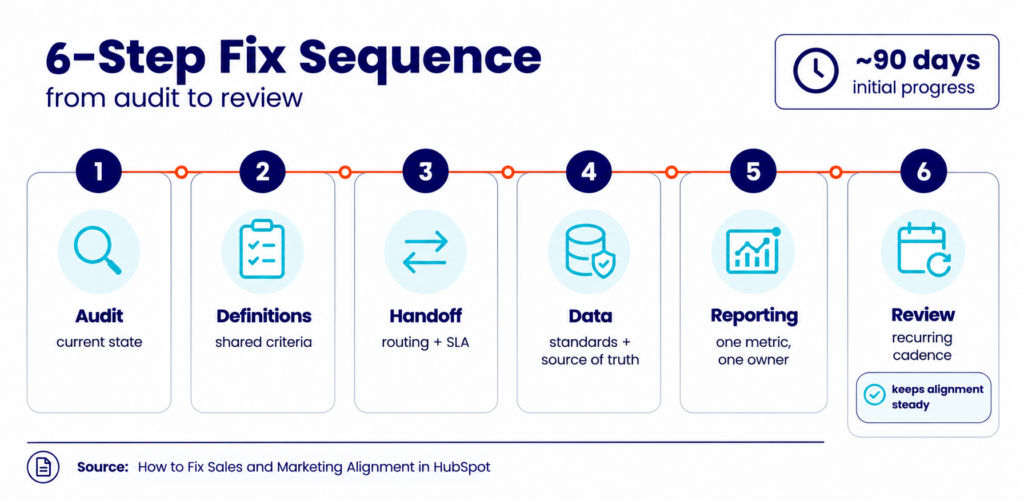
Progress on the first several steps is often visible within a single quarter, though sustained alignment tends to depend on the last step more than the first. Definitions, integrations, and buyer behavior all change, and a portal that was aligned a year ago can drift without the review that catches the change early.
Conclusion
Sales and marketing alignment inside HubSpot tends to come down to a small number of connected conditions: shared definitions both teams endorse, a handoff that reliably assigns and notifies an owner, automation governed against agreed rules, data clean and consistent enough to trust, integrated systems with clear sources of truth, reporting both teams believe, and a feedback loop that keeps qualification honest. None of these is a single feature to switch on. Each is a place where the system should be doing coordinated work, and where a quiet configuration decision may be doing the opposite.
Treated this way, alignment becomes less a matter of getting two teams to like each other and more a matter of governing a shared operating model, which is the work revenue operations exists to do. The organizations that hold that model steady tend to be the ones that revisit it on a regular cadence rather than assuming a one-time fix will last.
For teams facing complex process, data, automation, reporting, or integration problems, an outside assessment can help separate the symptoms from the underlying causes and prioritize the changes most likely to matter. As a HubSpot Elite partner focused on RevOps and implementation, Vonazon works with organizations that want an objective read on their HubSpot environment and a practical path to improving it. The useful next step is usually a clear-eyed diagnosis of the current portal rather than a wholesale rebuild.
Frequently Asked Questions
What causes sales and marketing misalignment in HubSpot?
Misalignment usually forms where the two teams’ processes meet rather than inside either one. Common structural causes include different goals, undefined or unshared lead definitions, data silos between records and systems, a handoff that does not reliably assign and notify an owner, and weak feedback loops that let qualification criteria drift. These can create friction even when both teams intend to collaborate, because the disagreement is encoded in configuration rather than expressed in conversation. The more durable remedies tend to be structural too: shared metrics, documented processes, governed CRM data, clear ownership of definitions, and consistent lifecycle stages that both teams accept.
How do I know if my sales and marketing teams are misaligned?
Several signals tend to appear together. Sales consistently sets aside marketing-generated leads; marketing content and campaigns go unused by sellers; pipeline reports conflict depending on their source; the two teams operate from different MQL definitions; success is measured with competing metrics; and lost opportunities prompt finger-pointing rather than a shared review. Weak lead feedback loops often sit underneath these signs, because without a structured way to report why leads were rejected, neither team can correct course. Where these patterns persist, a HubSpot portal audit and process review, of the kind Vonazon conducts, can help locate whether the cause sits in definitions, routing, data, or reporting before any rebuild begins.
What is a service level agreement between sales and marketing?
A service level agreement (SLA) is a documented commitment that defines what sales and marketing owe each other. On the marketing side, it typically specifies how many qualified leads will be delivered and the criteria those leads must meet. On the sales side, it usually sets a response-time window and a minimum number of follow-up attempts for each qualified lead, along with how compliance will be reported and reviewed. The value comes less from the document than from the shared definitions and accountability it forces. HubSpot’s research on SLAs is consistent with that: among marketers working under an SLA, 85% consider their marketing strategy effective, and organizations with an active SLA are 31% more likely to be hiring additional salespeople to meet demand. Reviewing SLA compliance on a regular cadence tends to matter more than the wording of the initial agreement.
How does HubSpot support sales and marketing alignment?
HubSpot supports alignment mainly by holding marketing and sales activity in one CRM, so lifecycle stages, lead routing, engagement history, sales activity, and reporting can share a single source of data. Automated workflows can move records between stages and assign owners; attribution and funnel reports can show the buyer journey across both teams; and shared dashboards can give each side the same numbers. Whether those capabilities actually produce alignment depends heavily on configuration and governance, since the same workflow that enforces a shared definition can just as easily enforce a private one. Organizations that want these capabilities configured around their specific process, rather than left at defaults, sometimes engage a partner such as Vonazon for HubSpot implementation to align the setup with how their revenue teams actually work.
What metrics should aligned sales and marketing teams share?
Shared metrics work best when they require contribution from both teams and describe joint outcomes rather than departmental activity. Common examples include pipeline velocity, marketing-influenced revenue, lead-to-customer conversion rate, MQL-to-SQL conversion rate, qualified-lead response time, pipeline creation, opportunity conversion, and revenue attribution. The reason these help is less about the specific list and more about where they point attention: a metric that neither team can move alone tends to shift the conversation away from marketing’s numbers versus sales’ numbers and toward the pipeline both teams are accountable for.
How long does it take to fix sales and marketing alignment?
Where the scope is a focused set of foundations, auditing the current state, agreeing on shared definitions, establishing ownership, fixing the basic handoff, and implementing a few core workflows, many teams see initial improvement within roughly 90 days. That figure is a reasonable planning assumption rather than a guarantee. Actual timing varies with portal complexity, the number of integrations, data quality, process maturity, team size, and how much automation already exists. Sustained alignment usually takes longer than the initial fix, because it depends on quarterly reviews, continuous feedback, workflow monitoring, data governance, and periodic recalibration as definitions and buyer behavior change.
What is the difference between an MQL and an SQL in HubSpot?
In HubSpot’s default lifecycle model, a Marketing Qualified Lead (MQL) is a contact marketing considers ready for a closer look, usually based on fit and engagement, while a Sales Qualified Lead (SQL) is one sales has reviewed and accepted as worth active pursuit. The practical difference is ownership and acceptance: an MQL reflects marketing’s judgment, and an SQL reflects sales agreeing with it. Misalignment often appears precisely at this boundary, which is why a shared, documented definition of each, enforced through workflows, tends to matter more than the labels themselves.
How should marketing leads be handed off to sales in HubSpot?
A dependable handoff usually combines four elements: a qualifying trigger both teams accept, an ownership assignment so the record has a clear owner, a notification or task so the owner knows to act, and a response-time expectation so follow-up is timely. In HubSpot, these are typically built with workflows that update the lifecycle stage, rotate or assign owners, create tasks, and send internal notifications. Testing the handoff with a sample contact, and watching whether each step fires, is often more revealing than reviewing the workflows in isolation.
What role does RevOps play in sales and marketing alignment?
Revenue operations provides the ownership that alignment depends on. Rather than leaving definitions, handoff configuration, data standards, and reporting as shared informal habits, RevOps holds them as one governed system with clear accountability. Its role is less about adding technology and more about ensuring the technology encodes definitions both teams have agreed to, and about catching drift before it reappears as friction. In many mid-market organizations, naming that ownership is the change that makes other alignment fixes durable.
Which HubSpot reports can reveal sales and marketing misalignment?
Several standard reports tend to expose misalignment quickly. A lifecycle-stage funnel report can show where contacts stall between MQL and SQL, which often points to a definition or handoff problem. Deal reports filtered by create date and stage can reveal disagreements about what pipeline created means. Sales activity reports can surface slow time-to-first-touch after handoff. And attribution reports can show whether both teams agree on how influence and revenue are credited. Discrepancies among these reports are frequently a symptom of underlying definition and data issues rather than a reporting error on their own.





If your HubSpot setup is creating friction between marketing and sales, the problem usually starts in process, data, and ownership. Vonazon helps teams fix the gaps, improve reporting, and build a HubSpot system your revenue team can trust.