

Inbound vs. Outbound in 2026: What Mid-Market B2B Teams Are Actually Doing That Works
Most B2B deals are decided before a sales rep ever enters the conversation. Research from 6sense, a B2B revenue intelligence platform and HubSpot technology partner, found that:
94%
Read that twice, because it rewrites the job. For a mid-market marketing team, the work that decides the deal happens long before a lead record exists.
That single fact reframes the tired inbound-versus-outbound debate. Inbound helps buyers find and evaluate you on their own terms, while outbound puts your message directly in front of selected accounts and contacts. Most teams already run both, so the channel mix is rarely the thing holding them back. What holds them back is fragmentation: content, outreach, CRM data, and sales follow-up running as four separate programs that happen to share a budget line. A blog post ranks, earns a demo request, and the request sits until Thursday. An outbound sequence hits someone whose company downloaded three assets last month, and the rep has no idea. Marketing counts leads by source. Sales tracks accounts. The numbers never meet.
This post is about closing that gap. Here is where each approach earns its keep, where they depend on each other, and the operational layer that decides whether either one moves fast.
Table of Contents
What the Buying Journey Looks Like Before a Lead Record Exists
If the shortlist forms early, the next question is who forms it, and the answer is not one person.
13
Internal Stakeholders
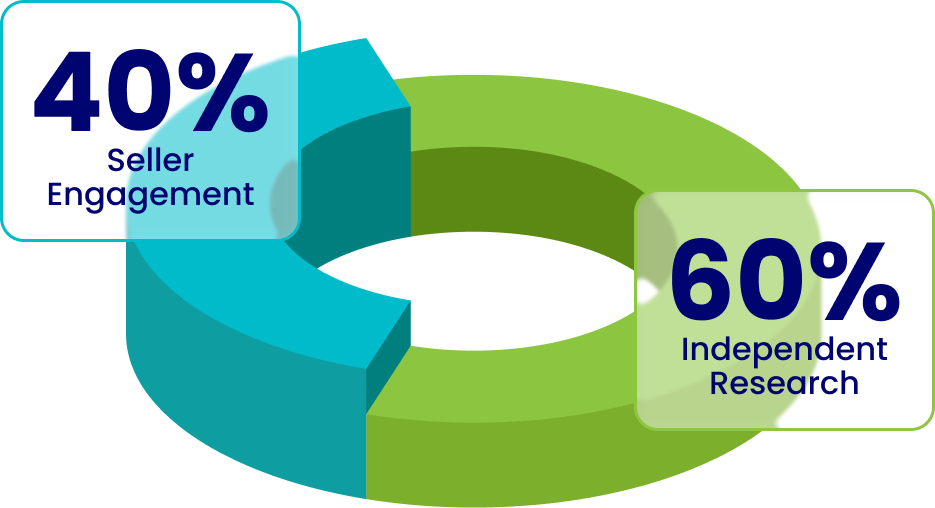
6sense research puts the split at roughly 60% independent research and 40% seller engagement, with buyers reaching out far later than most pipeline models assume.
Who Shapes the B2B Shortlist?
The decision starts before a lead record exists

Shortlists Form Early
Influence happens before a lead record exists..


Who Shapes the Decision?
13
Internal Stakeholders
~9
External Influencers


How Buyers Evaluate

No Single Channel Reaches the Whole Buying Group

Content shapes the problem.

Outreach reaches unseen stakeholders.
The takeaway for a mid-market team is blunt. Most of the influence happens before a lead record exists, and no single channel reaches a group that large. Content shapes how the problem gets defined. Outreach reaches the stakeholders who never touch the website. Both feed the same shortlist.
Where Inbound Marketing Does Its Heaviest Work
Inbound shines in that quiet pre-contact window because it works on the buyer’s schedule. It hands a buying group everything it needs to evaluate a vendor without asking permission, and that material keeps working after hours, on weekends, and inside internal threads no rep can join. The core assets tend to be:
- Search visibility and comparison pages that answer the questions a rep used to field on a call
- Technical documentation and customer stories a champion can forward to a skeptical finance stakeholder
- Community presence and thought leadership that build familiarity before any conversation starts
Inbound Works on the Buyer's Schedule
Buyers can evaluate a vendor before talking to sales.
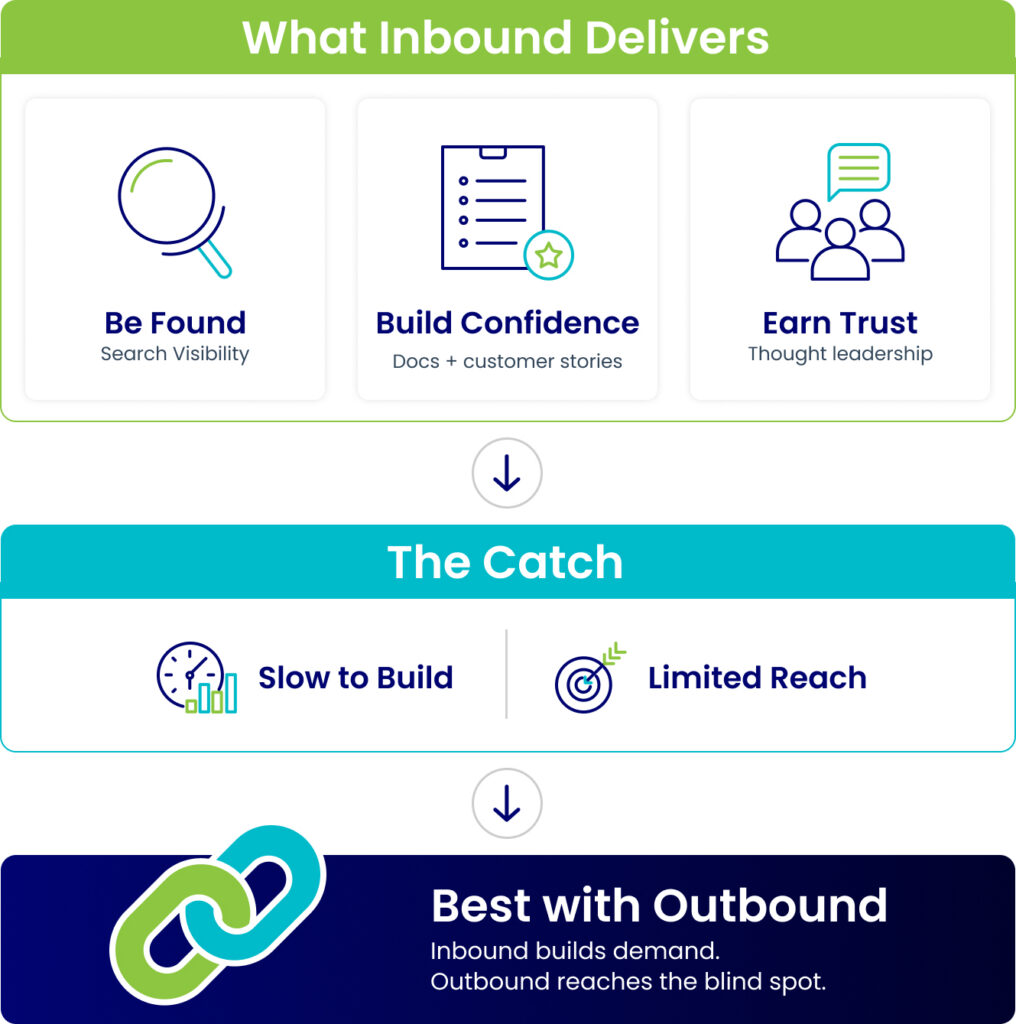
Run a content marketing program as an asset with a roadmap instead of a monthly word-count quota, and the returns compound. An article published two years ago still pulls qualified sessions today, and cost per opportunity improves as the library deepens. The catch is timing. Rankings, authority, and referral habits take quarters to build, which makes inbound a hard thing to lean on when the number is due Friday.
Inbound also has a reach limit. It finds accounts that have already started searching, so the perfect-fit company that has not begun looking never shows up in an inbound report. That is exactly why B2B inbound marketing services work best next to a deliberate outbound motion, and why teams building full-funnel inbound sales and marketing programs plan for that blind spot up front rather than discovering it in a pipeline review.
Where Outbound Earns Its Place
Outbound closes that blind spot. Targeted outreach reaches priority accounts on the team’s clock, which makes it the practical move when a specific segment needs coverage, a new product needs its first conversations, or a quarter needs pipeline that inbound cannot conjure in time.
73%
It burns future goodwill. Sequences anchored to something real, such as a technology change, a hiring spike, an engagement history, or a documented operational headache, hold up far better than blasts built on firmographics alone.
This is also why a well-run account-based marketing program tends to beat spray-and-pray prospecting. The targeting and the message get decided together, and the same account intelligence powers the ad, the content offer, and the first sales email.
The Layer That Makes Both Approaches Faster
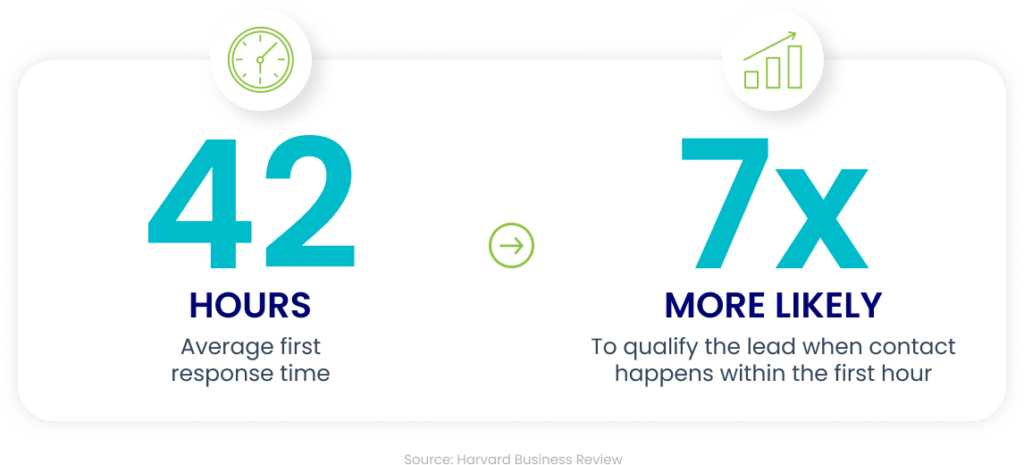
Here is the part most channel debates skip. Neither motion moves fast when the plumbing underneath is a mess, and lead response speed shows it plainly. A classic Harvard Business Review audit of 2,241 companies clocked an average first response of 42 hours among firms that responded at all, and found that companies making contact within the first hour were nearly seven times more likely to qualify the lead. The useful part is where those hours vanish, and it is almost never lazy reps:
- Routing rules that send a lead to the wrong owner, or to no owner at all
- Ownership gaps where nobody is accountable for the first response
- Fuzzy lifecycle definitions that stall the handoff between marketing and sales
- Form submissions dropping into a queue nobody checks on a Friday afternoon
Lead Response Speed Matters
The response window directly affects lead qualification.
Shared data fixes more of this than another headcount ever will. When content engagement, outreach activity, intent signals, and deal history live on the same CRM record, a rep opening an account sees the whole story before typing a word. For teams using HubSpot, that means configuring company, contact, engagement, and deal data to create a shared account view, rather than allowing each team to work from separate records and reports. A working revenue operations practice keeps that record honest, because lifecycle stages, field definitions, and handoff rules drift fast when nobody owns them.
Once the plumbing holds, campaign speed jumps for an unglamorous reason. A launch no longer needs a list export, a hand-built segment, and three approvals across two tools, because the audience already sits in the CRM and the lifecycle logic already routes it. In a platform such as HubSpot, lists, workflows, lifecycle stages, lead scoring, and reporting can support that shared operating model, but only when they are configured around the way marketing and sales actually work. Much of what slows teams here is structural rather than behavioral. Duplicate lifecycle logic across teams, attribution that argues with the sales pipeline, and lead scoring nobody trusts are classic causes of CRM and RevOps misalignment, and they drag on execution no matter how sharp the creative or the targeting.
A Practical Way to Decide the Mix
Skip the argument over budget percentages. A cleaner way to sort demand runs on two questions: how well can the target accounts be named in advance, and how fast is the pipeline needed? The answers usually point in a clear direction.
Lean toward outbound and ABM when | Lean toward inbound when |
|---|---|
Target accounts are easy to name in advance | Demand is hard to predict or name up front |
Pipeline is needed inside the current quarter | There is runway to build over several quarters |
A defined segment or new product needs fast coverage | An emerging or broad horizontal need must be surfaced |
Real portfolios hold both columns at once, and the ratio shifts quarter to quarter rather than sitting still across a fiscal year. The survey data backs the coordinated version. In the Content Marketing Institute’s 2026 B2B research, drawn from 1,015 B2B marketers, 65% of account-based marketing users said those campaigns outperform traditional marketing, and among teams calling their marketing effective, 45% credited alignment with sales. Both numbers describe functions working together, not one channel beating another.
What Coordinated Execution Looks Like in Practice
Teams running inbound and outbound as one program share a few habits worth copying:
- One definition of the ideal customer profile across every content brief and target account list
- Agreed lifecycle stages and clear triggers, so a marketing qualified lead means the same thing to both teams
- Account-level reporting alongside lead-level reporting, so a director can see the content asset that warmed up a deal months before it closed
All of that rests on a CRM that mirrors how the business actually sells. A deliberate CRM strategy separates a system that records activity after the fact from one that routes work the moment it arrives. Configuration carries as much weight as intent. For teams running HubSpot, a careful implementation is usually what turns agreed definitions into automation that survives real volume, especially around lead routing, scoring thresholds, and attribution both teams will trust.
Conclusion
Inbound and outbound answer two different questions about the same market. One asks what the market is trying to solve right now. The other asks which specific accounts are worth chasing today. Treating them as rivals for budget misses the real story, because the payoff from either one rides on the operational layer they share.
For most mid-market B2B teams heading through 2026, the gains hide in that connective layer. Content that frames how a buying group defines its problem, outreach that reaches the stakeholders a website never will, intent signals that flag an account before a form is filled, and follow-up quick enough to matter all pull from the same CRM record, the same lifecycle definitions, and the same account view. Wire them together and the two motions build more pipeline than either does alone, and they fire faster because the audience, the routing, and the reporting already exist.
If your team runs HubSpot and the gap feels like it lives in that shared layer rather than the channel mix, an audit and health check is a practical place to start. It surfaces where routing, lifecycle logic, and attribution are dragging campaigns down. To map exactly where inbound and outbound are coming apart in a real pipeline, schedule a consultation with Vonazon.
Frequently Asked Questions
How long does inbound marketing take to produce pipeline?
Think quarters, not weeks. Search rankings, domain authority, and referral habits compound gradually. A single asset can pull qualified traffic within a couple of months if it nails a specific buyer question, but dependable pipeline usually shows up once the library covers a topic with real depth. That slow start is exactly why inbound struggles to rescue a quarter closing short, and why it pairs so naturally with a faster outbound motion.
Can a small marketing team realistically run both motions at once?
Yes, as long as the shared layer is in place. The real constraint for a lean team is rarely creative firepower. It is the manual grind of exporting lists, rebuilding segments, and reconciling reports across tools. Park lifecycle stages, target account lists, and attribution in one CRM, and a small team can run both because the setup handles the routing. A revenue operations foundation is what makes that work without new hires.
How do buyer-intent signals fit into an inbound and outbound strategy?
Intent signals flag accounts researching a problem before they ever fill out a form, which lets a team choose the right touch: content, outreach, or a blend of both. Handled well, they turn two separate motions into one sequence. An account showing early research interest gets relevant content first and a well-timed sales conversation later. The whole thing only works if those signals land on the same CRM record the sales team already lives in.
Where should a team start when connecting the two motions?
Start by tracing how leads move through the system today: routing rules, lifecycle definitions, scoring, and the marketing-to-sales handoff. Cracks in those mechanics are what slow campaigns, and they surface fast in a HubSpot audit and health check before a single new asset or sequence gets built. Fix the mechanics first, and everything that runs afterward returns more.
Does AI change how mid-market teams choose between inbound and outbound?
AI has pushed even more of the journey into self-directed research, which raises the stakes on being discoverable early and reaching buying groups before a favorite is locked in. It does not crown one motion over the other so much as reward coordination between them, since buyers now form opinions across content, peer chatter, and AI-assisted research long before a sales call. The smart response is stronger fundamentals in both motions, not a bet on one.



If routing, lifecycle logic, attribution, or sales handoffs are slowing pipeline, a HubSpot audit can uncover where the two motions are coming apart and what needs attention first.