Table of Contents
What is the contract object in HubSpot, and what does it not replace?
The contracts object is a native CRM record that holds committed revenue after a quote is accepted. It carries current terms, renewal dates, and billing details, linking to invoices, subscriptions, and payments. It represents the live commercial commitment, not a signed legal file.
- Deal = the opportunity being pursued
- Quote = the commercial offer
- Contract = the current commercial commitment
- Invoice = the amount due
- Payment = the amount collected
A contract does not replace an executed legal agreement such as an MSA. It models the revenue commitment, while signed legal terms stay in the documents built for them. For a fuller view of how contracts work in HubSpot, the object ties committed revenue to the customer record.
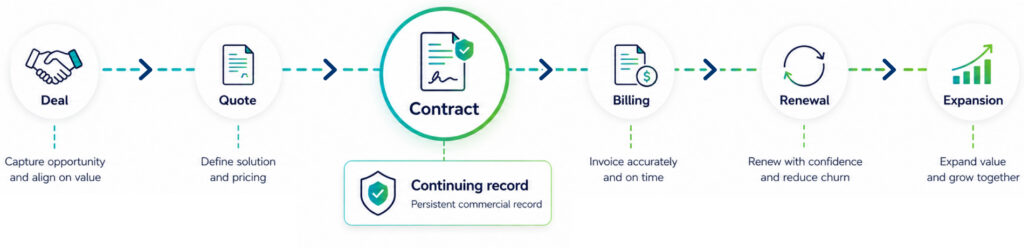
Connected Commercial Lifecycle
How the contract becomes the continuing commercial record from deal through expansion
How do HubSpot contracts improve renewals, expansion revenue, and recurring revenue reporting?
When an accepted quote creates a contract, that active commercial agreement can give renewal visibility before the term ends. It can capture amendments through change quotes, reflect expansion against the current commitment, and connect recurring revenue metrics to a shared revenue history. Reporting then reads from committed terms, not a static Closed Won snapshot.
Why shouldn't the Closed Won deal remain the permanent revenue record?
A Closed Won deal records what was sold on one date. It does not update when seats change, terms shift, or the customer renews. The contract keeps the current commitment accurate, reflecting what the customer has now, not only what closed months ago.
What happens when a quote is accepted?
When a quote is accepted, HubSpot can create the associated contract, capturing the commitment as the customer agrees. The contract then carries the committed terms and a billing schedule, not a static deal.
The flow sits inside HubSpot Revenue Hub, HubSpot’s quote-to-cash system. Once the contract exists, its billing schedule, invoices, and renewal date attach to the record. The deal still answers what was won. The contract answers what is true now.
How do HubSpot contracts change renewals?
Contracts can move renewal planning from spreadsheet tracking toward the CRM record. Because the contract holds the renewal date and current terms, the renewal window sits inside HubSpot, not a separate file. An accepted renewal quote can then create a new contract, linked to the prior one, which preserves the history.
Timing is the point. In HubSpot’s research, 91% of revenue leaders agree expansion opportunities should be visible before renewal, not after. Visibility still depends on governance, since dates and terms are only as reliable as the data entered.
What happens when customers expand mid-term?
A change quote can update the existing contract rather than opening a new standalone deal, with changes applying after the quote is accepted. If proration is selected, HubSpot can prorate charges and credits for the remaining billing period. The current commitment and its history stay in one place.
Original
100 seats x $100 =
$10,000 MRR
Expansion
+25 seats =
+$2,500 MRR
Current commitment
$12,500 MRR
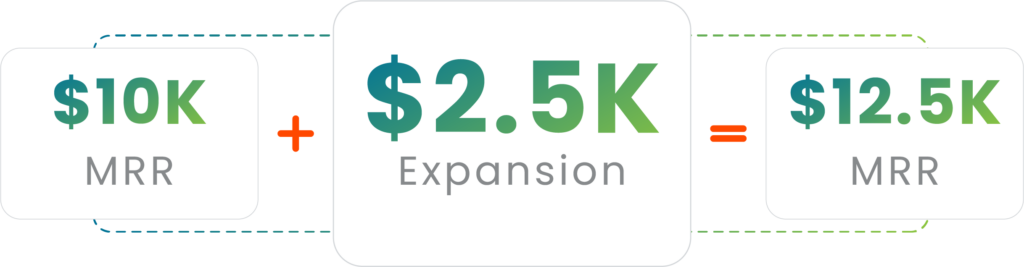
The path runs expansion deal, change quote and proration, contract update, then reporting. What shifts is less the arithmetic and more the commercial history: the contract shows $12,500 now while retaining the original $10,000 context.
Expansion Value Progression
How expansion value increases monthly recurring revenue.
Can contract changes explain why ARR and MRR moved?
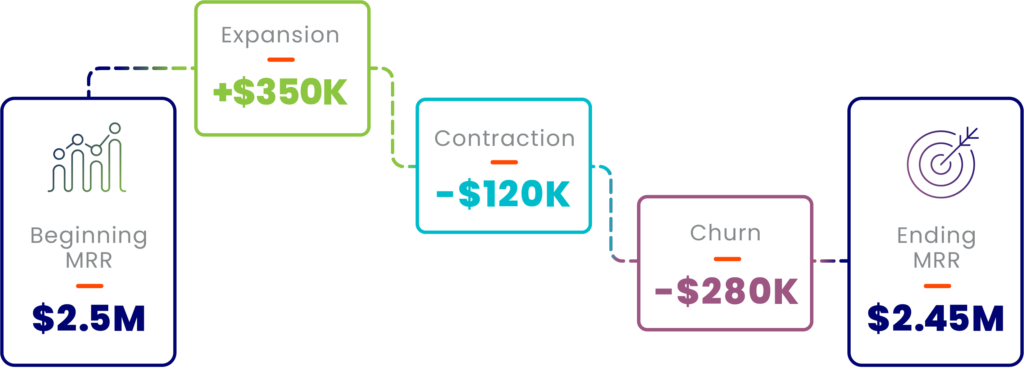
Snapshot reporting shows a number at a point in time. Movement reporting explains how it got there. Contract changes supply the cause: expansion, contraction, churn, renewal, or new recurring revenue, each carrying an effective date and a recorded change in monthly recurring revenue.
The contract record supplies the reason behind the delta, not just the delta. Beginning MRR of $10,000, an expansion of +$2,500, and current MRR of $12,500 read more clearly when each move is attributable.
Revenue Question | Best Data Context |
|---|---|
What was originally sold? | Deal plus accepted quote |
What is currently committed? | Contract |
What changed? | Change quote plus contract history |
What renews next? | Contract plus renewal deal |
Why did MRR increase? | Expansion plus contract change |
Two caveats matter. Not every recurring-revenue metric is automatic, since some analytics depend on portal tier and configuration. And committed contract value is a commercial figure, not recognized accounting revenue. HubSpot does not replace an ERP, a general ledger, or formal revenue recognition.
MRR Movement Waterfall
How expansion, contraction, and churn move recurring revenue from beginning to ending MRR.
Deals or contracts: Which record should answer which revenue question?
Deals and contracts answer different questions. The deal owns the pursuit and the win. The contract owns the live commitment and its changes. Treating one as the other is what produces competing revenue numbers.
Object | Question it Should Answer |
|---|---|
Deal | What opportunity are we pursuing? |
Quote | What are we offering? |
Contract | What has the customer committed to? |
Invoice | What is owed? |
Payment | What has been collected? |
Is revenue reporting a dashboard problem or a data-model problem?
Often it is the data model. Conflicting numbers usually trace to revenue context living apart from the customer record, not to the dashboard itself. When committed terms, changes, and billing attach to one contract, reporting gains a single place to read from.
In HubSpot’s State of B2B Revenue report, 78% of revenue leaders spend significant time reconciling revenue data monthly. This is where HubSpot contracts change the reporting question.
Could contract-centered reporting reduce the number of competing revenue truths? It can narrow them, but reconciliation will not disappear. That gap often surfaces first when consolidating fragmented revenue data.
What should RevOps configure before trusting contract data?
Contract data is only as trustworthy as the setup behind it. Before reporting from contracts, RevOps needs product and pricing governance, clear ownership, agreed metric definitions, and a migration plan. Weak governance turns a new object into another conflicting number.
- Product, pricing, and line-item governance
- Renewal and expansion pipeline design
- Contract ownership and billing ownership
- Agreed ARR and MRR definitions
- Integrations and a historical migration plan, often handled during HubSpot onboarding
Each item is a setup decision, settled before contracts become a reporting source.
Where can contract reporting go wrong?
Even with a clean object, reporting can drift when the data behind it is inconsistent. The common failure points are predictable, and most trace back to weak governance rather than the contract object itself.
- Old manual ARR fields left in place
- Expansion deals that never update the contract
- Inaccurate renewal dates and inconsistent product setup
- Disconnected billing systems and weak user adoption
Could another CRM object simply add another conflicting revenue number when governance is weak? Without ownership and shared definitions, yes. The stakes reach beyond dashboards.
In HubSpot’s research, 72% of leaders say their AI tools lack access to integrated, accurate revenue data. That points to a governance gap before a tooling one.
Clean structure also preserves operational leverage from a HubSpot portal.
What changes when the contract carries the revenue story forward?
What was sold? What is committed now? What changed? What renews next? Why did MRR move? Can the number be reconciled? A connected contract record can reduce how many systems a revenue team reconciles to answer those questions. Different objects still hold different roles. HubSpot contracts do not remove the need for governance, definitions, or a clean data model. They also do not replace signed legal agreements or an accounting ledger. Used with that discipline, they can carry the commercial record past Closed Won, so renewals, expansion, and recurring revenue reporting read from connected context. For teams planning that shift, it is an architecture decision as much as a tooling one. That is where HubSpot implementation services earn their keep.

How much revenue context disappears after Closed Won?
If renewals, expansion, billing, and recurring revenue reporting still depend on manual reconciliation, the issue may sit in the revenue architecture, not the dashboard. A short review of how deals, contracts, and billing connect often surfaces where context leaks, and what a contract-centered model would change.
FAQs
What are HubSpot contracts?
They are a native CRM object that records committed revenue once a quote is accepted. Each one holds current terms, renewal dates, and billing links, recording what a customer has agreed to.
Do contracts replace deals in HubSpot?
No. Deals track the opportunity and the win, while contracts track the commitment that follows. Both objects stay in use, each answering a different revenue question.
Can the contracts object manage renewals?
It supports renewal visibility by holding the renewal date and current terms in the CRM. An accepted renewal quote can create a new contract, linked to the prior one, keeping the history connected.
Can contracts track expansion revenue?
Yes. A mid-term change quote can update the contract. If proration is enabled, an added 25 seats worth $2,500 MRR reflects against the current commitment, not a separate deal.
Can HubSpot contracts report ARR and MRR?
Contract data can support recurring-revenue metrics like ARR and MRR, though the output depends on configuration and data quality. Commercial ARR and MRR are not the same as formal accounting revenue recognition.
Do contracts replace signed legal agreements?
No. A contract models the committed revenue and its changes. Executed legal terms, such as an MSA, still belong in the documents and systems built to hold them.