FOR MARKETING OPERATIONS & REVENUE LEADERS
Marketo got you this far. What’s the right next step for your team?
You don’t need a massive platform migration to fix friction, manual steps, or reporting gaps. Whether the right answer is optimizing your current setup, connecting HubSpot alongside it, modernizing in stages, or migrating fully, we help you make an objective, data-backed choice.

KEY PRINCIPLE
No assumption that replacement is the answer. Get an objective roadmap built for your specific environment.

Proof from a completed Marketo-to-HubSpot migration
783 Hours
Saved annually in manual workarounds
$30K+
50% Lower
In customized fields
& clutter
4 into 1
Nurture campaigns consolidated into one workflow
Results are specific to this environment and are not a guarantee of outcomes for every migration. View the full case study.
Common operational friction points
These are common signs of operational friction. None of them automatically means Marketo needs to be replaced. They are signals worth evaluating.

Single-Admin Dependency
“Only one person knows why this Smart Campaign exists.”

Slow Campaign Launch Times
“Updating a scoring model requires QA across dozens of Flow steps.”
Fragmented Reporting
“Getting full revenue attribution means stitching Marketo data with CRM spreadsheet exports.”

Tool Overlap & Middleware
“We’re paying third-party tools to force Marketo to talk to our stack.”

Find the path that best matches the friction you are seeing
Start with the issue that feels closest to your current situation. The page will surface a path to explore and explain when it may fit. The evaluation determines the right recommendation for your specific environment.
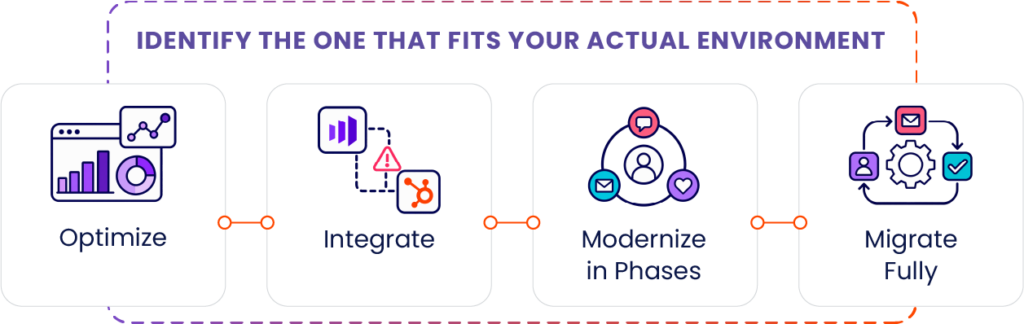
Optimize the current environment
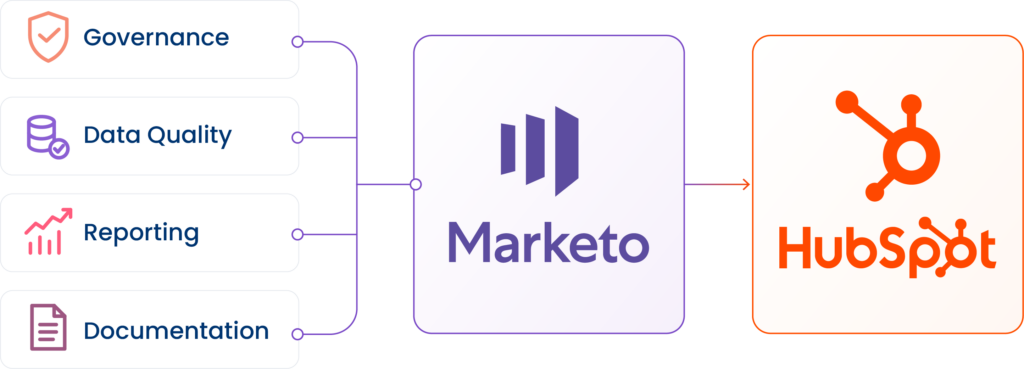
Improve governance, data quality, reporting, documentation, and automation within the Marketo environment you already have.
bEST WHEN
Marketo still supports your core programs, but administration, Smart Campaign complexity, reporting, or data quality have become harder to manage as the environment has grown.
Could Include
Marketo still supports your core programs, but administration, Smart Campaign complexity, reporting, or data quality have become harder to manage as the environment has grown.
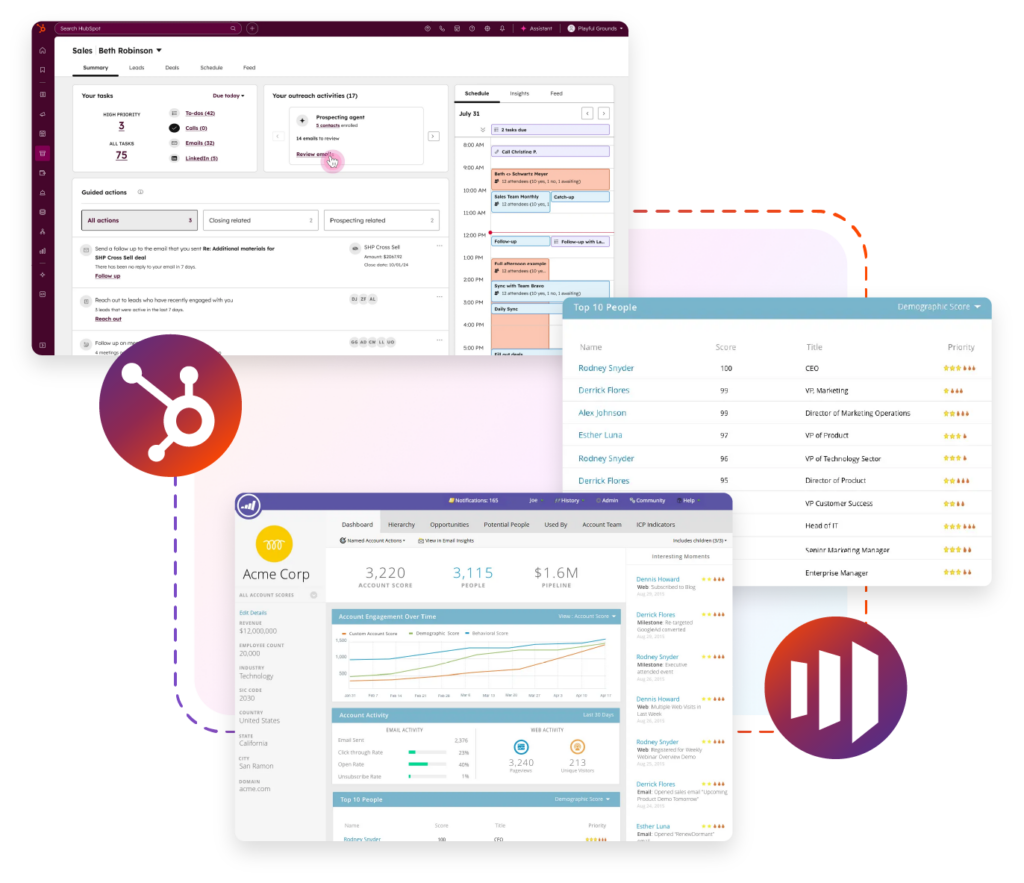
Integrate Marketo with HubSpot
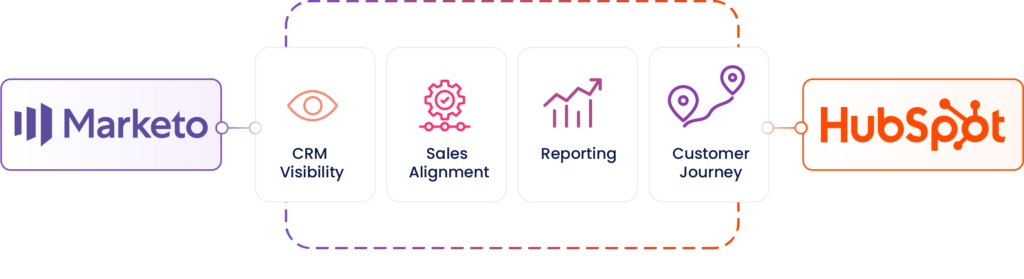
Keep Marketo where it continues to work while connecting HubSpot to support CRM visibility, reporting, sales alignment, service, or other customer-facing functions.
Best When
Established Marketo programs should remain in place, but disconnected systems, reporting gaps, or other parts of the customer journey need to become more connected.
Could Include
System ownership • field mapping • lifecycle alignment • integration architecture • cross-platform reporting
Modernize in phases
Move selected lifecycle stages, campaigns, teams, or customer touchpoints into HubSpot while established Marketo programs continue to run.
Best When
The customer journey needs to become more connected, but a full platform change would introduce unnecessary risk or disruption.
Could Include
Pilot programs • phased migration • parallel operation • staged data and asset movement • team enablement
Migrate fully to HubSpot
Consolidate marketing, CRM, automation, and reporting onto HubSpot when the benefits of simplifying the environment justify a full platform transition.
Best When
Administration burden, reporting complexity, integration overhead, usability, cost, or an upcoming renewal makes it worthwhile to evaluate full consolidation.
Could Include
Data and asset rationalization • Smart Campaign reconstruction • integration planning • testing • cutover • team training
Compare all four paths
Optimization, integration, phased modernization, and full migration are all legitimate options. The goal is to identify the one that fits your actual environment.
Best when you know something in the current environment needs to change, but the source of friction or the right technology path is not yet clear.
The Marketo Modernization Evaluation is designed for this exact situation. It starts with the environment you have today and recommends a path based on evidence, not a predetermined migration outcome.
HubSpot is worth a second look
If your impression of HubSpot was formed several years ago, the platform is worth reassessing. HubSpot has evolved into a CRM-native platform designed to connect marketing, sales, and service around the same operational data.
Objects, associations, and a CRM-native data model:
Contacts, companies, deals, and custom objects can be related within the same platform, reducing some of the workarounds that account-level and multi-stakeholder reporting can require.
Workflow automation with native code actions:
Visual workflows can include custom code actions where needed, reducing dependence on external scripts or on a single specialist who understands the full chain of logic.
Reporting built on the same data model as the CRM:
Marketing, sales, and service data can be reported from the same operational system rather than requiring as many exports and reconciliations across tools.
A broader app ecosystem and documented API access:
A wide partner ecosystem and documented API access can reduce, though not always eliminate, the need for custom middleware.
OBJECTIVE. ADVISOR-LED. NO HARD SELL.
Request your Marketo Modernization Evaluation
An objective, 20-minute review of your Marketo environment to determine whether the right next step is optimization, integration, phased modernization, or migration.
Customized 4-Path Assessment:
Which path makes the most sense for your tech stack.
Dependency & Risk Map:
Identification of hidden CRM, API, data, or Smart Campaign bottlenecks.
Actionable Next Steps:
Practical, prioritized recommendations with no hard-sell pressure.
Common Questions About Marketo Modernization
Do we have to be ready to leave Marketo to talk to Vonazon?
No. The evaluation is designed to identify the right path. That may mean optimizing the Marketo environment you already have, integrating it with HubSpot, modernizing selected processes in phases, or evaluating a full migration.
Can Marketo and HubSpot operate together?
Yes. Many organizations can run both platforms for an extended period when each has a clearly defined role. The important questions are system ownership, data synchronization, lifecycle alignment, consent, and reporting governance.
Does all of our Marketo data and all of our assets need to move if we migrate?
Not necessarily. A migration should not automatically recreate years of accumulated fields, lists, programs, and workflows. Part of the evaluation is determining what still creates value, what should be redesigned, and what can be retired.
What happens to Smart Campaigns, scoring models, and nurture programs in a migration?
They should be evaluated before they are rebuilt. The goal is to preserve the business logic that matters without reproducing unnecessary complexity one-for-one in HubSpot.