


Marketo vs. HubSpot When Is It Time to Make the Move?
Table of Contents
Marketing Automation Is Only Part of the Decision
Connected Data Makes Reporting More Useful
Platform Consolidation Can Create More Value Than Another Feature
Where Marketo Still Has an Edge
Moving to HubSpot Doesn’t Mean Recreating Marketo
What Does a Real Marketo-to-HubSpot Migration Look Like?
A Few Questions Worth Asking Before You Decide
Introduction
Marketo is powerful. HubSpot is easier to operationalize. That’s the short version of this comparison, and if you’re already evaluating a move, it’s probably the version that matters most.
For years, Marketo has been a go-to choice for sophisticated B2B marketing teams. It’s flexible, powerful, and capable of supporting complex programs at scale.
But the marketing technology landscape has changed.
HubSpot has evolved well beyond its roots as an inbound marketing platform. Today, it brings CRM, marketing, sales, service, content, data, automation, and AI together around one connected customer platform. For many organizations, that changes the Marketo versus HubSpot conversation completely.
The decision is no longer simply about which platform has the better marketing automation features.
It’s about which platform makes it easier for your business to turn customer data into action, without carrying operational drag: the ongoing tax of specialists, workarounds, and reconciliation work a platform quietly requires just to keep running.
There are still situations where Marketo makes sense, particularly for organizations with highly specialized marketing operations teams, deeply established Adobe environments, and unusually complex automation requirements. But for many B2B organizations, HubSpot now offers a more compelling combination of sophisticated automation, connected customer data, usability, and cross-functional adoption.
That matters because marketing automation doesn’t create much value if every change requires an administrator, reporting lives somewhere else, sales can’t easily see what marketing is doing, or your team has to move between multiple platforms to manage the customer journey.
Marketing Automation Is Only Part of the Decision
Marketo built its reputation on automation, and rightly so. Smart Campaigns, scoring, segmentation, lifecycle programs, tokens, triggers, and detailed program structures give experienced marketing operations teams a tremendous amount of control.
HubSpot takes a different approach. Its workflows can automate nurturing, scoring, segmentation, lifecycle management, internal processes, sales handoffs, customer communications, and other actions using data that already lives within the CRM.
Both platforms can build sophisticated automation. The difference becomes more noticeable when you ask what happens outside the campaign.
Who owns the lead after marketing qualifies it? Can sales see the engagement that led to the handoff? Can customer service see the same record? Can an executive connect marketing activity to opportunities and revenue? Can someone on the marketing team make an ordinary workflow change without waiting for a specialist?
This is where HubSpot’s broader platform model starts to matter.
The CRM Changes the Equation
Marketo is primarily a marketing automation platform. It’s designed to integrate with a CRM. HubSpot is built around one.
That distinction can have a major operational impact. When marketing, sales, service, website activity, campaigns, lifecycle data, pipeline, and customer interactions are connected to the same CRM foundation, teams spend less time reconciling systems and more time using the information inside them. That can improve everything from lead routing and sales handoffs to segmentation, attribution, forecasting, and customer experience.
For an organization already committed to a highly developed Salesforce architecture, Marketo may still fit naturally. But if your business is questioning why so many customer-facing processes require separate platforms, integrations, administrators, and reporting layers, HubSpot deserves a closer look.
The pattern shows up in HubSpot’s own published research on customers switching from other platforms: users report meaningful reductions in time spent on manual work, and a large majority say they were productive on the platform within a month of onboarding, a sharp contrast to the specialist-dependent ramp-up that heavily customized Marketo environments often require. Those are vendor-reported figures, worth treating as directional rather than independent, but they’re consistent with what a connected-CRM model would predict, and with what we’ve seen firsthand in our own client migrations.
Complexity Has a Cost
Complexity isn’t automatically bad. Sometimes it’s necessary. The problem is paying for complexity your business doesn’t actually need.
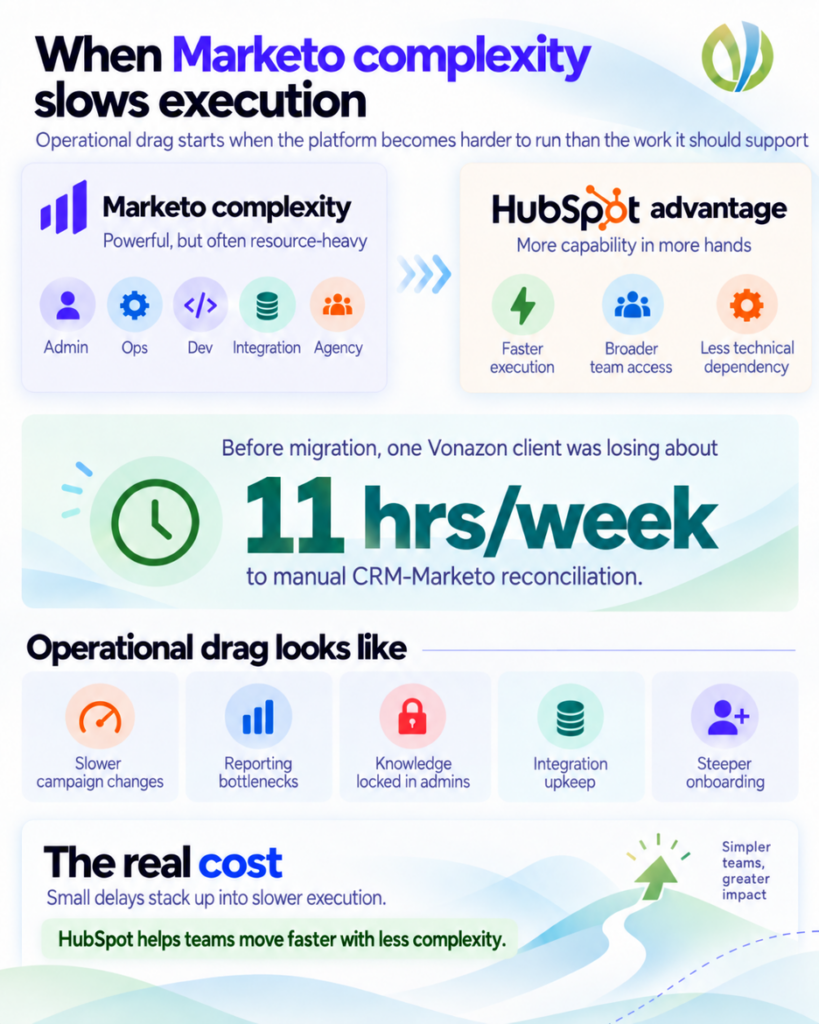
A highly customized Marketo environment can require experienced administrators, marketing operations specialists, developers, integration support, or agency resources to maintain it effectively. That may be completely appropriate for a global organization running extremely complex marketing operations. It can also become a bottleneck.
Campaign changes take longer. Reporting depends on a smaller group of people. Institutional knowledge accumulates inside individual administrators. Integrations require ongoing attention. New employees face a steeper learning curve.
Over time, the platform can begin dictating how the team works rather than supporting how the team wants to work. That’s operational drag, and it’s easy to underestimate because it shows up as a dozen small delays rather than one obvious cost. One Vonazon client was losing about 11 hours a week to manual reconciliation between Marketo and their CRM before they migrated, a routine task nobody had budgeted for when they first built the integration. More on that below.
HubSpot’s advantage isn’t simply that it’s “easier.” The more important advantage is that sophisticated capabilities can often be put into the hands of more people, which tends to translate into faster execution and less dependency on specialized technical resources.
Connected Data Makes Reporting More Useful
Marketing teams rarely struggle because they lack reports. They struggle because the data behind those reports lives in different places.
Marketing engagement may sit in one platform. Opportunity information lives in the CRM. Revenue data is somewhere else. Website behavior is tracked separately. Different teams use different definitions for lifecycle stages, sources, campaigns, and attribution.
At that point, adding another dashboard doesn’t solve much. It’s more operational drag dressed up as a solution.
HubSpot’s connected CRM model gives organizations an opportunity to simplify that architecture. Marketing activity can be tied to contacts, companies, deals, campaigns, pipeline, and revenue within the same ecosystem. That doesn’t magically fix poor data governance, but it removes some of the technical distance between marketing activity and business outcomes.
Marketo offers sophisticated reporting capabilities as well, particularly in mature enterprise environments with the right surrounding architecture. The real question is how much architecture your organization wants to maintain in order to get the answer.
Platform Consolidation Can Create More Value Than Another Feature
Feature comparisons tend to make Marketo and HubSpot look closer than they feel in practice.
Both can send email. Both can score leads. Both can nurture prospects. Both can automate campaigns. Both can segment audiences.
The larger difference is how many other systems need to surround the marketing automation platform.
HubSpot can bring CRM, marketing, sales, service, content, website management, reporting, automation, customer data, and other capabilities into a connected environment. That doesn’t mean every organization should replace every application it owns with HubSpot. It does mean the organization can be more intentional about which systems actually need to remain separate.
For businesses trying to simplify their technology stack, reduce integration dependencies, and create a more connected customer experience, that can be a much bigger advantage than winning an individual feature comparison. Fewer systems to reconcile is, in practice, the most direct way to cut operational drag.
Where Marketo Still Has an Edge
Marketo remains a very strong platform for organizations that genuinely need highly granular marketing automation and have the operational infrastructure to support it.
A large global enterprise with dedicated Marketo administrators, deeply established campaign architecture, complex scoring and segmentation models, extensive Adobe investments, and tightly integrated enterprise systems may have good reasons to stay where it is.
The important word is need. A platform shouldn’t remain complicated simply because the organization has become accustomed to managing the complexity. If the capabilities that once justified Marketo are no longer differentiating your business, it’s worth asking whether the operating model still makes sense.
Moving to HubSpot Doesn’t Mean Recreating Marketo
One of the biggest mistakes in a Marketo-to-HubSpot migration is treating the project like a copy-and-paste exercise. It isn’t.
Your Marketo instance contains years of decisions. Some are still valuable. Some were workarounds. Some exist because of former processes, old integrations, legacy campaigns, previous employees, or technology limitations that no longer apply.
A migration creates an opportunity to decide what should actually move forward. That means evaluating your data structure, lifecycle stages, segmentation, scoring, campaigns, workflows, forms, landing pages, integrations, reporting, attribution, suppression rules, and active programs before rebuilding them.
The goal shouldn’t be to reproduce Marketo inside HubSpot. The goal should be to preserve what works, improve what doesn’t, and design the new environment around how your business needs to operate now.
That’s also why a Marketo migration is more than a data transfer. The operational logic inside programs, automations, integrations, and lifecycle processes has to be understood and deliberately rebuilt.
What Does a Real Marketo-to-HubSpot Migration Look Like?
This is where the decision becomes less theoretical. Here’s what removing operational drag actually looked like for one Vonazon client, an enterprise cloud services company:
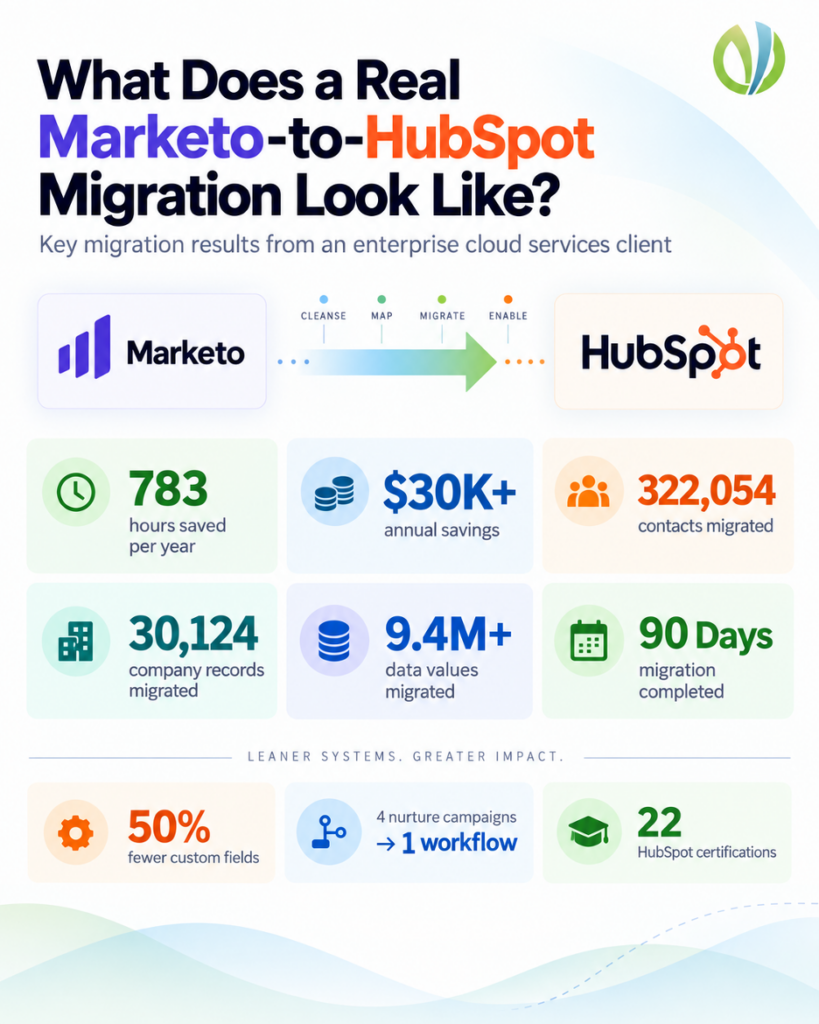
The backstory: a CRM switch had broken the client’s existing Marketo integration, and the team had been relying on a third-party tool just to keep Marketo and the new CRM in sync, a manual process that was costing them about 11 hours a week, the same operational drag described above. The internal team also completed 22 HubSpot certifications during the transition.
That’s the part of migration planning that feature comparison charts can’t show you: real deadlines, real data volumes, and a real reduction in the manual work required to keep systems talking to each other.
Related case study: See how Vonazon approached this Marketo-to-HubSpot migration.
A Few Questions Worth Asking Before You Decide
Does moving to HubSpot mean giving up advanced automation?
No. HubSpot’s workflow engine can handle the same nurturing, scoring, segmentation, and lifecycle logic Marketo does. What changes is where that logic lives: inside the same system your CRM, sales, and reporting already run on, rather than in a platform your CRM has to integrate with.
Is a Marketo-to-HubSpot migration risky?
It carries the same risk any platform migration does if it’s treated as a lift-and-shift. The risk drops considerably when the migration starts by mapping what your current environment actually does, not just what it contains, before anything gets rebuilt.
What Your Organization Could Do Differently
For a growing number of organizations, HubSpot presents a strong long-term case: sophisticated marketing automation, better adoption, connected marketing and sales, simpler reporting, less administrative dependency, and a more unified view of the customer.
Marketo can still be the right platform when its added complexity is genuinely supporting requirements your business needs. But complexity should have to earn its place.
If your team is maintaining multiple systems, leaning on specialist resources to make routine changes, or struggling to connect marketing activity to revenue, you’re carrying operational drag whether or not you’ve put a name to it. The more useful question isn’t whether HubSpot can replace Marketo. It’s how much of that drag your team could shed once it does.



Don’t start by rebuilding campaigns. Start by understanding what you have.
Vonazon can help evaluate your existing Marketo environment, including CRM architecture, data, automation, integrations, reporting, and active programs, to determine what should be migrated, rebuilt, redesigned, or retired. That gives you a migration plan based on the business you want to operate going forward, not the system you happen to be leaving behind.