A demo request, trial or product signal can look like buying intent. The harder question is whether your GTM system knows what should happen next.
At 9:07, someone requests a demo.
At 9:11, another person from the same company starts a trial.
At 9:14, a third visitor returns to the pricing page.
By 9:18, the trial user has invited three teammates.
That sounds like momentum.
Except marketing sees the form submission. Product sees the trial activity. Salesforce has the account history. Sales has a task queue. And nobody has quite the same version of what is happening.
Four signals. One account. Several systems. No obvious next move.
This is where a lot of software go-to-market systems break down.
The problem is rarely that the company lacks data. Software businesses generate signals everywhere: website visits, demo requests, trial registrations, content engagement, CRM activity and, where there is a product-led motion, activity inside the product itself.
The harder problem is turning those signals into a decision.
HubSpot has started talking about this explicitly through the idea of a signal-to-action system:1
- using data and automation to identify buyers
- detect intent
- trigger the right action at the right time
That idea fits naturally with HubSpot’s broader GTM methodology. Its Go-To-Market Playbook begins with Product-Market-Channel Fit, then connects the buyer journey, route to market, launch execution, cross-functional alignment and measurement. 2
But there is an execution layer underneath all of it.
What happened? What does it mean? Who should act? And what happens next?
That is the real software GTM engine.
The Problem Isn't Getting More Signals
Software companies are unusually good at generating activity.
A buyer can read an article, watch a webinar, visit the pricing page, request a demo, start a trial, invite a teammate, connect an integration and return to the website before they ever speak with a salesperson.
But activity is not automatically intent. And intent is not automatically qualification.
A demo request from an enterprise account is different from a trial registration by a student. A pricing-page visit from an existing customer is different from the same visit by a new prospect. A trial user inviting five colleagues may be meaningful. Or it may simply be normal onboarding behavior.
The system needs context before the signal becomes useful.
HubSpot forms can create or update CRM records and initiate follow-up actions after a submission. 3
Its current form-shortening capability can also use enrichment data to reduce the number of fields a visitor has to complete while still capturing useful contact and company information. 4
For a software company, that opens up a better question than “How many fields should be on the form?”
What information do we need to know what should happen next?
What motion produced the request: demo, trial, freemium or another conversion?
Which product, plan or use case is involved?
What role does this person play?
Which company or account are they associated with?
Is this a new prospect, an existing customer or a partner?
What happened immediately before the request?
And if the product itself is part of the buying motion, you may also need to know what happened after signup.
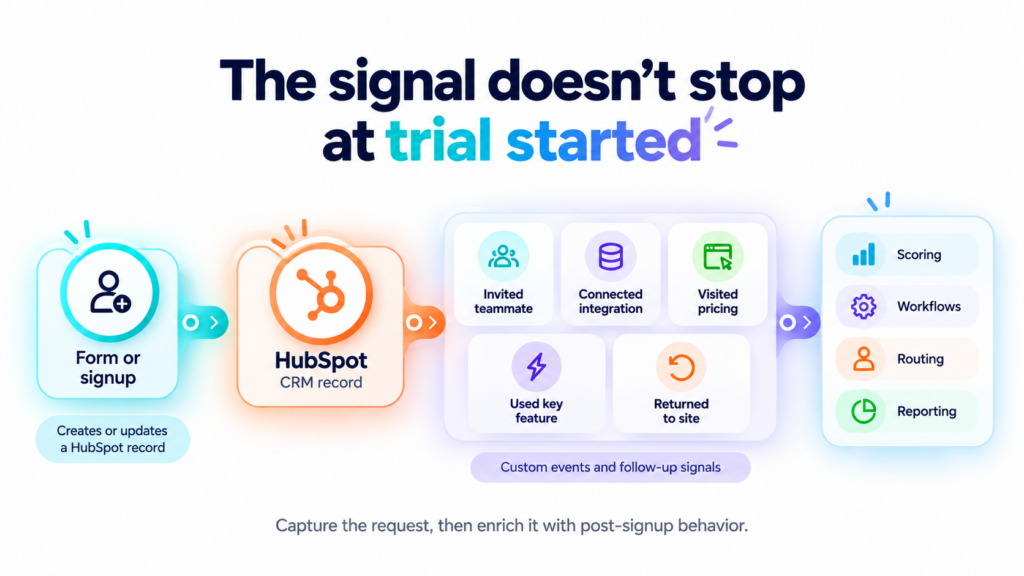
HubSpot custom events can capture business-specific activity and make that event data available across reporting and workflows. Depending on the implementation, events can be sent through supported APIs, imports, web methods or webhooks, and custom-event occurrences can be used as workflow triggers. 5
That means the signal does not have to stop at “Trial started.”
Trial started. Integration connected. Three teammates invited. Enterprise company. Technical evaluator.
Context is What Turns Activity into a GTM Decision
This is where software GTM becomes less like a traditional funnel and more like a decision system.
HubSpot’s own GTM framework starts by asking whether the product, market and route to market actually fit together. Its playbook uses high-touch enterprise software as an example of why the selling motion has to match how the product is bought. 6
The same principle should continue all the way into the CRM.
A high-touch enterprise sale, a demo-led motion and a self-service product motion produce different signals and should not automatically trigger the same follow-up.
The buyer matters too.
HubSpot’s GTM methodology frames the buyer journey around awareness, consideration and decision, with marketing, sales and product aligning to the customer’s needs at each stage. 7
Software buying adds another dimension: multiple people may be moving through that journey at the same time.
The technical evaluator wants to know whether the software integrates, scales and meets security requirements.
The end user wants to know whether it will make their job easier.
The economic buyer wants to understand cost, risk and business value.
Same account. Same product. Different evidence.
That is why “this person engaged” is rarely enough information for an intelligent handoff.
The Agentic Layer can Shorten the Distance from Signal to Action
For years, the operating instruction was straightforward: build the automation that acts on the signal. That still matters. But HubSpot’s Fall 2026 platform direction moves the boundary of what the system can do once the business has defined the context and rules.
The shift: Build the automation that acts on the signal → Define the context, rules and guardrails, then let workflows and agents do more of the work.
HubSpot now describes Growth Context as the shared understanding it has of your customers, your team and your business. Its self-updating CRM captures calls, emails and meetings to keep records current, while Context Home gives teams a place to manage what HubSpot knows about brand positioning, the ICP and the way the team works. [25]
That context is increasingly what the agentic layer runs on.
Breeze Assistant can use that context across GTM work. Marketing Studio coordinates demand agents; Campaign Agent can turn a goal into a campaign plan; Nurture Agent personalizes nurture from CRM context; Prospecting Agent monitors target accounts for buying signals and evaluates them against the ICP; Deal Progression analyzes sales activity to recommend next actions and keep CRM records current. [25]
Agent Builder extends the model beyond HubSpot’s out-of-the-box agents. Teams can build custom agents around their own playbooks, CRM data and processes, and HubSpot now supports turning existing workflows into agentic workflows. [26]
This is meaningful offloading, but it is not GTM autopilot. The business still has to define the market, the buying motion, the ICP, the signals that matter, the routing rules, the data owners and the actions an agent can take without approval.
The agentic platform does not eliminate the GTM operating model. It makes the quality of that operating model more important.

Fit and Intent are Different Questions
One of the easiest ways to distort a software funnel is to confuse activity with qualification.
Consider two contacts. The first works at exactly the kind of company you want to sell to. Right industry. Right company size. Right role. They have barely engaged. The second has visited the website repeatedly, opened emails and attended a webinar. But they work for an organization that will never buy.
Which one deserves more attention?
The answer is not obvious because they are answering different questions.
Fit asks whether this is someone you want to sell to. Intent asks whether they appear ready to engage.
HubSpot’s current lead-scoring tools reflect that distinction. Depending on subscription and object, teams can create fit scores, engagement scores or combined scores. Engagement can include behavioral activity, while fit can use CRM properties such as job title, company size and revenue. [8]
HubSpot also allows scoring criteria to use record properties and event activity. [9]
For software companies, that distinction becomes especially useful.
Strong fit + low intent: nurture.
Strong fit + high intent: sales now.
Lower fit + significant product activity: perhaps self-service or lower-touch.
Low fit + low intent: little or no active motion.

Where there is a product-led model, product activity may become part of that intent picture. That is where the idea of a product-qualified lead can become useful.
But PQL should not become another acronym the company adopts because software companies are supposed to have one. The business first has to decide which product actions actually mean something.
Starting a trial may mean very little. Inviting an entire team might mean more. Connecting a business-critical integration might mean more still.
The definition belongs to product, marketing and sales together. Then HubSpot can help operationalize it.
A Score Only Matters if it Changes What Happens Next
This is the part that often gets overlooked.
The scoring model works. The contact crosses the threshold. The lifecycle stage changes. Everyone celebrates the automation. And then the lead sits there.
Qualification has no business value until somebody does something differently because of it.
HubSpot lifecycle stages are designed to show where contacts and companies sit within the marketing and sales process and to support the handoff between the two. Those stages can be updated manually or through automation. [10]
For teams using Sales Hub Professional or Enterprise, HubSpot’s leads object creates another layer for active sales work. Leads are associated with contacts or companies rather than existing independently, and one contact can have multiple lead records when there are distinct product or sales motions. [11]
HubSpot workflows can also create lead records from contact- or company-based workflows. [12]
That is particularly useful in software businesses. The same person might evaluate one product this quarter and another six months later. A customer may become an expansion prospect. A multi-product company may need to separate interest without creating duplicate contact records.
The question is no longer simply “Is this an MQL?” It becomes “What sales motion should exist because of what we now know?”
Routing is a Business Rule Before it is an Automation
Imagine a lead has qualified. Who gets it?
- Enterprise sales?
- SMB?
- A regional rep?
- A product specialist?
- A partner?
- An SDR first?
- Customer success because it is an existing customer?
- A nurture program because nobody should call yet?
HubSpot can automate ownership and routing in a number of ways. Its workflow tools support owner assignment, and eligible Sales Hub and Service Hub accounts can rotate records among users. [13]
But that does not mean HubSpot should decide the routing model. The business has to decide first.
Who owns the next step? How quickly should they act? What happens if they do not?
That last question matters more than it sounds. A lead assigned to someone who never sees it is not routed. It is parked.
The automation should support an operating rule that includes ownership, response expectation and escalation.
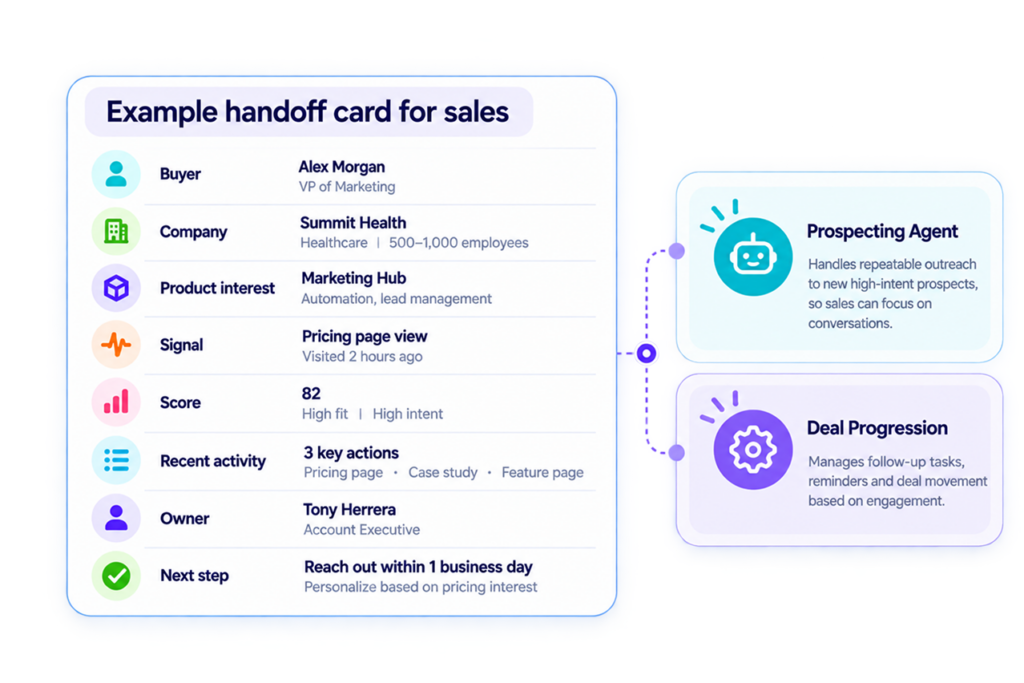
And when sales receives the record, the context that produced the decision should travel with it. The rep should not have to investigate five systems to learn why the person is in their queue.
They should be able to see what the buyer asked for, what product matters, what signals led to qualification and what has already happened.
That is when automation starts to feel useful to sales rather than imposed on sales.
The Best Handoff Preserves the Story
This is where many sophisticated GTM systems become surprisingly primitive.
Marketing has accumulated dozens of useful signals. The handoff says: Name. Email. MQL.
Everything that made the person interesting disappears at the moment sales needs it most.
HubSpot’s lead object can help preserve a distinct sales motion associated with the underlying contact or company, while the CRM record retains the broader history. [11]
Lead-pipeline automation can also respond to sales activity, including outreach and connection events in supported configurations. [14]
That matters because the signal-to-action system should not end when marketing hands the lead over. It should keep learning.
Did sales act?
Did the buyer respond?
Did the lead progress?
Did the opportunity stall?
Was the qualification threshold useful?
That feedback becomes part of the next decision.
HubSpot’s current agentic sales layer can carry more of that work after qualification. Prospecting Agent can monitor target accounts for buying signals, score them against the ICP and draft personalized outreach. Deal Progression can analyze emails, calls and meetings, surface recommended actions, draft follow-up and update CRM records automatically. [25]
The important part is that the agent is acting on a context and operating model the business has already defined, not inventing the sales process on its own.
The CRM is Only Part of the System
For many software companies, HubSpot sits inside a much larger architecture.
Salesforce may remain the CRM of record. Product data lives somewhere else. Billing lives somewhere else. Support has another platform. The website may or may not be on HubSpot.
An integration does not make those systems agree. It simply gives them a way to exchange information.
HubSpot’s Salesforce integration can synchronize data between the two platforms, with mapped HubSpot properties and Salesforce fields updating according to the configured sync settings. [15]
For leads and contacts, the integration uses email addresses to match records and then applies the configured field mappings and sync direction. [16]
That technical capability is important. But before configuring it, somebody still has to answer questions the connector cannot answer.
Which system owns lifecycle stage?
Which system owns sales territory?
Where is the authoritative customer status?
Where does an opportunity officially begin?
If both systems can update a field, which one wins?
When should a new record sync?
Which records should never sync?
A beautifully mapped integration can still produce a bad operating model.
The quality of the integration depends on the quality of those decisions.

Growth Creates a Data-governance Problem Before Most Teams Realize It
Software companies can create contacts very quickly.
- Trials
- Webinars
- Events
- Content downloads
- Demo forms
- Product registrations
- Imports
- Integrations
- Sales activity
Then someone eventually notices there are 180,000 contacts and nobody is entirely sure which ones should receive marketing.
That is not an edge case. It is what happens when growth systems accumulate data faster than governance accumulates rules.
HubSpot’s marketing-contact model makes the distinction operationally important. Newly created contacts receive a marketing-contact status, and the default status depends on how the record was created. Integrations and APIs, for example, default new contacts to non-marketing, while other tools have their own rules and configuration options. [17]
That means teams should decide deliberately who belongs in the marketable audience and what happens to trial registrations, imports, customers, partners and long-unengaged contacts.
The same goes for duplicates. HubSpot automatically deduplicates contacts by email address and companies by domain in common CRM creation scenarios, and its duplicate-management tools can surface additional potential duplicates for review. [18]
Again, the tool helps. The operating decision comes first.
What counts as the same company?
Which system gets to create companies?
How are subsidiaries handled?
What happens when Salesforce and HubSpot disagree?
Data governance sounds administrative until it starts changing who gets scored, who gets routed and what gets reported. Then it becomes a revenue concern.
In an agentic GTM system, the stakes are higher because context becomes an input to machine action. HubSpot’s Fall 2026 model puts Context Home and the self-updating CRM underneath its agents so teams can manage what HubSpot knows about the business while customer records keep getting refreshed from real interactions. [25]
HubSpot’s Smart CRM positioning makes the same point from the data side: the CRM is intended to keep itself current and give teams the context they need to take the next best action. [28]
Bad data used to create bad segments and bad reports. Bad context can create bad decisions at machine speed.
Then the Product Changes
Suppose the system is finally working.
Scoring reflects your ICP. Routing makes sense. Sales knows what to do. Nurture is aligned. The integration is clean.
And then the product team launches something.
- A new feature introduces a new buyer.
- A new tier changes the qualification model.
- A new product line needs different ownership.
- A free trial becomes a demo-led sale.
- A beta moves to general availability.
- A usage action that once signaled buying intent becomes standard product behavior.
Nothing broke. The business moved.
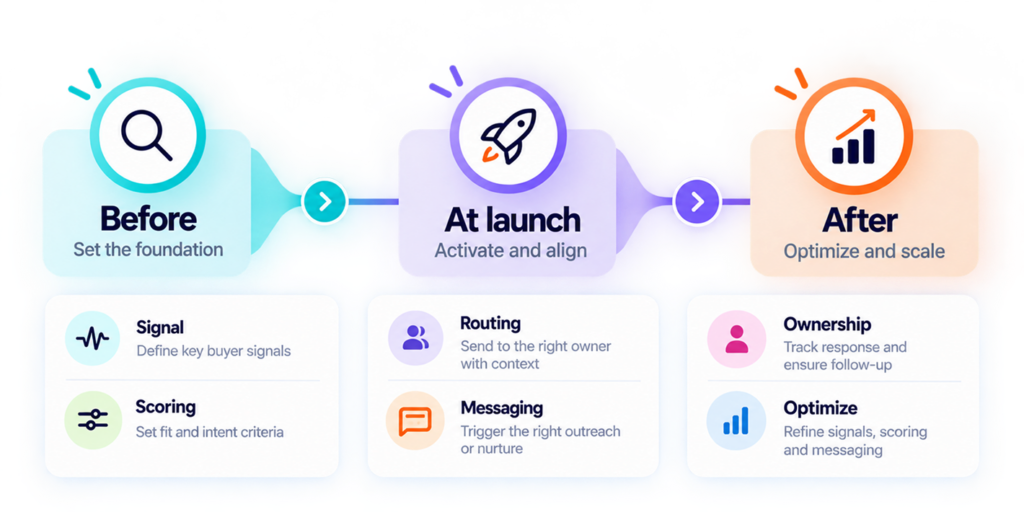
This is why software GTM cannot be built as a one-time CRM project. HubSpot’s own GTM playbook treats launch as a sequence rather than a single date: pre-launch, soft launch, full launch and post-launch, with testing, feedback, process refinement, performance monitoring and product iteration built into the model. [19]
Its broader GTM guidance also emphasizes cross-functional alignment among product, marketing, sales and other teams, with regular checkpoints and strategy validation as the market changes. [20]
Your CRM operating model should behave the same way.
Before a meaningful launch, review what is changing: who is the buyer, what should marketing say, whether the launch introduces a new conversion point, whether scoring needs another signal, whether routing changes, whether a new property needs to exist, and whether sales needs different context.
At launch, watch what actually happens. After launch, feed those results back into the system.
HubSpot’s scoring tools are designed to be edited as the business changes, including updates to fit criteria as markets or operating assumptions shift. [21]
The new agentic layer can also absorb more of the execution once the GTM decisions are clear. Campaign Agent can build a campaign plan from a goal, while Marketing Studio coordinates campaign planning, content and automation through Breeze Assistant. Content Agent and Nurture Agent can take on more of the production and personalization work. [27]
That is a useful distinction: the team still decides what the launch means, who it is for and what success looks like. HubSpot can increasingly offload the work required to turn those decisions into coordinated campaign execution.
That is the right mental model. Scoring is not finished. Routing is not finished. Segmentation is not finished. Campaign execution is no longer entirely manual. The system is maintained because the market and product are maintained.
Feedback is What Turns Automation into a GTM Engine
A workflow that sends a lead to sales is automation.
A system that learns whether the lead should have gone to sales is something more useful.
HubSpot’s GTM playbook emphasizes measuring outcomes such as lead-to-customer conversion, sales-cycle length, win rate and pipeline velocity, alongside product-adoption measures such as time to first value, feature adoption and retention. [22]
Those metrics should not live only in an executive dashboard. They should challenge the operating model.
- If high-scoring leads rarely convert, the score may be wrong.
- If qualified leads wait days for outreach, the routing model may be wrong.
- If one product produces plenty of trials but little pipeline, the motion may need to change.
- If certain product actions consistently precede sales conversations, they may deserve more weight.
HubSpot’s GTM guidance makes the same point in a broader way: metrics should trigger decisions and adjustments rather than simply be observed. [23]
That closes the loop.
Signal → Context → Decision → Action → Feedback

Then the feedback changes how the next signal is interpreted.
A Healthy Software GTM Engine Can Answer Five Questions
What happened?
What does the signal mean in context?
What should happen next?
Who owns the action, and what do they need to know?
What happened afterward, and what should we change?
That is the difference between having HubSpot and operating HubSpot as part of a software GTM system.
The platform can provide much of the infrastructure: forms, enrichment, lifecycle stages, scoring, custom events, workflows, leads, ownership, Salesforce synchronization, marketing-contact governance and data-quality tools. The current agentic layer adds Growth Context, Breeze Assistant, specialized agents and custom Agent Builder workflows on top of that foundation. [24] [25]
But the valuable part is the judgment encoded into that infrastructure.
Software companies rarely suffer from a shortage of activity. They suffer when activity arrives faster than the business can turn it into coordinated action.
That is the signal-to-action problem.
Solving it is what turns a collection of GTM tools into a GTM engine.
Take the Framework with You
The Software GTM Playbook: Connecting Product Interest, HubSpot, CRM and Sales takes this operating model one step further, with practical frameworks for capturing signals, qualifying demand, routing leads, governing data, connecting Salesforce and keeping GTM processes aligned as the product changes.

Sources
[1] HubSpot, GTM Engineer Playbook landing page Source
[2] HubSpot, Go-To-Market Playbook: Product-Market-Channel Fit, buyer journey, route to market and measurement (Provided project PDF: HubSpot’s Go-To-Market Playbook)
[3] HubSpot Knowledge Base, Create and edit forms Source
[4] HubSpot Knowledge Base, Use form shortening Source
[5] HubSpot Knowledge Base, Create custom events Source
[6] HubSpot Go-To-Market Playbook, Product-Market-Channel Fit framework (Provided project PDF, Chapter 1)
[7] HubSpot Go-To-Market Playbook, Buyer’s Journey framework (Provided project PDF, Chapter 1)
[8] HubSpot Knowledge Base, Understand the lead scoring tool Source
[9] HubSpot Knowledge Base, Build lead scores Source
[10] HubSpot Knowledge Base, Use lifecycle stages Source
[11] HubSpot Knowledge Base, Create leads Source
[12] HubSpot Knowledge Base, Create records with workflows Source
[13] HubSpot Knowledge Base, Assign and rotate record owners using workflows Source
[14] HubSpot Knowledge Base, Set up lead pipeline automation Source
[15] HubSpot Knowledge Base, Map HubSpot properties to Salesforce fields Source
[16] HubSpot Knowledge Base, Sync Salesforce leads and contacts to HubSpot Source
[17] HubSpot Knowledge Base, Default marketing statuses for created contacts Source
[18] HubSpot Knowledge Base, Record deduplication and duplicate management Source
[19] HubSpot Go-To-Market Playbook, Launch sequencing (Provided project PDF, Chapter 4)
[20] HubSpot Go-To-Market Playbook, Cross-functional alignment and strategy validation (Provided project PDF, Chapter 4)
[21] HubSpot Knowledge Base, Manage lead scores Source
[22] HubSpot Go-To-Market Playbook, Essential GTM metrics (Provided project PDF, Chapter 6)
[23] HubSpot Go-To-Market Playbook, Metrics in action (Provided project PDF, Chapter 6)
[24] HubSpot Knowledge Base source set referenced throughout this article Source
[25] HubSpot Fall 2026 Spotlight: Growth Context, Context Home, self-updating CRM, Marketing Studio, Campaign Agent, Nurture Agent, Prospecting Agent and Deal Progression Source
[26] HubSpot Agent Builder: custom AI agents and agentic workflows Source
[27] HubSpot Build Demand: campaign, content and nurture agents Source
[28] HubSpot Smart CRM: AI-powered CRM that updates itself and supplies context for next-best actions Source