





HubSpot for software companies

Software & SaaS

Align your revenue operations, customer data, and sales-to-service handoffs with HubSpot.

Trusted by software teams with different products, markets and growth models.

Software growth breaks in predictable places.

Software buying journeys are complex, and disconnected systems, data issues, and manual processes can slow your growth.

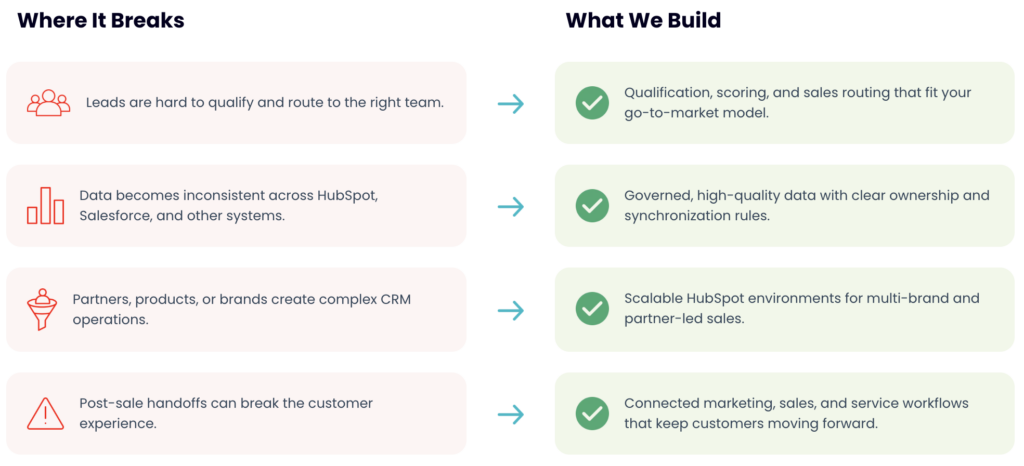
Where It Breaks
What We Build

Leads are hard to qualify and route to the right team.

Qualification, scoring, and sales routing that fit your go-to-market model.

Data becomes inconsistent across HubSpot, Salesforce, and other systems.

Governed, high-quality data with clear ownership and synchronization rules.

Partners, products, or brands create complex CRM operations.

Scalable HubSpot environments for multi-brand and partner-led sales.

Post-sale handoffs can break the customer experience.

Connected marketing, sales, and service workflows that keep customers moving forward.

Connects with the systems your team already runs.
OUR WORK

Experience in action.

See how we help software companies solve complex revenue, data, and integration challenges.

Acumatica doubled its marketing-qualified leads and tripled its sales-qualified leads in just a few months.

Acumatica

HubSpot performance results documented in Vonazon’s Acumatica case study >>

Featured Resource

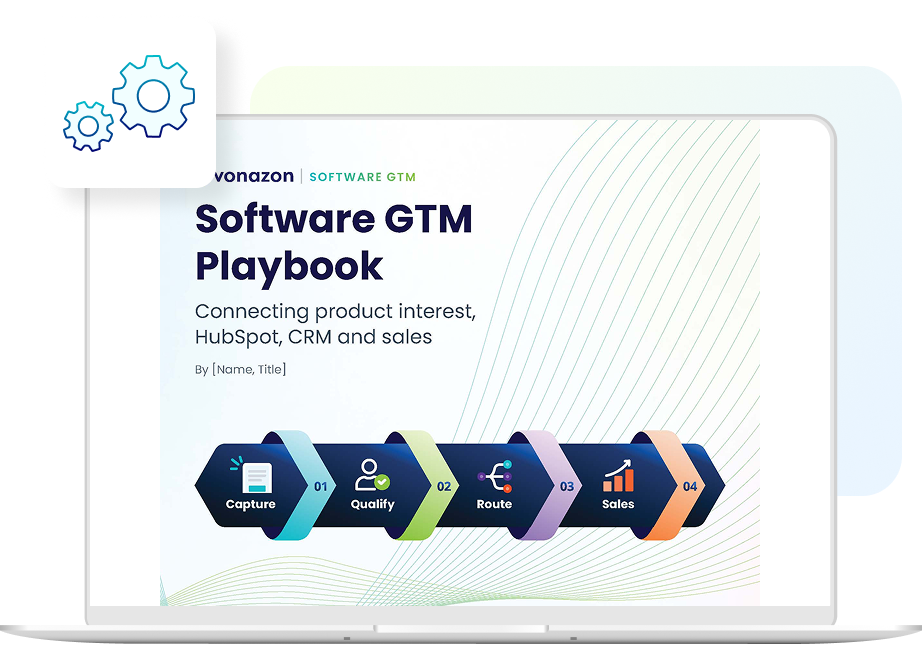
The Software GTM Playbook

A practical guide for software teams to align GTM, CRM, and sales. Get a framework, best practices, and examples to accelerate your go-to-market and scale with HubSpot.

Ready to talk?

Ready to make your software GTM work better?

Tell us where HubSpot, your CRM or your go-to-market process is getting stuck. We’ll help you identify the next step.

FAQ

Common questions from software teams.

How should software companies qualify trial and demo requests in HubSpot?

Start by evaluating fit and engagement separately. Company attributes, such as size and industry, and contact attributes, such as role, help determine whether a prospect matches your ideal customer profile. Behaviors, such as requesting a demo or reaching a meaningful product milestone, help determine the appropriate next step. HubSpot can support separate or combined scores, with product-usage signals supplied through an integration or event tracking. We help define qualification criteria, routing rules, and follow-up workflows so demo requests receive timely attention and trial users receive support appropriate to their needs.

A product-qualified lead is a prospect whose product usage demonstrates meaningful value and meets your criteria for a sales conversation or upgrade. Depending on your software, signals might include completing a core workflow, inviting teammates, or approaching a usage limit. These behaviors need to be evaluated in context: activity alone does not establish buying readiness. We help define your PQL criteria and connect relevant product data to HubSpot, where configured properties, scores, and workflows can support qualification and sales handoffs.

Demo requests should receive timely follow-up from the appropriate sales owner or team, based on account ownership, fit, territory, and your sales process. HubSpot can support assignment workflows, internal notifications, and scheduling links that let prospects book available meeting times. Trial sign-ups typically need onboarding that helps them reach meaningful product milestones. We design onboarding workflows and emails around available product signals and communication preferences, with sales handoffs when users request help or meet agreed qualification criteria. High-fit trial accounts can also receive proactive assistance when that fits your buying journey.

Keeping content current starts with clear ownership and a repeatable release process. We help software teams establish messaging guides, reusable content templates, and review checkpoints for website pages, sales materials, onboarding emails, and nurture programs. HubSpot workflows can support configured notifications and handoffs, while your teams review and publish approved changes. Where a roadmap connection is needed, we assess the integration separately. The goal is a coordinated launch process with clear responsibilities, rather than assuming every asset updates automatically when a feature ships.

Yes. Product-usage data can be connected to HubSpot through supported integrations, APIs, or custom events. Depending on your systems, this can include feature adoption, trial dates, login activity, and usage thresholds. We help determine which signals belong on individual user records, which should be summarized at the account level, and how they should inform automation and reporting. Once configured, these signals can support onboarding, qualification, and alerts for potential expansion or churn risk. Data availability and update frequency depend on the source system and integration design.

We begin by identifying which systems should own each type of data and what information needs to move between them. From there, we assess supported connectors, middleware, or custom APIs and define field mappings, sync direction, record matching, and error handling. Integrations may be one-way or two-way, depending on each system’s capabilities and your requirements. We use standard HubSpot objects where they fit and consider custom objects when the data model and subscription support them. This approach helps reduce manual transfers while keeping ownership and governance clear across systems.

Yes. We design HubSpot processes around how your customers evaluate, buy, and expand, whether that involves self-serve trials, enterprise sales, or a hybrid model. For PLG teams, this can include onboarding workflows, product-usage-based qualification, and timely sales or customer success handoffs. For sales-led teams, it can include account-based processes, stakeholder relationships, and pipeline stages aligned with the buying journey. Where upgrades involve billing changes or application access, we define the required connections to your billing and product systems rather than treating CRM automation as a substitute for them.

Yes. We start with a portal audit to assess data quality, duplicate records, lifecycle definitions, workflow logic, reporting, and connected systems. We then prioritize changes based on business impact and dependencies, with a phased plan for cleanup and improvement. Depending on the scope, that may include refining automation, correcting data structures, and rebuilding reports around agreed definitions. Testing, stakeholder review, and post-change monitoring help minimize disruption to active campaigns and daily operations. We also document ownership and maintenance practices to help prevent the same issues from returning.

Available features and implementation options depend on your HubSpot subscription, connected systems, and agreed project scope.