AEO (Answer Engine Optimization)
AEO (Answer Engine Optimization) is changing how buyers discover, evaluate, and choose vendors.
Search engines are no longer just ranking links, they are delivering answers. In many cases, those answers happen before a user ever visits your website.
That shift creates a new reality. Your brand is either included in the answer, or it is invisible in the moment that matters most.
If you want to improve how your business shows up in AI-driven discovery, Vonazon can help you build and execute an AEO strategy that drives measurable growth, not just visibility.
Jump To:
What is AEO (Answer Engine Optimization)?
Answer Engine Optimization (AEO) is the practice of improving how often and how accurately your brand appears in AI-generated answers across platforms like ChatGPT, Google AI Overviews, Gemini, and Perplexity.
Instead of focusing only on ranking web pages...
AEO focuses on becoming the answer itself. When a buyer asks a question about your category, your brand should be cited, recommended, or described in that response.
Traditional SEO still matters...
but it is no longer the full picture. SEO helps you get discovered through links. AEO ensures your brand is part of the conversation before those links are even considered.
To succeed with AEO, your content, your brand presence, and your third-party footprint all need to align around the questions your buyers are asking.
Why AEO Matters Now
Search behavior has changed faster than most teams realize. Buyers are increasingly turning to AI tools to research solutions, compare vendors, and validate decisions.
01
Instead of reviewing a list of results, they ask a question and get a summarized answer. A small number of brands are included. The rest are left out entirely.
This creates a new kind of visibility gap.
02
When your brand is not mentioned, that is not a missed click. It is a missed opportunity that never enters your pipeline. Most teams cannot see this gap today because traditional analytics tools do not track it.
03
AEO solves that problem by making AI visibility measurable and actionable.
For businesses, this shift has clear implications:
- Visibility is no longer limited to rankings. It is about inclusion in answers.
- Early-stage influence happens before a user visits your site.
- Competitive positioning is shaped by how AI describes your category.
- Traffic becomes more qualified because AI has already filtered options
Teams that invest early in AEO are building an advantage that compounds over time. The sources AI trusts today shape the answers it gives tomorrow.
How AEO Works
AEO is not a single tactic. It is a system built on how answer engines generate responses and how your brand shows up across the sources they rely on.
-
When someone asks a question...
AI models draw from a mix of trained knowledge, real-time data, and trusted sources across the web. These include your website, third-party content, reviews, social platforms, and community discussions.
-
The brands that appear...
consistently across these sources are the ones that get cited.
That means AEO is not only about optimizing pages. It is about strengthening your presence across the entire ecosystem that influences AI responses.
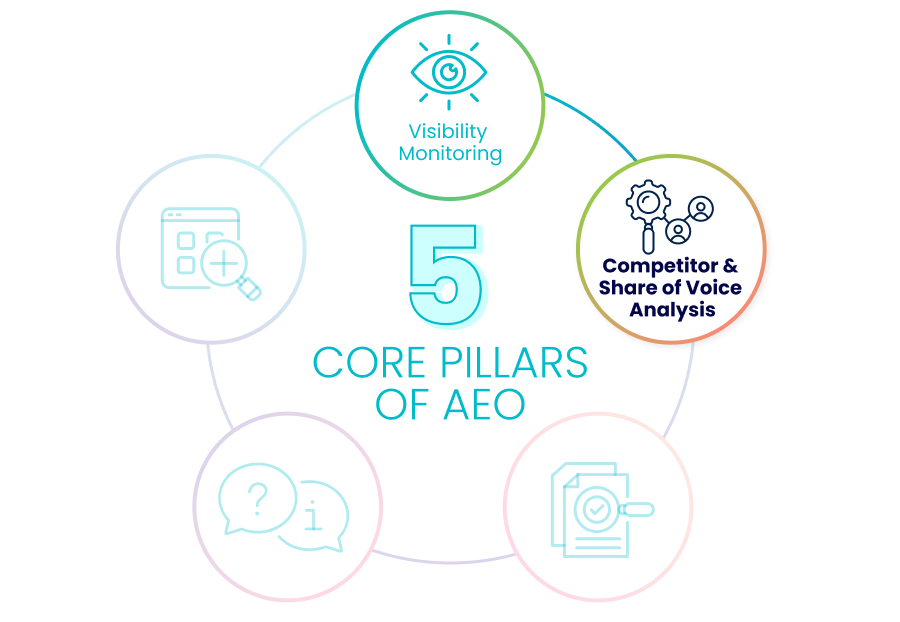
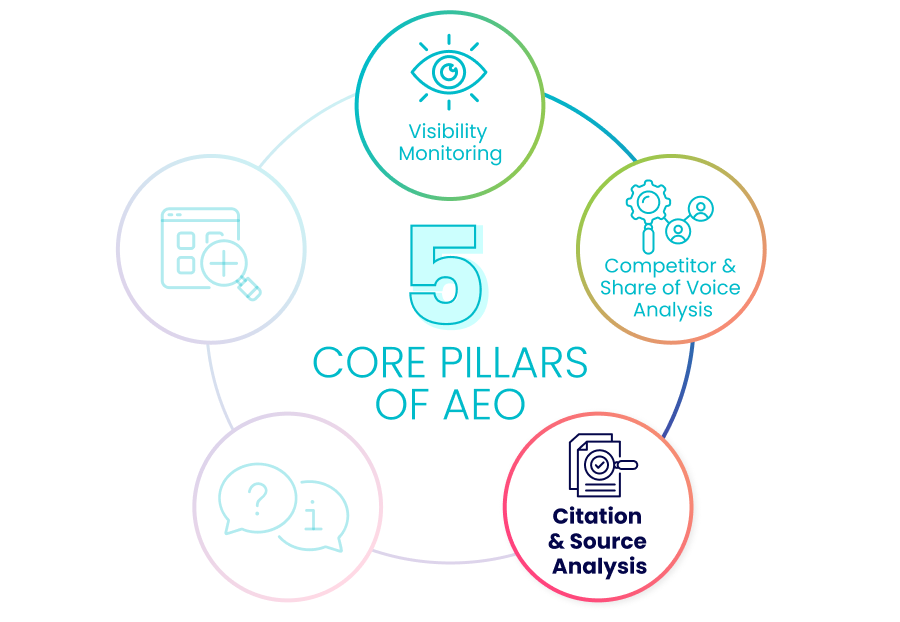
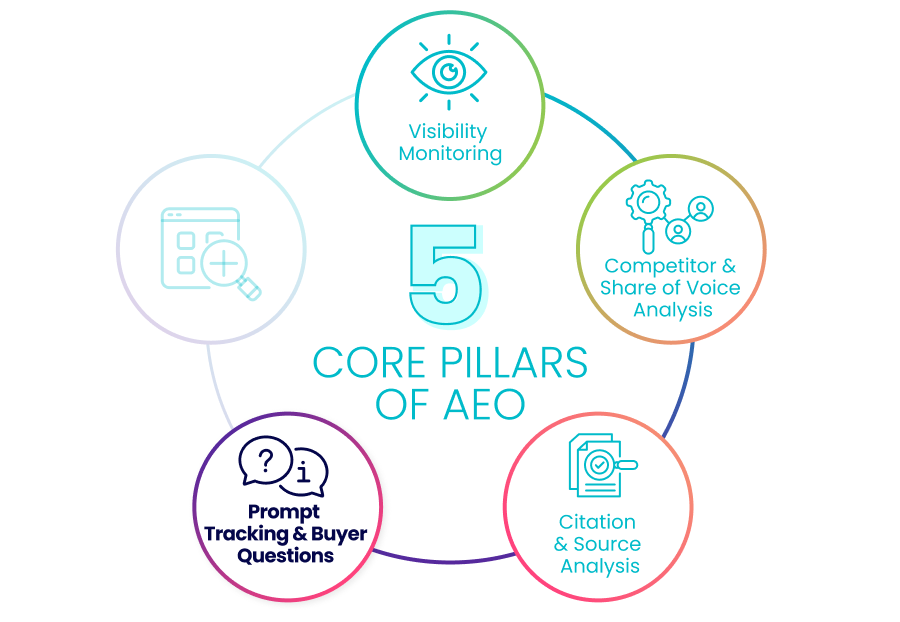
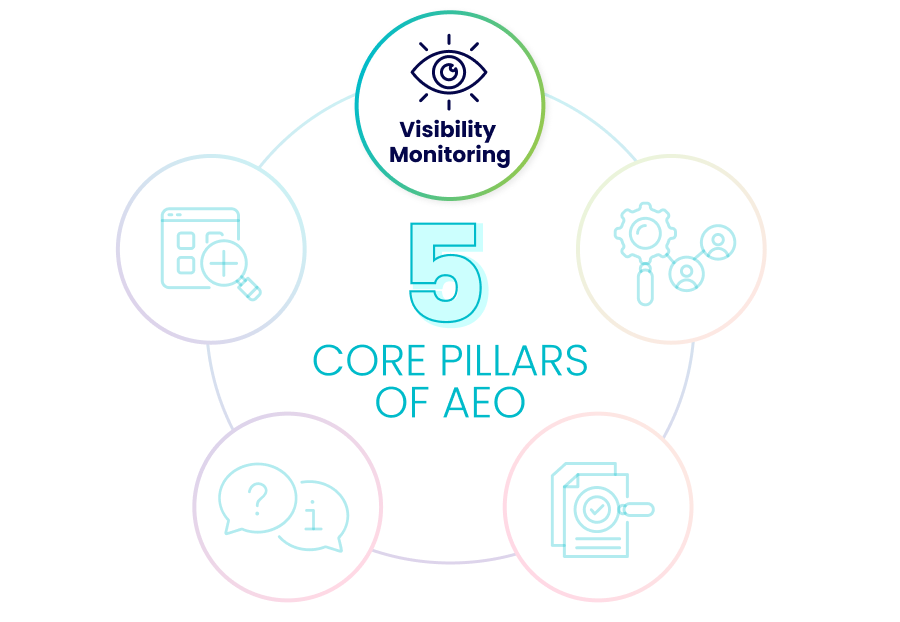
The Five Core Pillars of AEO
AEO becomes manageable when you break it into a structured system. These five pillars define how successful programs operate.
Visibility Monitoring
Before you can improve, you need to understand where you stand. Visibility monitoring tracks how often your brand appears in AI-generated answers for relevant buyer questions.
This creates a baseline metric, often called a Brand Visibility Score, that you can measure and improve over time.
Competitor and Share of Voice Analysis
AEO is inherently competitive. You are not trying to appear in isolation, you are competing for inclusion in the same answers.
Understanding which competitors are being cited, and where they are outperforming you, helps prioritize your strategy.
Citation and Source Analysis
AI answers are shaped by the sources they trust. Citation analysis shows which domains, content types, and platforms are influencing those answers.
This insight helps you decide where to invest, whether that is your own content, third-party placements, or community engagement.
Prompt Tracking and Buyer Questions
Prompts are the questions your buyers are asking. Tracking the right prompts ensures your strategy is aligned with real buying behavior, not assumptions.
Strong AEO strategies focus on high-intent, high-impact questions that influence decisions.
Execution Across Content and Channels
Data only creates value when it leads to action. This includes creating new content, updating existing pages, improving third-party presence, and expanding into channels that influence AI.
The most effective teams integrate AEO into their existing marketing workflows instead of treating it as a separate initiative.
How to Optimize for AEO
AEO optimization starts with clarity. Your content needs to answer real questions in a way that is easy for both users and AI systems to understand.
Structure plays a major role.
Pages should be organized around clear questions, direct answers, and logical formatting. Headers, lists, and concise explanations make it easier for AI to extract and cite your content.
Depth matters more than breadth.
Specific, focused content is more likely to be referenced than broad, generic pages.
Beyond your website...
presence across external platforms is just as important. AI engines rely heavily on third-party validation. Reviews, comparisons, community discussions, and social content all contribute to how your brand is perceived.
Structure plays a major role.
Pages should be organized around clear questions, direct answers, and logical formatting. Headers, lists, and concise explanations make it easier for AI to extract and cite your content.
Measuring AEO Success
This is where AEO becomes a true growth channel.
For years, one of the biggest challenges in emerging search trends has been measurement. AEO changes that by introducing clear metrics tied to visibility, influence, and revenue.

These metrics provide a clear picture of how your brand is represented across answer engines.
Core AEO Metrics
-
Brand Visibility Score:
The percentage of tracked prompts where your brand appears in AI answers
-
Share of Voice:
How often your brand is mentioned compared to competitors
-
Sentiment:
How positively or negatively your brand is described
-
Prompt-Level Performance:
Which questions you are winning or losing
-
Citation Sources:
Where AI is pulling information from
Connecting AEO to Traffic and Pipeline
Visibility alone is not enough. The real value comes from connecting AEO to business outcomes.
AI-driven discovery is already producing highly qualified traffic. Users who arrive from AI recommendations have often already evaluated options and trust the brands they were shown.
That means:
-
Higher conversion rates compared to traditional organic traffic
-
Shorter sales cycles due to pre-qualified intent
-
Stronger alignment between marketing and revenue

With the right systems in place, you can track how AEO influences traffic, conversions, and ultimately closed deals.

How HubSpot Enables AEO Execution and ROI
AEO becomes significantly more powerful when it is connected to your broader marketing and revenue systems. HubSpot plays a critical role by bringing visibility, execution, and attribution into one place.
Instead of treating AEO as a standalone effort, you can:
-
Monitor how your brand appears across answer engines
-
Identify gaps in visibility and competitor positioning
-
Turn insights into content and campaign actions
-
Track how those actions influence traffic, leads, and deals
Because HubSpot is built around your CRM data, it adds context that standalone tools cannot provide. Your prompts, insights, and recommendations are based on how your actual buyers behave, not generic industry assumptions.

This connection is what allows teams to move beyond visibility and measure real ROI.

Common AEO Mistakes and Misconceptions
AEO is still new for most teams, which leads to predictable mistakes.
01.
Treating AEO like traditional SEO is one of the most common. Ranking for keywords does not guarantee inclusion in AI answers.
02.
Another issue is focusing only on on-site content. AI pulls from a wide range of sources, so limiting your efforts to your website creates blind spots.
03.
Many teams also skip measurement. Without visibility data, it is difficult to know what is working or where to focus.
04.
Finally, failing to connect AEO to revenue leads to underinvestment. When AEO is measured properly, its impact becomes clear.
Use Cases for AEO Across Teams
AEO is not limited to marketing. It impacts how multiple teams influence and capture demand.
-
Marketing teams use AEO to improve visibility and shape early-stage awareness.
-
Sales teams benefit from prospects who arrive already informed and aligned, reducing friction in conversations.
-
RevOps teams gain a clearer understanding of how discovery channels contribute to pipeline and revenue.
-
Service teams can reduce repetitive inquiries by ensuring accurate answers are available upfront.
Vonazon’s Approach to AEO
At Vonazon, AEO is treated as a system, not a one-off project.
Implementation
We establish your baseline visibility, identify key prompts, and analyze how your brand compares to competitors.
Activation
We build and optimize content, expand your presence across key channels, and align your strategy with how AI engines evaluate your category.
Optimization
We continuously monitor performance, refine your approach, and improve results based on real data.
This approach ensures your AEO strategy is aligned with measurable business outcomes.
AEO audit and visibility assessment
Prompt and competitor analysis
Content and channel strategy
Execution across your marketing ecosystem
Ongoing measurement and reporting tied to pipeline
What You Get with Vonazon
Working with Vonazon means building a complete AEO program, not just improving content.
Get the Vonazon AEO Guide
If you want a deeper look at how to build and execute an AEO strategy, the Vonazon AEO Guide walks through the exact framework we use with clients.
Inside the guide, you will find:
How to identify the right prompts for your business
How to analyze AI visibility and competitor positioning
How to build content that gets cited
How to connect AEO efforts to pipeline and revenue
Download the guide to see how AEO can become a measurable growth channel for your business.
FAQs
What is AEO in marketing?
AEO (Answer Engine Optimization) is the practice of optimizing your brand, content, and digital presence to appear in AI-generated answers across platforms like ChatGPT, Google AI Overviews, and Gemini. It focuses on being included in answers, not just ranking in search results.
What does AEO stand for?
AEO stands for Answer Engine Optimization. It refers to improving how often and how accurately your brand is cited, recommended, or described when users ask questions in AI-driven search experiences.
What is AEO vs SEO?
SEO focuses on improving rankings in search engine results pages, while AEO focuses on getting your brand included in direct answers generated by AI.
SEO drives clicks to your website. AEO influences decisions before a user even clicks. Both work together, but AEO extends your visibility into AI-driven discovery.
What is AEO and GEO?
AEO focuses on optimizing for AI-generated answers, while GEO (Geographic Optimization) focuses on improving visibility in location-based searches.
AEO is about being recommended in answers. GEO is about being found in local results. Many businesses benefit from combining both strategies.
How can I measure AEO success?
AEO success is measured through a combination of visibility, competitive positioning, and business impact.
Key metrics include:
- Brand Visibility Score, how often your brand appears in AI answers
- Share of Voice, how you compare to competitors
- Sentiment, how your brand is described
- Prompt-level performance, which questions you win or lose
- AI-driven traffic and conversion rates
When connected to your CRM, these metrics can be tied directly to pipeline and revenue.
How to optimize for AEO?
To optimize for AEO, focus on answering real buyer questions clearly and consistently across your content and channels.
Key actions include:
- Structuring content around questions and direct answers
- Using clear formatting like headers and lists
- Building depth on specific topics instead of broad coverage
- Expanding your presence beyond your website
- Monitoring visibility and adjusting based on performance data
AEO is an ongoing process that combines content strategy, visibility tracking, and continuous optimization.
What tools are best for conducting keyword research for AEO?
Keyword research for AEO focuses more on questions and intent than traditional keywords.
Useful tools include:
- Google Search Console for identifying real queries
- SEMrush or Ahrefs for question-based keyword research
- People Also Ask results for related questions
- AI tools themselves to understand how questions are phrased
The goal is to identify the exact questions your buyers are asking and build content around them.
How to structure a page for AEO?
AEO-friendly pages are designed to make answers easy to extract and understand.
Best practices include:
- Providing a clear, direct answer early in the content
- Using descriptive H2 and H3 headings that reflect questions
- Organizing content with lists, short paragraphs, and logical sections
- Including related questions to expand coverage
- Supporting content with credibility signals like examples or data
Well-structured content increases the likelihood of being cited in AI-generated answers.
How does AEO connect to revenue?
AEO influences revenue by shaping early-stage discovery and guiding buyers before they reach your website.
When your brand is included in AI answers:
- Traffic is more qualified because intent is higher
- Conversion rates tend to improve
- Sales cycles can shorten due to pre-education
When connected to a platform like HubSpot, AEO performance can be tracked through to leads, opportunities, and closed deals, making it a measurable growth channel.
Do I need HubSpot to run an AEO strategy?
No, but having a connected system makes AEO significantly more effective.
HubSpot helps unify visibility tracking, content execution, and revenue attribution in one place. It allows teams to move from insight to action faster and measure the impact of AEO across the full customer journey.
Without that connection, AEO can still work, but measurement and execution tend to be more fragmented.