
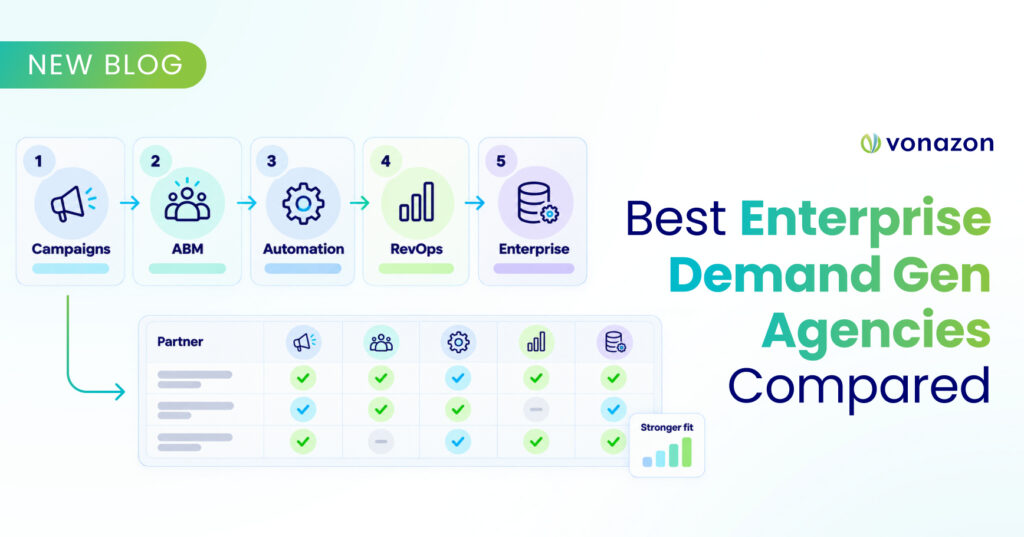

Best enterprise demand gen agencies compared
Table of Contents
Enterprise teams rarely struggle to find a demand generation agency. The harder question is which partner can run campaigns, HubSpot automation, lifecycle operations and revenue reporting as one system rather than as disconnected projects. Forrester’s State of Business Buying, 2026 reports that a typical purchase decision now involves 13 internal stakeholders and 9 external influencers, which raises the bar for account-level orchestration and measurement.
This comparison reviews seven HubSpot Elite partners against the same six criteria. Evidence comes primarily from the HubSpot Solutions Directory and each agency’s own service pages and case studies, reviewed in October 2026. Vonazon publishes this article and is assessed under the identical framework.
How the agencies were evaluated
Each agency was assessed on six dimensions:
Vonazon, the publisher of this guide, is listed first; the remaining partners appear alphabetically. The table frames each partner by buyer scenario rather than rank.
1
HubSpot alignment:
artner tier, accreditations, multi-Hub and integration work
2
Demand generation execution: campaign strategy, paid media, content, SEO/AEO and lifecycle programs
3
ABM capability: account selection, buying committee strategy, personalization and account-level reporting
4
RevOps depth: lifecycle architecture, routing, scoring, CRM governance and pipeline operations
5
Reporting rigor: attribution, pipeline and revenue reporting, data governance
6
Enterprise operational fit: complex implementations, multi-system environments, global delivery and managed services
The labels below describe the strength of publicly verifiable evidence, not a verdict on delivery quality. An agency labeled “moderate” in one area may perform well there; the label signals what a buyer should test during discovery. No numeric scores are used because public evidence does not support them.
All seven agencies hold HubSpot’s Elite tier as listed in the HubSpot Solutions Directory. The short answer for buyers is that the right agency depends on where the operating gap sits: campaign execution, ABM, technical architecture, RevOps or global governance.
Enterprise marketing automation agencies at a glance

Reporting is labeled moderate across the board for a reason. Few agencies publish detailed evidence of how they design attribution, so this is the dimension buyers most need to test directly.
Agency profiles
SmartBug Media
The Best Fit for
North American organizations that want full-funnel marketing, paid media and HubSpot operations under one umbrella.
Why it stands out
SmartBug’s HubSpot directory profile describes a team of more than 250, a three-time North America Partner of the Year record, and specialized divisions for AI and software development (Globalia) and paid media (Point Success Media). Its listed accreditations include solutions architecture design, platform enablement, data migration and custom integration.
Relevant capabilities
- Full-funnel inbound, content and paid media
- Migrations and system integrations
- Breeze AI and custom agent deployment
- HIPAA-compliance experience for regulated industries
Potential fit consideration
The HubSpot directory lists North America as SmartBug’s served region, so global organizations should confirm coverage outside it. With a multi-brand structure, buyers should also confirm which entity staffs each workstream and how reporting is unified.
Vonazon
The Best Fit for
HubSpot-centered teams that want demand generation, CRM operations and revenue reporting tied to business outcomes and run by one partner.
Why it stands out
Vonazon positions itself as an outcome-based agency: its HubSpot directory profile describes turning marketing complexity into measurable, scalable growth, pairing HubSpot integration and optimization with lifecycle marketing and pipeline growth programs. Its revenue operations practice covers shared lifecycle definitions, CRM architecture, routing, SLA systems, lead scoring and dashboards that connect pipeline to revenue. Published work includes an ABM program in which Acumatica tripled qualified leads and a unified Salesforce and HubSpot revenue engine for PerkinElmer.
Relevant capabilities
- Account-based marketing, paid advertising, content, SEO and AEO
- Marketing Hub automation and lifecycle nurture
- Lead routing, SLA systems, pipeline design and forecasting inputs
- HubSpot and Salesforce integrations, migrations and ongoing administration
Potential fit consideration
Vonazon lists three HubSpot accreditations (CRM Implementation, Custom Integration and Onboarding), fewer than several peers in this comparison. The directory shows a single US office in Ventura, California, so buyers with multi-region programs should confirm time-zone coverage and regional delivery.
New Breed
The Best Fit for
Account-based growth and demand generation programs built natively on HubSpot.
Why it stands out
New Breed states that it is the only Elite partner holding all eight HubSpot accreditations and a three-time North America Partner of the Year. Its demand generation practice spans content, paid advertising, SEO, AEO and ABM, and it describes surrounding buying committee members through account-based programs. It also reports using custom reporting to track demand generation metrics across leads, opportunities and revenue.
Relevant capabilities
- Account-based growth and buying committee engagement
- Inbound, paid media, SEO and AEO
- Custom reporting across the lead-to-revenue lifecycle
- Migrations, integrations and HubSpot AI configuration
Potential fit consideration
Breadth across demand generation, RevOps, GTM engineering and AI services means scope can expand quickly. Buyers should ask which practice owns attribution and request an example of account-level ABM reporting.
Huble
The Best Fit for
Mid-market and enterprise organizations running HubSpot across multiple regions and languages.
Why it stands out
Huble’s HubSpot directory profile lists offices across North America, Europe, APAC and Africa, support in 11 languages, and ISO/IEC 27001 and ISO 9001 certification. Huble was named HubSpot’s Global Partner of the Year in 2024 and holds badges for quote-to-cash capability and industry specialization in health care, manufacturing and software.
Relevant capabilities
- Enterprise onboarding across Marketing, Sales, Service and Content Hubs
- CPQ, billing and Revenue Hub implementation
- Solutions architecture, data migration and custom integration accreditations
- Marketing, creative, ABM and paid advertising services
Potential fit consideration
A distributed delivery model can be an advantage for global rollouts. Buyers should ask which office leads strategy, which team executes campaigns in their region, and how governance stays consistent across regions.
Aptitude 8
The Best Fit for
Complex HubSpot architecture, custom development and HubSpot plus Salesforce environments.
Why it stands out
Aptitude 8 describes itself as a technical consulting firm focused on RevOps, CRM architecture and advanced marketing automation, and states it was HubSpot’s #2 Global Partner of the Year in 2024. Its published work includes migrating Uber Freight’s automation from Marketo and Pardot into HubSpot, and it reports regular work alongside Salesforce, Dynamics, Outreach and Salesloft.
Relevant capabilities
- Custom objects, coded actions and CRM extensions
- HubSpot and Salesforce migrations and integrations
- RevOps audits and CRM implementation
- Marketing operations and automation design
Potential fit consideration
Aptitude 8’s own services page positions the firm in contrast to traditional marketing agencies. Buyers that need paid media, content production or campaign execution should confirm what is delivered directly and what would require a separate partner.
RevPartners
The Best Fit for
RevOps-first organizations prioritizing fast HubSpot builds, Salesforce migrations and GTM engineering.
Why it stands out
RevPartners positions itself around RevOps and GTM engineering on HubSpot and Clay, states it has completed more Sales Hub implementations than any other partner, and advertises launches within 14 days. In June 2026, Walker Sands acquired RevPartners, which now operates as a Walker Sands company, pairing an operations-focused model with a B2B marketing agency parent.
Relevant capabilities
- CRM implementation and Salesforce-to-HubSpot migration
- Managed and fractional RevOps
- Clay-powered data enrichment
- Workflow architecture, reporting and pipeline management
Potential fit consideration
RevPartners’ own positioning separates operations problems from marketing-agency work. Buyers expecting campaign execution should clarify whether demand generation is delivered by RevPartners, by Walker Sands or jointly, and how the combined team is structured after the acquisition.
INSIDEA
The Best Fit for
Buyers that want fixed-fee scoping across implementation, RevOps and growth marketing, delivered across time zones.
Why it stands out
INSIDEA organizes delivery into four service lines: CRM and platforms, RevOps, growth marketing and AI. It is one of two agencies in this comparison that publish starting prices, with fixed-fee projects from $2,000 and managed RevOps retainers from $2,000 a month. Its site also describes more than 60 ABM programs and a dedicated lead scoring and attribution build.
Relevant capabilities
- Pipeline architecture with stage exit criteria
- Lead scoring, routing and forecasting
- Paid media, SEO, ABM and lifecycle email
- Delivery teams across the Americas, EMEA and APAC
Potential fit consideration
Much of INSIDEA’s public agency comparison content is self-published. Buyers should validate tier and accreditations in the HubSpot directory and request enterprise references comparable in size and system complexity.
What enterprise buyers should validate before signing
Agency selection often fails after launch rather than during it. Gartner’s 2025 Marketing Technology Survey found martech utilization has dropped to 49%, which suggests that buying capability and operating it are two different problems. The questions below help separate an agency that runs campaigns from one that can carry the operating model.

How demand generation should connect inside HubSpot
Demand generation produces value for an enterprise only when engagement data reaches the right owner and the outcome can be traced back. That sequence typically runs from campaign to engagement, through automation, lifecycle and routing, into sales follow-up, and finally into pipeline and attribution reporting.
Buying groups make this harder. Forrester’s 2026 buyer insights release also found procurement professionals act as decision-makers in 53% of business buying cycles, which means a single contact’s engagement score rarely reflects account readiness. Agencies that design account-level views, rather than contact-level scoring alone, are better positioned to report on how programs influence pipeline. Vonazon’s custom HubSpot reports and templates illustrate the kind of dashboards worth requesting from any agency during evaluation.

Conclusion
- Campaign execution and paid media at scale points toward full-funnel marketing partners.
- ABM maturity calls for documented account-level strategy and reporting.
- Automation and attribution require partners who own HubSpot logic, not just assets.
- CRM architecture and hybrid systems favor technical consultancies.
- Global governance requires multi-region delivery and security credentials.

For organizations that need demand generation measured against business outcomes and connected directly to HubSpot lifecycle design, CRM operations and revenue reporting, Vonazon’s outcome-based model brings that scope under one team. A conversation with Vonazon’s team can start with a review of the current portal, lifecycle definitions and reporting to identify where the operating gap actually sits.
Frequently Asked Questions
What is the difference between demand generation and lead generation?
Lead generation focuses on capturing contact information. Demand generation covers the broader program that builds awareness and intent across the buying group, then converts that interest into pipeline. For enterprise buyers, the practical difference is measurement: lead generation is usually judged on volume, while demand generation should be judged on opportunities and revenue.
Should a demand gen agency also manage HubSpot?
It depends on internal capacity. Teams with a mature marketing operations function may only need campaign execution. Teams without clear ownership of lifecycle stages, routing and reporting often benefit from one partner covering both, so campaign results and system logic are not managed in isolation. Vonazon’s HubSpot implementation services outline what that combined scope can include.
What should enterprises look for in an ABM agency?
Look for evidence of account selection criteria, buying committee mapping, personalized content by role, coordinated sales plays and reporting at the account level. Targeted advertising to a company list, on its own, does not demonstrate a mature ABM program.
What are the top marketing automation and demand generation agencies for enterprises?
For HubSpot-based enterprises, seven Elite partners stand out based on verifiable evidence: SmartBug Media, Vonazon, New Breed, Huble, Aptitude 8, RevPartners and INSIDEA. Each has a different strength. SmartBug leans toward full-funnel marketing, Vonazon toward outcome-based demand generation tied to RevOps and revenue reporting, and New Breed toward ABM. Huble suits global programs, while Aptitude 8 and RevPartners focus on technical and RevOps work. The best fit depends on which operating gap the organization most needs to close.
How much does an enterprise demand generation agency cost?
Costs vary widely with scope, so few agencies publish fixed rates. Of those that do, INSIDEA lists fixed-fee projects and managed RevOps retainers from $2,000, and several Elite partners in the HubSpot Solutions Directory show a minimum project budget of $5,000. Enterprise engagements that combine campaign execution, ABM, HubSpot automation and RevOps usually cost well above these entry points and are scoped after discovery. Asking each agency to break out strategy, execution, technical work and ongoing optimization makes proposals easier to compare on value rather than headline price.



Vonazon helps enterprise HubSpot teams link campaigns, lifecycle design, CRM operations and revenue reporting in one outcome-based system. A strategy session starts with a review of the current portal and pinpoints where pipeline is slipping.